
The power of rare birds
Although the Estonian Ornithological Society’s Bird Rarities Committee (hereinafter HK) deals with only a small fraction of the bird species observed in Estonia and their scientific study, it remains a highly fascinating field. Beyond the thrill of encountering and successfully documenting a rara avis in the wild, it is also captivating to follow the ongoing development of bird identification knowledge, technology and taxonomy.
HK’s work in registering rare bird sightings and curating the national species list is, in a sense, a scientific counterpart to the two main driving forces behind amateur birdwatching: the passion for encountering as many rare and diverse bird species as possible in the wild and the obsessive maintenance of yearlists and lifelists.
Among the author’s circle of friends, there is even a birdwatcher who also keeps track of bird species seen in dreams. For unknown reasons, no such dream-based observations have yet been submitted to HK. As a result, updates to Estonia’s official bird list proceed slowly.
Numerology is often an integral part of amateur birdwatching. Every beginner knows that magical feeling of identifying their 100th bird species in a single year. Any somewhat more seasoned birder knows that a birding year doesn’t really count unless it yields at least 200 species. The main milestone in becoming a true birding guru is reaching 300 or more species observed in Estonia over a lifetime.
One of the interesting aspects of maintaining bird lists is that the competitive spirit can be channeled either inwardly — tracking how many (new) species one sees each year compared with previous years — or outwardly, competing with other birders. Even the national species list can be viewed through a competitive lens: marking the arrival of milestone numbers or comparing results with neighboring countries.
This essay offers readers both the knowledge and opportunity to celebrate Estonia’s national bird list reaching 400 species. Admittedly, for seasoned enthusiasts, the excitement may be somewhat muted this time. The milestone was first reached back in 2022.
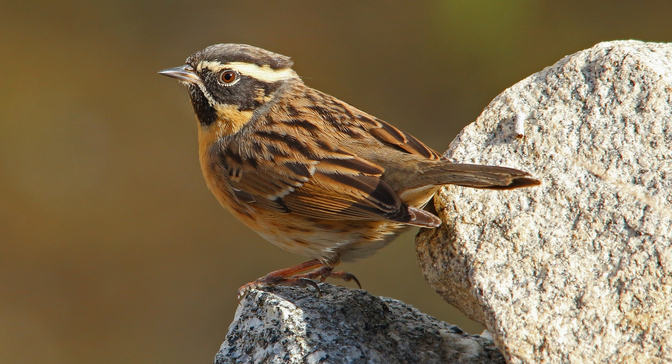 Black-throated accentor (Prunella atrogularis). Source: Imran Shah/CC BY-SA 2.0
Bird rarities committees, which in most countries operate as subgroups of national ornithological societies, are united across Europe under the Association of European Rarities Committees (AERC). Finland and Sweden serve as prime examples of such expert bodies at a high level. These countries have strong traditions of nature observation, both in terms of widespread public participation and internationally recognized experts.
In Sweden, the national bird list has now grown to over 560 species and Finland is nearing the 500 mark. By contrast, Estonia’s Baltic neighbors, Latvia and Lithuania, have bird lists that still contain only about 380–390 entries. Estonia’s list reached its 400th species already in March 2022, with the observation of a black-throated accentor (Prunella atrogularis) on the island of Muhu.
Estonia’s bird no. 400: Take two
In recent decades, there have been many changes in bird species classifications and Latin names, driven by new knowledge gained through molecular biology research. At the same time, advancing technology has made it increasingly possible to identify bird species in the wild without direct human involvement — through the analysis of satellite data, trail camera footage and sonograms from audio recordings.
Taxonomy — the classification of bird species — has emerged as the most fluid, controversial and, for some, thrillingly unpredictable aspect of this process, shaped by how scientific data is interpreted and systematized.
Until recently, multiple competing bodies maintained different global bird checklists — primarily the IOC World Bird List and the Clements Checklist of Birds of the World. But in June of last year, following four years of intense effort, a unified checklist was published: AviList: The Global Avian Checklist. Developed as a joint project among the world’s leading scientific institutions, AviList aims to serve as a consensus-based global standard for bird taxonomy.
 Himalayan griffon (Gyps himalayensis). Source: Imran Shah/CC BY-SA 2.0
All Scandinavian bird rarities committees immediately adopted the new taxonomy and, starting next year, Estonia will also begin maintaining its national bird list according to AviList.
Following the sighting of a black-winged kite (Elanus caeruleus) on Saaremaa in spring 2024 and the appearance of a Himalayan griffon vulture (Gyps himalayensis) on a trail camera in Harju County on June 4 of the same year, Estonia seemed poised to record its 403rd bird species. However, due to taxonomic reshuffling, we’re once again celebrating the milestone of reaching 400 species.
According to the AviList classification, the carrion crow (Corvus corone) and hooded crow (Corvus cornix), previously treated as separate species, are now merged back into a single species with subspecies under Corvus cornix. Likewise, the green-winged teal (Anas carolinensis) is once again considered a subspecies of the Eurasian teal (Anas crecca) and Stejneger’s stonechat (Saxicola stejnegeri) becomes a subspecies of the Siberian stonechat (Saxicola maurus).
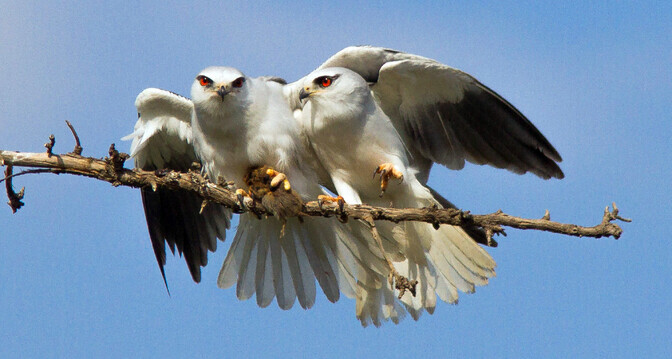 Black-winged kite (Elanus caeruleus). Source: Wolbrum avner/CC BY-SA 2.0
As a result of these changes, Estonia’s official bird list loses three species, bringing the total back down to 399. Over the past year, no Estonian birder succeeded in spotting a completely new species on home soil. And unfortunately, there were no helpful surprises from satellite transmitters, trail cameras or nocturnal migration audio loggers to push the number back up.
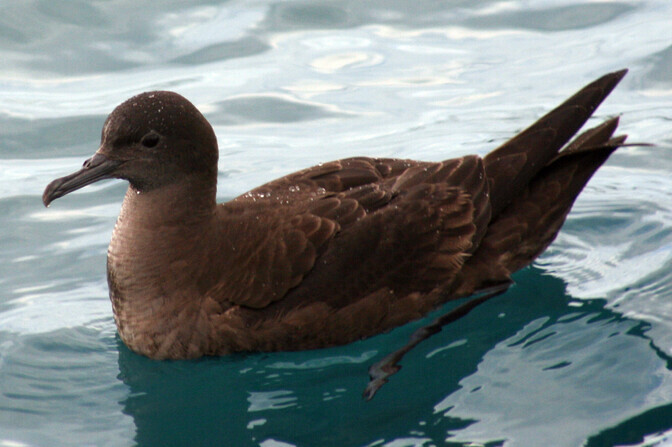
But at the end of October, a group of Polish birdwatchers came to the rescue. They observed and photographed a sooty shearwater (Ardenna grisea) out at sea near Sõrve — a species never before seen in Estonia. Thanks to the new taxonomy and a positive ruling from the Bird Rarities Committee, it now becomes Estonia’s 400th bird species.
Hitchcock’s bird
The sooty shearwater is a seabird that breeds in New Zealand, eastern Australia and the southern tip of Chile. Outside of the breeding season, it roams the open oceans. The species is regularly observed off the coasts of Japan, Kamchatka, California and Alaska — and even as far north as the Arctic Ocean waters off Norway.
This very bird species is also linked to an event that shaped the history of world cinema. On August 18, 1961, thousands of sooty shearwaters, poisoned by toxic algae, crashed onto the California coast. They vomited fish mid-flight, collided with objects and died in the streets. The bizarre incident caught the attention of a local resident — legendary director Alfred Hitchcock. It inspired one of his most famous films, the horror classic “The Birds.”
The lone sooty shearwater spotted a couple of months ago in Estonian waters near Saaremaa, however, behaved quite peacefully and allowed itself to be photographed in great detail. As a result, the expert panel on Estonian bird rarities had no reason to doubt the accuracy of the identification. However, the previous claim that “no Estonian birder observed a species previously unrecorded in the country over the past year” must now be firmly rejected.
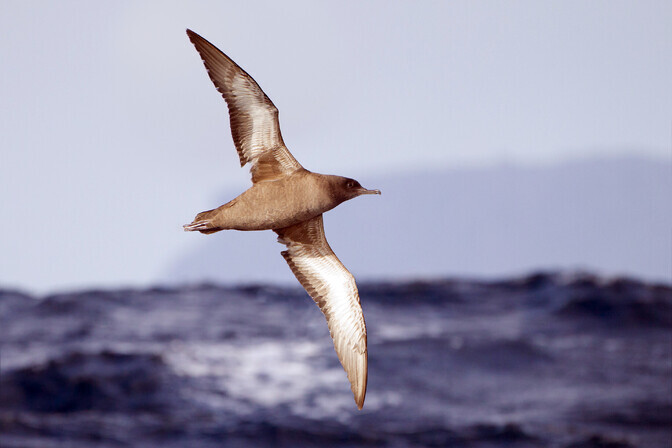 The sooty shearwater (Puffinus griseus)—the bird that caught the eye of legendary director Alfred Hitchcock. Source: JJ Harrison/CC BY-SA 3.0
In May 2010, a saker falcon (Falco cherrug) made its way into Estonia, spending three days across Viljandi, Harju and Pärnu counties. The saker falcon is the national bird of both Hungary and Mongolia and features on the coats of arms of several Arab countries. Used for thousands of years in falconry in Arabia, the Middle East and later among Europe’s nobility, the species is capable of soaring at speeds of up to 150 km/h, ranking just behind the white-throated needletail (Hirundapus caudacutus), which holds the global record at 169 km/h.
Although no one actually saw the falcon during its brief stay in Estonia, it became the country’s first officially confirmed record of the species. The bird had previously been captured in Hungary and fitted with a GPS transmitter by researchers. The geolocation log from the transmitter confirmed beyond doubt that the raptor had been present on Estonian territory. As such, Estonia’s bird list received a long-awaited addition, even though no one had physically observed the species in the country.
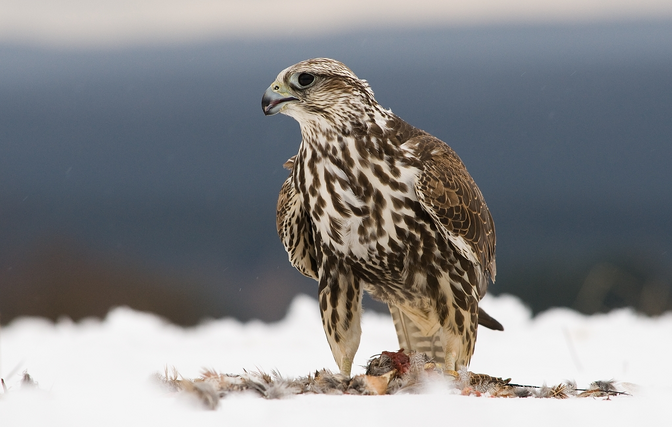 Saker falcon (Falco cherrug). Source: Bohuš Číčel/CC BY-SA 3.0
The stark contrast between hard scientific data and the lived experience of Estonian birders persisted for 15 years — until this past August, when a noble saker falcon graciously chose to spend several weeks near the town of Lihula. This act of generosity, registered by the Bird Rarities Committee as the species’ second occurrence in Estonia, gave even the most travel-weary local birders the rare chance to see one of the world’s most majestic raptors without having to leave the country or upon returning home.
New HK: Rarities and priorities
At the end of November, the newly reappointed Estonian Bird Rarities Committee (HK), which met in Tartu, reviewed 48 new observation records and processed four older reports that had been postponed for various reasons. The current committee includes Anni Miller (secretary), Madis Karu, Sten Lassmann, Pelle Mellov, Mihkel Metslaid, Kalle Muru, Jan Nordblad and Uku Paal.
Among the confirmed cases was the second-ever record in Estonia of a yellow-legged gull (Larus michahellis) equipped with a GPS transmitter, which visited the country in 2023. This time, however, it was officially logged as the second national observation, since the species had already been visually identified back in 2007 at Cape Põõsaspea.
Of the 52 reports reviewed, only three were rejected due to insufficient evidence. Of the 48 new submissions, 42 pertained to birds seen in Estonia over the past year — all of which were confirmed. The black-throated accentor (Prunella atrogularis), first spotted in Estonia in 2022 on the island of Muhu and crowned the country’s 400th bird species under the previous taxonomy, was recorded for a second time this November — this time at Sõrve Peninsula.
In addition to these “megararities,” the national bird record was supplemented in 2025 with a glossy ibis (Plegadis falcinellus, fifth observation), long-legged buzzard (Buteo rufinus, sixth observation) and desert wheatear (Oenanthe deserti, seventh observation).
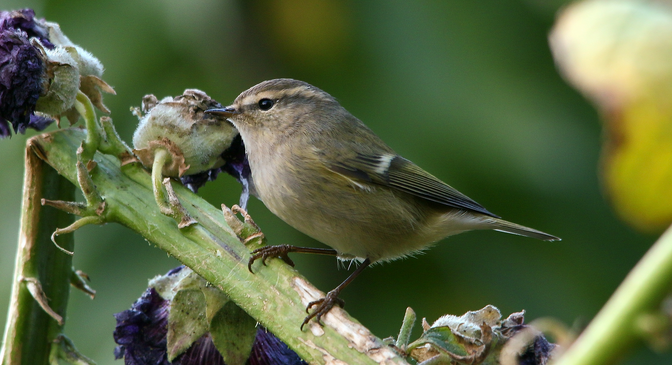 Hume’s leaf warbler (Phylloscopus humei). Source: Imran Shah/CC BY-SA 2.0
The Hume’s leaf warbler (Phylloscopus humei), a small bird that breeds at the foot of the Karakoram and Altai Mountains, often strays into Europe during autumn, occasionally reaching as far as the British Isles. In Estonia, it had been recorded just nine times previously. This year’s unusually long autumn brought sightings of the species in four locations — two individuals even remained near the Sõrve lighthouse until early December.
HK’s work reflects the constant shifts in Estonia’s birdlife. Beginning January 1, 2026, two increasingly common species — the little bittern (Botaurus minutus) and the collared flycatcher (Ficedula albicollis) — will be removed from the list of species requiring documentation. In the past decade, in addition to increased awareness and improved access to information, the committee’s work has also benefited from the significant advances in photographic technology and its wider availability. The number of people outdoors with cameras has grown dramatically.
Going forward, HK will also place greater focus on the occurrence of hybrids resulting from the interbreeding of different bird species in Estonia. One of the most exciting new frontiers is the automatic recording of nocturnal bird migration. Many species migrate exclusively at night, making them virtually impossible to observe visually, let alone identify. Yet it is a vast and fascinating natural phenomenon that is attracting a growing base of devoted followers worldwide.
So-called “nocmig” (short for “nocturnal migration”) enthusiasts even install specialized automated audio recorders in urban areas. By analyzing the sonograms of these recordings, it is possible to identify bird species flying overhead at night based on their flight calls. At the most recent HK meeting, for example, a record of a dotterel (Eudromias morinellus) flying over the city of Tartu at night was confirmed based on audio evidence.
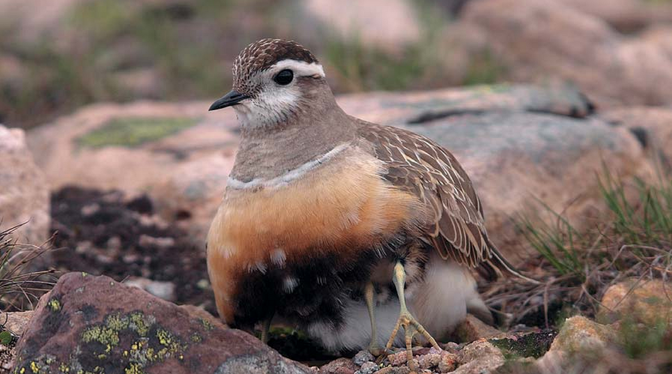 Eurasian dotterel (Eudromias morinellus). Source: Lutz Lücker/CC BY-SA 3.0
By approaching the task systematically, it becomes possible to collect valuable new data. In theory, the moment may not be far off when Estonia adds a new bird species to its national list based solely on an audio recording of a bird flying overhead in the dark — its flight call serving as valid documentation of a rare species.
Perhaps, then, it’s not entirely impossible that one day humanity will gain the ability to record and analyze dreams, making it scientifically feasible to compile observation lists of birds seen in sleep. At present, however, it’s unclear whether such dream-bird sighting reports would fall under the purview of the Estonian Ornithological Society or whether a new expert commission would need to be formed under the auspices of a rival scientific institution.
The Estonian Bird Rarities Committee wishes all nature enthusiasts a happy New Year and looks forward to receiving many reports in the coming year of rare and unusual bird sightings. Submissions can be sent to the new contact address: estonianrc@gmail.com
Sten Lassmann is a concert pianist and lecturer at the Estonian Academy of Music and Theater. As of last year, he also serves on the Estonian Ornithological Society’s Bird Rarities Committee.
—