
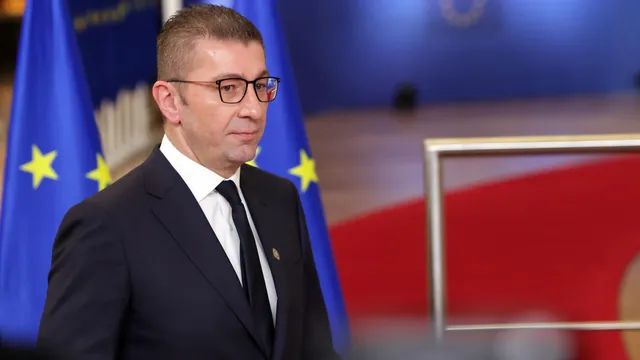
The Prime Minister of North Macedonia, better known as “little Vučić,” who blindly copies the authoritarian methods of Aleksandar Vučić, has revealed the true face of the Skopje government – the fragile VMRO-ZNAM coalition.
This is stated in a declaration by the opposition Social Democratic Union (SDSM), reported by BGNES.
The leader of VMRO-DPMNE is not an independent leader, but a puppet under the direct influence of Belgrade, who is exposing our country to danger, decline, and isolation from Europe. This is not just our accusation, it is confirmed by numerous reports and articles in European and international media. But everything changed two days ago. The arrest of Nicolas Maduro by US forces led to accusations of narco-terrorism and money laundering. Vucic, who until yesterday praised Trump, is now directly attacking him (personally and through specially coordinated publications), calling the action “the destruction of international law” and the law of the “strong” and announcing a doubling of Serbian military capabilities for “defense.”
This comes after Jared Kushner, Trump’s son-in-law, withdrew his company Affinity Partners from the project to build Trump hotels in Belgrade due to a corruption scandal, arrests of ministers and government officials, court cases, and protests, according to The New York Times and The Week. All this is happening because of Vučić’s panic that he may be next on the list of US sanctions for corruption and crime,” the SDSM statement said.
North Macedonia, Serbia, and Montenegro are awaiting the appointment of new ambassadors, and the implementation of a new US policy against crime and corruption is also expected, with sanctions for corrupt leaders, where US representatives emphasize the expansion of the “blacklist” for politicians and businessmen involved in corruption and organized crime. This is part of the Western Balkans Democracy Act of December 2025, which criticises corruption among key leaders in Serbia and the region. Serbia under Vucic’s rule is “the Venezuela of Europe”, as the German magazine Tichys Einblick calls it. Serbia is portrayed as a country where corruption is widespread, independent media are systematically destroyed, and strategic raw materials (such as lithium) serve as a bargaining chip in the geopolitical struggle.
Serbia is portrayed as a country where corruption is widespread, independent media are systematically destroyed, and strategic raw materials (such as lithium) serve as a political shield for the regime. The analysis states that Vučić uses his power to destroy critics, control the media, and maintain an authoritarian system, citing examples such as the ban on independent media channels and allegations of corruption in infrastructure.
This image of Serbia mirrors what is happening in Macedonia under the VMRO-ZNAM coalition and the replication of a model that leads to ruin. This connection is manifested through business and corruption ties between the SPP (Vucic’s party) and VMRO-DPMNE (the prime minister’s party). An example of this is the entry of the Serbian Alta Bank into the Macedonian market, which is directly linked to Vučić’s SPS, according to the SDSM.
Alta Bank, owned by Davor Matsuura (close to Vučić), has been accused of laundering money from corruption schemes in Serbia, and its entry into Macedonia (takeover of Stomanska Banka AD Bitola) became possible only a few months after the VMRO-ZNAM coalition came to power. This is part of Vučić’s broader influence over VMRO and Macedonia, where the “Serbian world” (mentioned in the EP report), a nationalist concept that the EU sees as a threat to stability in the region, is being used to block North Macedonia’s integration into the EU. According to EUObserver, Vučić’s “Serbian world,” similar to Putin’s “Russian world,” is directed at North Macedonia, hindering its progress toward the EU.
According to the SDSM, “the prime minister, under the influence of Vučić, is showing duplicity in his reaction to Maduro’s arrest: he supports the actions of the US, but at the same time he does not support them, claiming that international law is not being respected and that this is a “dangerous precedent” that undermines the world order. Probably, like Vučić, he is afraid of what awaits him, precisely because of his personal relationship with Vučić. This is further proof of his dependence on Belgrade, where he copies Vučić’s views to avoid pressure from Washington. I BGNES