
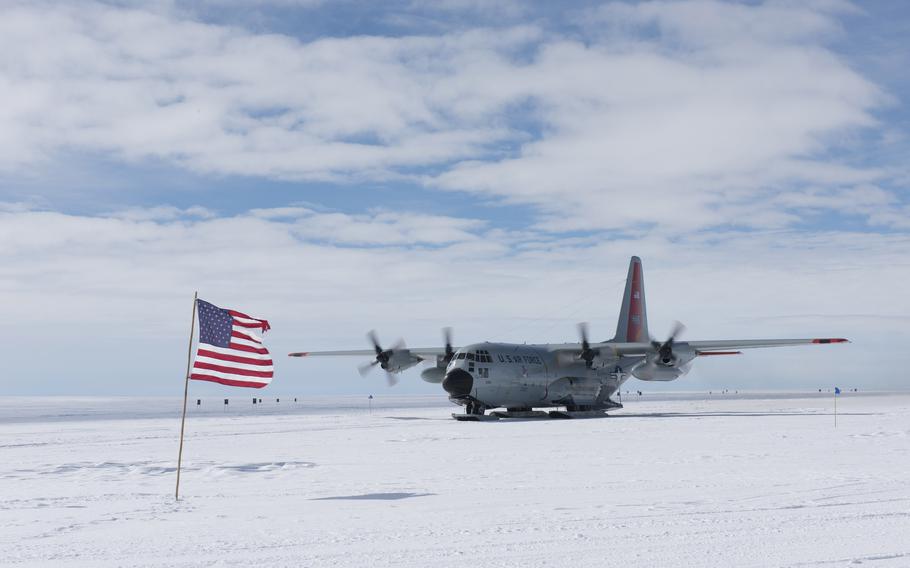
An LC-130 Skibird from the New York Air National Guard sits on the ice at Camp Raven in Greenland in 2016. President Donald Trump’s push for more control over the island, which is a Danish territory, has sparked concerns in Europe that coercion from Washington could lead to NATO’s unraveling. (Benjamin German/U.S. Air National Guard)
STUTTGART, Germany — A clash over the status of Greenland is shaping into a NATO stress test as President Donald Trump’s push for more control sparks European concerns that coercion from Washington could lead to the alliance’s unraveling.
Some analysts say one way to avoid such a scenario is to find a diplomatic off-ramp that leaves the political autonomy of the Danish island intact but entails more U.S. forces on the ground and greater American access to its natural resources.
The question is whether the United States and Denmark can reach a deal that satisfies Trump’s stated desire for more security on the territory while avoiding a rupture in NATO that could come from a unilateral American push into the territory.
The White House doubled down this week on its assertion that Greenland should be transferred to American control.
“You know what Denmark did recently to boost up security in Greenland? They added one more dogsled,” Trump said.
But if the United States strongarms its way into seizing control of fellow NATO ally Denmark’s territory, it could put the bloc’s future viability at risk. NATO’s core principle — that an attack on one member is an attack on all — would effectively be turned on its head.
The situation calls for a new “Northern Corridor Doctrine” that would update U.S.-Danish security cooperation agreements while expanding allied efforts to develop key minerals and other resources on the territory, Vienna-based geopolitical strategist Velina Tchakarova said.
That would bolster the American and European position against Russia and China, as well as manage what she called “an unavoidable reality.”
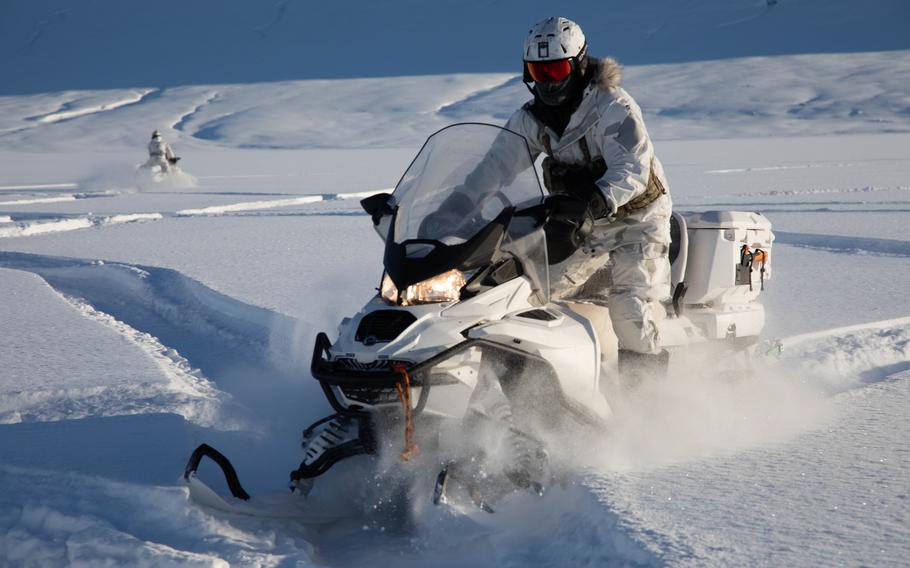
U.S. Army Special Forces soldiers operate snow machines during exercise Arctic Edge in Mestersvig, Greenland, in March 2024. Since taking office, President Donald Trump and other top administration officials have repeatedly argued that the U.S. needs to take over Greenland, citing increased Russian and Chinese activity in the Arctic. (Andrew Estrada/U.S. Army)
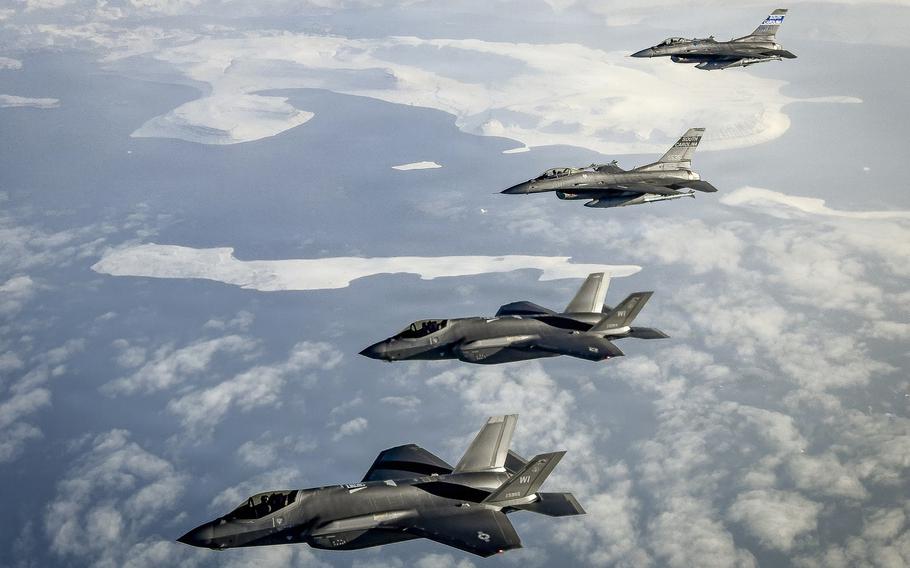
North American Aerospace Defense Command F-35 Lightning and F-16 Fighting Falcon jets fly over Greenland on Oct. 7, 2025. President Donald Trump’s recent reiterations of U.S. designs on the Danish territory are sparking worries in Europe about the future viability of NATO. (Cameron Lewis/U.S. Air National Guard)
“The United States will expand its military, security, and geoeconomic presence in Greenland,” Tchakarova said. “The only strategic question is whether this expansion produces confrontation and polarization or cohesion and stability among strategic allies.”
A new arrangement would expand U.S. access in Greenland in exchange for a wide range of security activity, she said.
“Such an agreement would acknowledge an uncomfortable but necessary truth: in Cold War 2.0, Greenland is once again indispensable to North American and transatlantic security,” Tchakarova said. “Avoiding this reality does not preserve sovereignty. It weakens it.”
There is a historical basis for ramping up the U.S. military presence in Greenland. During the Cold War, the United States had thousands of troops there in addition to numerous military sites equipped with nuclear-armed long-range bombers.
Today, the presence is much smaller, with about 200 troops involved in an early-warning ballistic missile mission.
One reason Greenland has emerged as a potential flashpoint is the failure of Europeans to recognize its strategic importance, Atlantic Council analyst Justina Budginaite-Froehly said.
“Europe’s problem is not that Washington sees Greenland as a strategic asset. It is that Europe has largely failed to do so itself,” Budginaite-Froehly said. “For decades, Greenland was treated as a political sensitivity rather than a strategic priority. That complacency is now dangerous.”
In an era of great-power competition, “territory that is weakly defended, lightly governed, or externally dependent invites pressure, regardless of legal status,” she said.
That reasoning echoed comments by Stephen Miller, Trump’s deputy chief of staff.
“We live in a world … that is governed by strength, that is governed by force, that is governed by power,” Miller told CNN host Jake Tapper on Monday. “These are the iron laws of the world since the beginning of time.”
When asked about using force against a NATO ally, Miller responded that “nobody’s going to fight the United States militarily over the future of Greenland.”
Danish Prime Minister Mette Frederiksen said Monday that such a move would spell the end of the transatlantic security bloc, founded 76 years ago as a counter to the Soviet Union and a linchpin of Western security strategy ever since.
“If the United States chooses to attack another NATO country militarily, then everything stops,” Frederiksen told Danish broadcaster TV2. “That is, including our NATO and thus the security that has been provided since the end of the Second World War.”
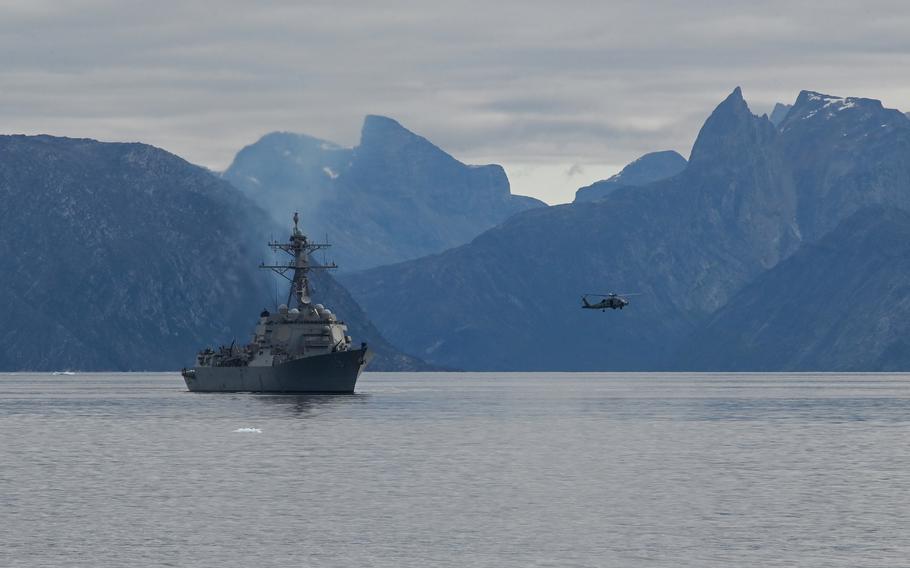
The destroyer USS Delbert D. Black and a U.S. Navy MH-60R Seahawk helicopter transit through the Nuup Kagerlua fjord near Nuuk, Greenland, on Aug. 21, 2024. President Donald Trump said recently the U.S. needs Greenland from the standpoint of national security. (Anthony Randisi/U.S. Coast Guard)
But Trump made it clear Sunday that the status quo in Greenland was coming to an end, saying that U.S. national security concerns were at stake and that Denmark was not up to the job of keeping Russia and China from dominating the region.
And so far, he appears to have been unimpressed by allied efforts to do more in the Arctic.
Budginaite-Froehly said Denmark and other European countries should ramp up their military commitments in Greenland and the Arctic to signal to the Trump administration that security concerns in the region are being taken seriously.
In practice, that means a European military presence that can deny Russia and China the ability to encroach deeper into the Arctic region.
“A Europe that treats Greenland as central to its own security, rather than as a liability to be explained away, can shift the Trump administration’s fixation on acquiring Greenland toward cooperating on Greenland’s security,” Budginaite-Froehly said.