
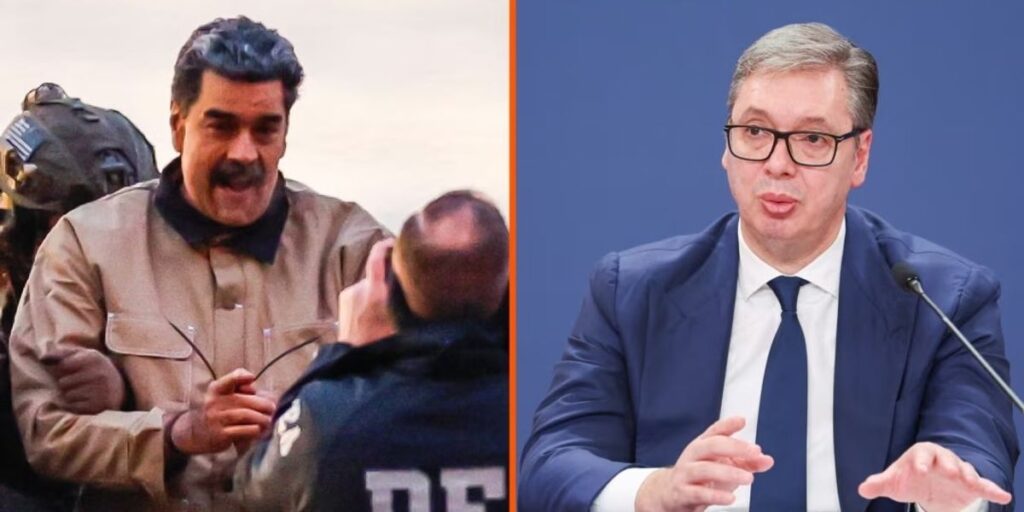
“Great friend”… This is how Serbian officials until recently described the now-deposed leader of Venezuela, Nicolas Maduro.
While his downfall in an American action was assessed as “the right of force” and “the right of the strongest.”
“The finding was not like this when, in 2022, Russia started the war in Ukraine,” Jelica Minic from the non-governmental European Movement in Serbia told REL.
Official Belgrade supported the territorial integrity of Ukraine, but did not join Western sanctions against Russia and continued to maintain ties with Moscow.
Serbia strengthened relations with Venezuela and its authoritarian regime, while this country, close to Russia, was under sanctions from the European Union and the United States.
Maduro was arrested along with his wife on January 3 in a US raid in Venezuela, from where they were transferred to New York, where they will face drug trafficking charges.
A day after this action, Vučić said that the old world order is collapsing and that no rules apply, assessing that the right of force dominates and that “whoever is stronger, oppresses.”
While, harsher words, as he said, were not used so as not to damage relations with the United States.
The Serbian president’s assessments of Jelica Minic, from the European Movement, are partly a result of interests in bilateral relations “as he sees them”.
“And partly fear that Serbia is giving enough reasons on the international stage, which could be used for some new intervention, of one kind or another, against his regime,” she added.
Vučić stated on January 5 that he understands the national interests of the United States and that he has enormous respect for both President Donald Trump and the US, but that Serbia has no other alternative than to respect international law.
Most Western Balkan countries supported the American action, stating that it is a narco-criminal regime and that Maduro is a dictator who did not come to power thanks to free and fair elections.
The US State Department did not respond to REL’s question regarding the Serbian president’s reaction to Maduro’s overthrow, until the publication of this text.
The US action was condemned by Iran, Russia and other allies of the South American country, while United Nations Secretary-General Antonio Guterres said the US military action represents a “dangerous precedent.”
Many of Washington’s allies, although they declared that they have no sympathy for Maduro or his regime, warned of the need to respect international law.
Maduro’s fall was welcomed by Venezuelans living in exile.
Friendship for the sake of Kosovo
Officials in Serbia have declared in recent years that Serbia and Venezuela are “true friends.”
The friendship stemmed from Venezuela’s refusal to recognize Kosovo’s independence.
While strengthening ties, Serbia and Venezuela signed the Visa Waiver Agreement in mid-2023.
Commenting on the reaction of the Serbian president, Jelica Minic assessed that “Maduro was considered a ‘friend’ and ally due to the closeness of the regimes.”
According to assessments by international organizations, Serbia is a country with a damaged democracy, where civil liberties are violated and pressure is exerted on independent media.
The stance on Maduro’s legitimacy
Serbia, despite EU sanctions, some of which it has supported itself, has not questioned Maduro’s legitimacy.
At the same time, she supported the EU political declaration questioning the electoral process of July 28, 2024 and stating that Maduro does not have the legitimacy of a democratically elected president, but also had her representative at his inauguration.
The Speaker of Parliament, Ana Brnabić, attended Maduro’s inauguration in Caracas in January 2025, where he began his third six-year term.
Brnabic stated then that Venezuela, as a “great friend of Serbia”, helps to ensure that the position on the inviolability of borders is shared by a large number of Latin American and Caribbean countries.
Belgrade, among others, also counts on this group of countries in the fight against the recognition of Kosovo’s independence.
The non-recognition of Kosovo was also emphasized by the President of Serbia, Aleksandar Vučić, after a telephone conversation with Maduro in August 2025.
Then he called him a great friend of Serbia, expressing his belief that in the years to come they will continue to cultivate this “precious friendship.”
Also, in June 2025, the Venezuelan Deputy Minister of Foreign Affairs for Europe and North America, Andrea Gabriela Corao Faria, arrived in Belgrade.
She participated in the first meeting for planning international participation in the Specialized Exhibition Expo, to be held in Belgrade in 2027.
Sanctions against Venezuela
While Serbia, as a candidate country for membership in the European Union, strengthened relations with Venezuela, Brussels imposed sanctions on the regime there.
The sanctions were imposed at the end of 2017 and were subsequently supplemented.
Thus, on December 15, the European Council extended the existing restrictive measures for another year, taking into account the situation in Venezuela.
As REL unofficially learns, Serbia, as a candidate country for EU membership, harmonized with this decision.
The decision was taken in light of ongoing actions that undermine democracy and the rule of law, as well as ongoing human rights violations and repression of civil society and the democratic opposition.
This, as announced, also includes events following the presidential elections of July 28, 2024.
Serbia has harmonized with some decisions on EU sanctions against Venezuela, while it has not with others.
Broad US sanctions are also in force, which, among other things, are focused on individuals linked to the regime of Nicolas Maduro, as well as on Venezuela’s oil sector.
Serbia’s turn towards the US?
Criticism of the US action has also been spread by pro-government tabloids in Serbia.
From support for Trump, which was also reflected in the placement of billboards with the inscription “Trump, Serb”, they now write about the “dissolution of all laws and logic”.
Asked whether the Serbian president’s assessments could affect relations with the US, Jelica Minic from the European Movement stressed that there are already serious problems there.
“Serbia also has a special place in the US National Security Strategy of December 2025, where further policy towards our region is envisaged by executive act,” she said.
The National Defense Authorization Act, which Trump recently signed, also mentions the Western Balkan countries and the need for their Euro-Atlantic integration and reducing energy dependence on Russia.
This law also expresses concern about the state of democracy in Serbia, but also stipulates that Serbia and Kosovo should aim to achieve immediate progress regarding the implementation of the agreement on the normalization of relations.
It is also emphasized that the US should continue to support the achievement of a comprehensive final agreement between Kosovo and Serbia, which will be based on mutual recognition.
Serbian President Aleksandar Vučić recently admitted that instead of the great progress expected from the Trump administration, decisions have been made that are not in Serbia’s interest.