
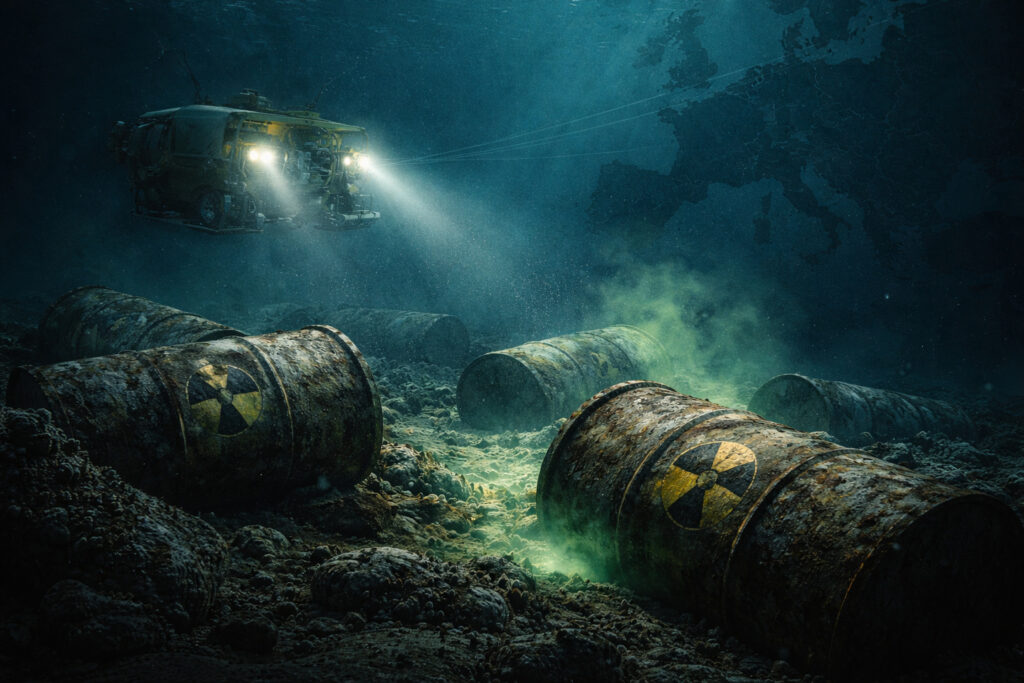
Between 1950 and 1980, European countries dumped thousands of barrels of radioactive waste into the Atlantic; scientists are only now able to map this submerged nuclear waste.
For more than three decades of the 20th century, the bottom of the Atlantic Ocean was treated by European powers as a silent and definitive destination for nuclear waste. Between the 1950s and 1980s, France, United Kingdom, Belgium, Netherlands, Germany and Switzerland They participated in official operations to dispose of radioactive waste at sea, launching thousands of metal barrels containing nuclear waste in deep areas of the Northeast Atlantic. At the time, the practice was considered legal, technically safe, and aligned with available scientific knowledge. Today, it is seen as one of the greatest environmental liabilities of the nuclear age.
The problem remained off the public radar for decades. The exact dumping sites were not widely publicized, the barrels were dumped at great depths, and it was believed that the ocean would dilute any risk. Only recently, with advances in underwater mapping technologies and a new generation of environmental studies, have scientists begun to locate, count, and assess the actual state of these submerged containers.
European nuclear waste disposal in the Atlantic during the atomic age.
Following World War II, the rapid expansion of nuclear power plants and research programs generated an increasing volume of low- and intermediate-level radioactive waste.
With no definitive land-based solutions and facing the high cost of secure storage, the ocean began to be seen as a viable alternative. Between the 1950s and 1980s, European countries organized joint disposal operations, launching sealed barrels into deep ocean areas, far from the coast and busy shipping lanes.
These operations took place under government supervision and, in many cases, with the scientific backing of the time. It is estimated that more than 200 barrels have been dumped into the Northeast Atlantic, mainly in areas known as dumping sites, located at depths ranging from 3 and 5 meters.
Which countries participated in the dumping of radioactive waste?
The practice was neither isolated nor clandestine. France and the United Kingdom led in the volume of disposal, but Belgium, Netherlands, Germany and Switzerland They also participated officially. In some cases, landlocked countries, such as Switzerland, used international agreements to send their waste to European ports and integrate it into maritime operations.
The waste included contaminated laboratory materials, filters, clothing, tools, and solidified liquid waste. Although classified as less hazardous compared to spent nuclear fuel, these materials contained radionuclides with… half-life of decades or centuries, such as cobalt-60, cesium-137, and plutonium in trace amounts.
Why was the ocean chosen as the “solution”?
In the logic of the time, the deep ocean offered three advantages considered decisive: geographic isolation, low water circulation, and enormous dilution volume.
The prevailing belief was that the barrels would remain intact long enough for the radioactivity to decay to harmless levels.
This reasoning is now widely questioned. Modern studies show that Deep ocean environments are not static.There are currents, biological activity, extreme pressure, and chemical processes capable of accelerating the corrosion of metal containers.
What has changed and why have scientists returned to the topic?
Scientific interest in submerged nuclear waste resurfaced in the 2000s, driven by three main factors: technological advancement, increased environmental concern, and climate change.
Autonomous underwater vehicles, high-resolution sonar, and radiation sensors have made it possible, for the first time, accurately map disposal areas which were previously only estimated on old maps.
Institutes such as the IFREMER (France) and international programs related to International Atomic Energy Agency (IAEA) They began conducting expeditions to locate barrels, assess their structural condition, and measure potential leaks.
Initial results indicate that many containers are already… severely corrodedalthough there is still no consensus on the extent of the radioactive release.
What has already been found at the bottom of the Atlantic?
Scientific missions have located barrels partially buried in the sediment, others collapsed, and some covered by colonies of marine organisms.
In specific locations, they were detected High levels of radioactivity in the immediate vicinity., even though they are rapidly diluted in the ocean volume.
The greatest risk is not a sudden event, but a slow and continuous release radionuclides in the marine environment. These elements can be absorbed by microscopic organisms, enter the food chain and, over time, reach larger fish.
The Northeast Atlantic is home to economically important fishing areas for Europe. Although there is no evidence of large-scale contamination to date, scientists warn that monitoring needs to be continuous and long-term. The fear is that the progressive degradation of the barrels will generate cumulative impacts, difficult to detect in the short term, but significant over decades.
In addition to the environmental impact, there is concern about… international responsibilityMany of the disposals occurred under legal regulations that no longer exist. In 1993, the London Convention became… completely ban the dumping of radioactive waste into the sea, officially ending this practice.
Why was the problem hidden for so long?
For years, submerged nuclear waste was treated as a closed issue. The lack of adequate technology, the high cost of deep-sea research, and the political discomfort in revisiting past decisions contributed to the silence. Only now, with greater scientific transparency and environmental pressure, has the topic returned to public debate.
Reopening this discussion means confronting an uncomfortable legacy: decisions made by previous generations continue to produce risks that affect the present and the future.
A nuclear liability that the ocean did not erase.
The dumping of radioactive waste into the Atlantic by European countries is a stark reminder of how solutions considered acceptable in a given historical context can transform into long-term global problems. The ocean, far from “solving” the problem, only temporarily concealed it.
Today, scientists are trying to understand the true extent of this submerged nuclear liability. The big question is not just what has already leaked, but what could still leak as time and corrosion progress.
And you, reader: should the bill for this historic nuclear waste be paid collectively by the international community or individually by the countries that decided to dump it on the seabed?