
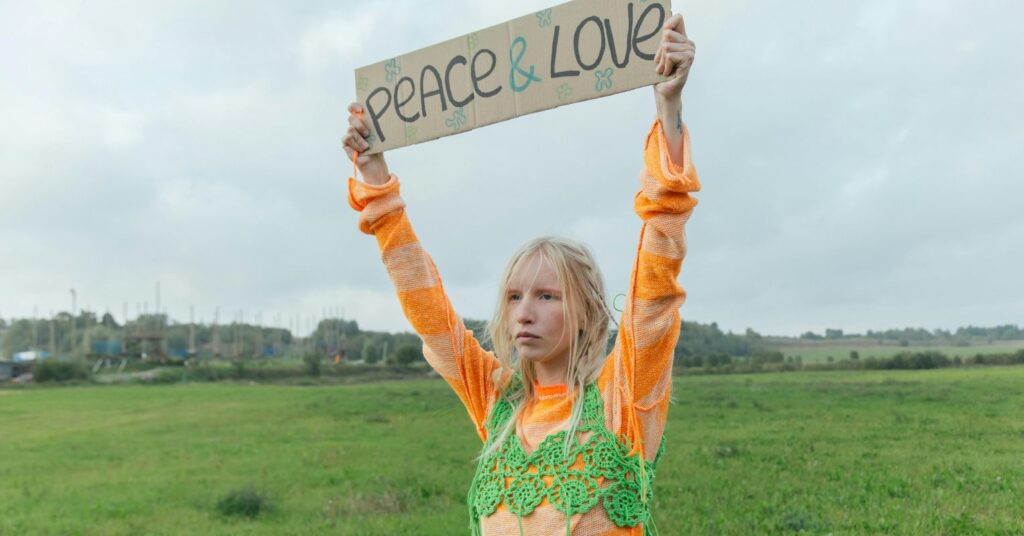
By the time people reach their seventh decade, they have learned many lessons. From a psychological standpoint, they understand what really matters. They have learned what to let go of. They know what they need to be happy. They also acknowledge the importance of being kinder to themselves and how relationships and experiences are more important than possessions. They tend to reflect on lessons learned and often recover more easily from adversity. They also focus on wanting the best for their loved ones.
My Story
I am a 71-year-old mother of three adult children and six grandchildren. The nurturing part of me wants to protect my family from all that threatens their safety, dignity, or emotional well-being. I want them to grow up in a peaceful world where all men and women are created equal, where music brings us together, and where everyone has a chance to self-actualize. This may be idealistic, but that’s the way I feel. My dreams for my grandkids are as lofty as they were for the three beautiful children I brought into the world.
I was born in the 1950s and raised in New York during the hippie generation. I hung out in head shops in the suburbs of New York City, wore beaded necklaces, walked barefoot in the park, burned incense, and listened to music under black lights. Because I had asthma, I never got into smoking marijuana, but I did protest the war and say goodbye to friends who went to fight in Vietnam. I fought for numerous causes and wore cut-off jeans that swept the dirty streets. Incidentally, I even brazenly wore the American flag slung like a scarf around my shoulders. As a writer, I filled my journal with musings about the utopian world of my dreams.
The Hippie Generation
The hippie generation was, in essence, an emotional rebellion against the mindless direction in which our world was headed. The 1960s counterculture asked questions and begged for answers—and wanted peace. From a psychological perspective, it was also a collective search for meaning, autonomy, and belonging—core human needs that surface most forcefully during times of upheaval. History has a way of circling back, and the conditions that fueled that era—division, violence, unchecked power—today feel uncomfortably familiar. Perhaps what is needed again is not chaos, but conscience.
For my last birthday, a childhood friend called to wish me a happy birthday. We reminisced about the peace and love spirit of the 1960s, and how we now feel the same stirrings—the desire to come together, create and instill change, and bring calm to unsettled times. We recognize the same quiet pull toward activism that we felt decades earlier, now tempered by reflection rather than urgency.
Cultural Shifts
In examining today’s cultural shifts, it’s easy to see parallels to the hippie generation, which was a time of excess—racial violence, war, corporate greed, and a buildup of intolerance and dissatisfaction. Drugs were widespread during that time; the current drug wars and the recent legalization of marijuana in many states illuminate another parallel. Today, social media amplifies voices that once went unheard, creating both connection and combustion—conditions ripe for transformation.
Like Buddhist teacher Thich Nhat Hanh says, “No mud no lotus.” Also, the Hopi, Native Americans, known for their peaceful nature and quiet resilience, believe that darkness is a prerequisite to experiencing transformation. Using this metaphor, their mythology emphasizes that although the caterpillar has already become the butterfly in the darkness, it begins to move inside the cocoon and show life again. However, it does not begin to break out of the cocoon until it’s ready (Schaefer, 2006). Only then is it ready to share its messages.
Messages to Future Generations
As an elder, I want to be the messenger to my kids and grandchildren and inspire them to keep the faith, be compassionate, and promote the power of interconnectedness. As was said in the 1960s, “Make love, not war.” This is not just a slogan; it’s vital to our collective well-being. The resurgence of the hippie revolution merely means that we need to reevaluate old thoughts and bring in fresh new ideas. It might be a good time to revisit books such as The Hippie Dictionary by John Bassett McCleary (2004), which is really a history book that casts a beautiful picture of those times. McCleary highlights some phrases in the book’s introduction that I think still apply today, such as “hang in there” and “keep on trucking.” Most importantly, let’s keep in mind some of the words in that dictionary and the core of what this country was built upon: “A democracy is a society or form of government in which the population is given the opportunity to contribute to the decisions that govern them.”
We are still an ongoing experiment…and hopefully always will be.
Celebrating the Aging Process
My new book, co-edited with my colleague Chryss Yost, called Women in a Golden State: California Women 60 and Beyond (Gunpowder Press, 2025), amplifies celebrating and honoring the aging process, and the prevalence of resilience, wisdom, and transformation. As McCleary indicated, it’s important that we make our opinions known through writing or communicating with the collective.
As Gabor Mate says in his book The Myth of Normal, “It all starts with waking up: waking up to what is real and authentic in and around us and what isn’t; waking up to who we are and who we’re not; waking up to what our bodies are expressing and what our minds are suppressing; waking up to our wounds and gifts….”
Now, as an elder, I see my role less as a protester and more as a guide. The impulse to protect, to hope, and to imagine a better world has not left me. It has simply matured. What I once chanted in the streets, I now try to model in my relationships: empathy, presence, and faith in humanity. Therefore, the road from rebellion to reverence has led my generation, full circle, back to love and quieter and perhaps less radical times.