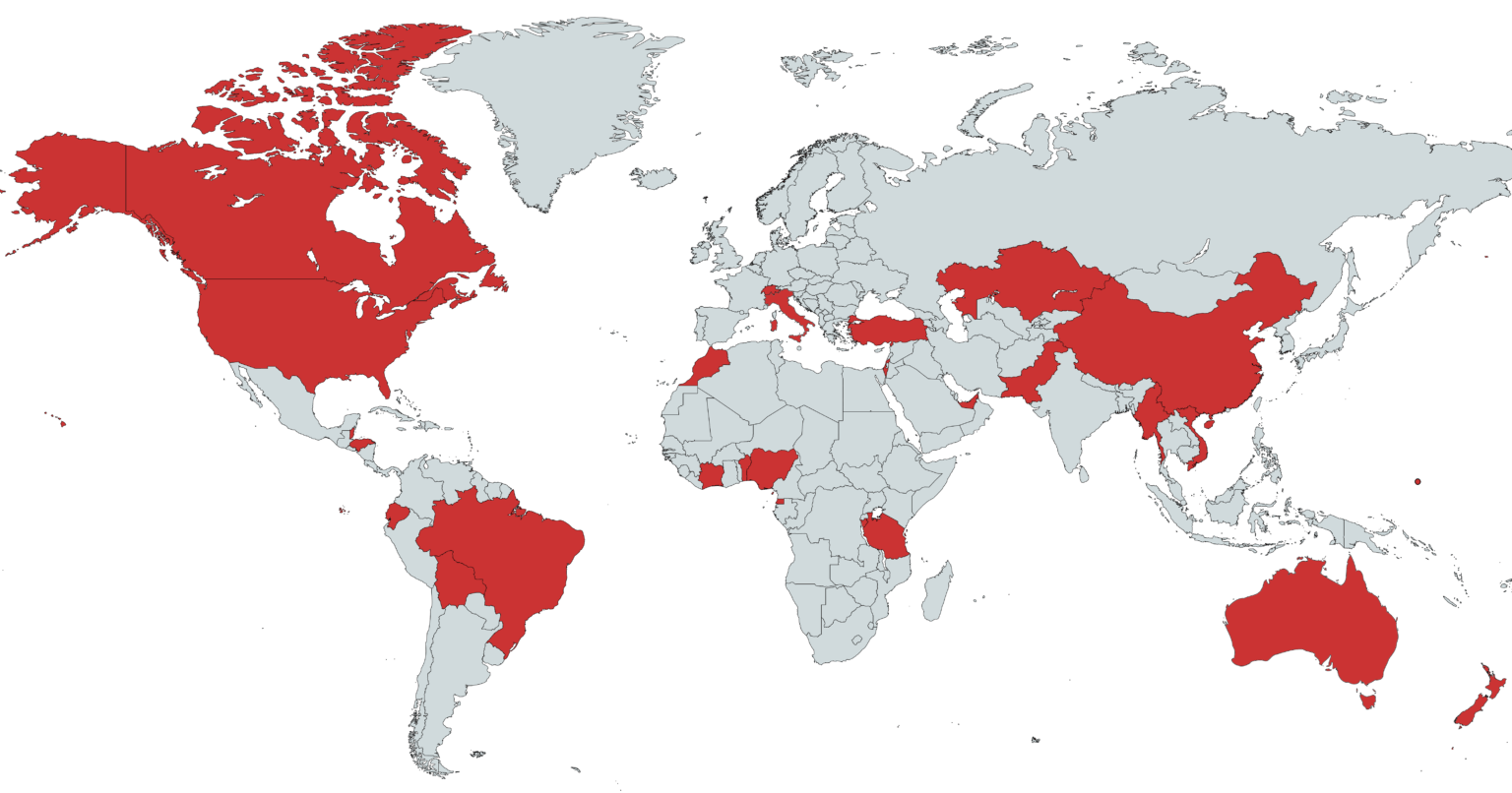
Capital city in this context is considered de-facto executive center of the country. So, Rotterdam-The Hague Metropolitan Area is considered the capital of the Netherlands. Since it is more populated than Amsterdam Metropolitan Area, the Netherlands is colored gray in the map.
Cities of Ruhr Area are considered separate because of the polycentric nature of the region.
BainbridgeBorn on
this map would come in handy when playing [https://www.geogridgame.com](https://www.geogridgame.com) because one of the columns sometimes is countries whos capital isn’t the largest city
whatissevenbysix on
I’m not very familiar with what ‘conurbation’ means.
In case of Sri Lanka, Sri Jayawardenepura Kotte is the capital whereas Colombo is typically the commercial/trade center of the country. Similar to DC vs NYC.
SJC is not within Colombo or anything like that. Considering Colombo as the capital is incorrect.
ZealousidealBuilding on
This shows Italy as red but I believe Rome is comfortably the biggest city in Italy.
EmergencyGarlic2476 on
The capital of Liechtenstein is Vaduz but the biggest city is Schaan
Acedv179 on
Why is Israel red?
The_Ivliad on
Johannesburg is bigger than Pretoria.
HunterSpecial1549 on
You can add Indonesia to the list soon. They’re planning on making Nusantara the official capital in 2028.
garanvor on
For decades Brazilians everywhere complained about Juscelino Kubitschek building the new Brazilian capital in the middle of nowhere in the center of the country. Funny how it started making a lot more sense in the last few days…
Consistent-Annual268 on
Is South Africa correct? Johannesburg (City of Johannesburg) surely has a higher population than the capital Pretoria (City of Tshwane)?
hill10003 on
This map is “fake news”. Look at Rome, Italy.
EmptyBodybuilder7376 on
What is the largest metro area in Italy?
No_Gur_7422 on
Scotland’s capital is Edinburgh but its largest city is Glasgow.
Ncaak on
I wouldn’t be so sure that is the case in Ecuador. The last census that the government conducted in 2022 was half-assed and very poorly managed. The last reliable census was in 2010.
During 2010 to 2017 more or less and even beyond Quito, the political capital, also became a very influential financial center rivaling Guayaquil which is the “largest” city. Which impacted the population growth.
Furthermore there is an underlying issue of migration that the country suffered heavily from since 2010 with waves of migrants from Colombia, Cuba, and Venezuela. It has been impactful enough to drive what could be considered barely a town, Santo Domingo de los Tsáchilas, to be one of the most populous cities in the country. The growth was such that it became its own province (it had also other reasons to be considered but without this it wouldn’t had happened regardless), seceding from Pichincha which is the province that Quito, the capital, is part of and Province Capital too. The growth was something along the lines of 50k to more than 300k in the course of a decade.
So this has impacted both Guayaquil and Quito and put both of them roughly with similar population estimations between 3 and 4 million in each.
There is also the problem of how you count said populations. Quito’s Metropolitan area is barely 2 million but the bordering Canton (a provincial sub-division) Rumiñahui has also like 1 million people and they are normally grouped together when counting what Quito’s population is. Guayaquil has a similar issue with Samborondón and Duran that as Rumiñahui are nominally their own cities and depending on how and who you ask they might be counted as different entities or the same. Duran has been mostly a different entity from Guayaquil since their administrations have clashed regularly for more than a decade and now with the increase in violence in the country and particularly in Duran it is politically convenient to count them separately in all cases even if they are just a bridge apart (a very large bridge). That’s not the case with Samborondón which is often grouped with Guayaquil.
All of this makes the population vary between different estimations some even putting Quito ahead than Guayaquil. But regardless of the source both Quito and Guayaquil do have similar populations and their largest gap in the last two decades as far as I am aware has been not more than half a million but often is one or two hundred thousand and maybe some more. Which for cities their size well is considerable but changing in their floating populations and the undercounted and unregistered populations among migrants.
I imagine that many countries face similar situations.
Aleppo is the largest city of Syria, not Damascus.
deet0109 on
I didn’t expect to see Honduras here!
suggestion_giver on
Italy…? Isnt the largest city in Italy just Rome itself?
[deleted] on
[deleted]
Momshie_mo on
The Philippines should be here because while the capital is Manila, the biggest city is Quezon city
Rjoe1993 on
In any measurement, Mumbai is a bigger city than Delhi
_pratik475 on
There’s at least one error. In India’s case, while the Delhi metro area is larger than that of Mumbai, Delhi is not the capital city. It’s New Delhi, one of the eleven subdivisions of the National Capital Territory, and it is far smaller than either Mumbai or Delhi.
AdNational1490 on
Capital of India is New Delhi and largest city in India is Delhi. You would think they are the same thing and I’m insane but Delhi has 11 districts(13 now) of which New Delhi is one and only that district is India’s capital.
Relative-Recording63 on
Israel should be grey
xXxPizza8492xXx on
Italy is wrong.
Nikrsz on
Isn’t La Paz metro bigger than Santa Cruz’s? Thought Santa Cruz was bigger only by city proper.
Mx_Liewe_Heksie on
How is South Africa not on here? Pretoria is tiny compared to Joburg. Are they counting Cape Town, Bloem and Tshwane together?
Pershing99 on
Smart move for any country safe from invasion would be move their capital to different cities every few years. This would prevent build up of cliques and make espionage harder.
3_Stokesy on
Interesting, if Scotland ever goes independent it would also join the red, an outlier for Northern Europe.
The reason is because Edinburgh is the capital and historic administrative centre but Glasgow grew to be larger because of industry, since Edinburgh is built on a volcanic rock and is not favourable geographically for industry compared to Glasgow which is on a river plain.
panyu0863 on
The capital of Indionesia is Nusantara now and it is not the largest city.
AuthenticCourage on
South Africa wants a word
Erno-Berk on
Italy red (Milan vs Rome), but not Germany (Essen vs Berlin). Weird.


32 Comments
My main source for the map:
[https://www.citypopulation.de/en/world/agglomerations/](https://www.citypopulation.de/en/world/agglomerations/)
The map counts conurbations as single cities.
Capital city in this context is considered de-facto executive center of the country. So, Rotterdam-The Hague Metropolitan Area is considered the capital of the Netherlands. Since it is more populated than Amsterdam Metropolitan Area, the Netherlands is colored gray in the map.
Cities of Ruhr Area are considered separate because of the polycentric nature of the region.
this map would come in handy when playing [https://www.geogridgame.com](https://www.geogridgame.com) because one of the columns sometimes is countries whos capital isn’t the largest city
I’m not very familiar with what ‘conurbation’ means.
In case of Sri Lanka, Sri Jayawardenepura Kotte is the capital whereas Colombo is typically the commercial/trade center of the country. Similar to DC vs NYC.
SJC is not within Colombo or anything like that. Considering Colombo as the capital is incorrect.
This shows Italy as red but I believe Rome is comfortably the biggest city in Italy.
The capital of Liechtenstein is Vaduz but the biggest city is Schaan
Why is Israel red?
Johannesburg is bigger than Pretoria.
You can add Indonesia to the list soon. They’re planning on making Nusantara the official capital in 2028.
For decades Brazilians everywhere complained about Juscelino Kubitschek building the new Brazilian capital in the middle of nowhere in the center of the country. Funny how it started making a lot more sense in the last few days…
Is South Africa correct? Johannesburg (City of Johannesburg) surely has a higher population than the capital Pretoria (City of Tshwane)?
This map is “fake news”. Look at Rome, Italy.
What is the largest metro area in Italy?
Scotland’s capital is Edinburgh but its largest city is Glasgow.
I wouldn’t be so sure that is the case in Ecuador. The last census that the government conducted in 2022 was half-assed and very poorly managed. The last reliable census was in 2010.
During 2010 to 2017 more or less and even beyond Quito, the political capital, also became a very influential financial center rivaling Guayaquil which is the “largest” city. Which impacted the population growth.
Furthermore there is an underlying issue of migration that the country suffered heavily from since 2010 with waves of migrants from Colombia, Cuba, and Venezuela. It has been impactful enough to drive what could be considered barely a town, Santo Domingo de los Tsáchilas, to be one of the most populous cities in the country. The growth was such that it became its own province (it had also other reasons to be considered but without this it wouldn’t had happened regardless), seceding from Pichincha which is the province that Quito, the capital, is part of and Province Capital too. The growth was something along the lines of 50k to more than 300k in the course of a decade.
So this has impacted both Guayaquil and Quito and put both of them roughly with similar population estimations between 3 and 4 million in each.
There is also the problem of how you count said populations. Quito’s Metropolitan area is barely 2 million but the bordering Canton (a provincial sub-division) Rumiñahui has also like 1 million people and they are normally grouped together when counting what Quito’s population is. Guayaquil has a similar issue with Samborondón and Duran that as Rumiñahui are nominally their own cities and depending on how and who you ask they might be counted as different entities or the same. Duran has been mostly a different entity from Guayaquil since their administrations have clashed regularly for more than a decade and now with the increase in violence in the country and particularly in Duran it is politically convenient to count them separately in all cases even if they are just a bridge apart (a very large bridge). That’s not the case with Samborondón which is often grouped with Guayaquil.
All of this makes the population vary between different estimations some even putting Quito ahead than Guayaquil. But regardless of the source both Quito and Guayaquil do have similar populations and their largest gap in the last two decades as far as I am aware has been not more than half a million but often is one or two hundred thousand and maybe some more. Which for cities their size well is considerable but changing in their floating populations and the undercounted and unregistered populations among migrants.
I imagine that many countries face similar situations.
Belgium? Cameroon? India? Gambia? Sudan? Syria? Taiwan?
There are all sorts of errors here.
Aleppo is the largest city of Syria, not Damascus.
I didn’t expect to see Honduras here!
Italy…? Isnt the largest city in Italy just Rome itself?
[deleted]
The Philippines should be here because while the capital is Manila, the biggest city is Quezon city
In any measurement, Mumbai is a bigger city than Delhi
There’s at least one error. In India’s case, while the Delhi metro area is larger than that of Mumbai, Delhi is not the capital city. It’s New Delhi, one of the eleven subdivisions of the National Capital Territory, and it is far smaller than either Mumbai or Delhi.
Capital of India is New Delhi and largest city in India is Delhi. You would think they are the same thing and I’m insane but Delhi has 11 districts(13 now) of which New Delhi is one and only that district is India’s capital.
Israel should be grey
Italy is wrong.
Isn’t La Paz metro bigger than Santa Cruz’s? Thought Santa Cruz was bigger only by city proper.
How is South Africa not on here? Pretoria is tiny compared to Joburg. Are they counting Cape Town, Bloem and Tshwane together?
Smart move for any country safe from invasion would be move their capital to different cities every few years. This would prevent build up of cliques and make espionage harder.
Interesting, if Scotland ever goes independent it would also join the red, an outlier for Northern Europe.
The reason is because Edinburgh is the capital and historic administrative centre but Glasgow grew to be larger because of industry, since Edinburgh is built on a volcanic rock and is not favourable geographically for industry compared to Glasgow which is on a river plain.
The capital of Indionesia is Nusantara now and it is not the largest city.
South Africa wants a word
Italy red (Milan vs Rome), but not Germany (Essen vs Berlin). Weird.