
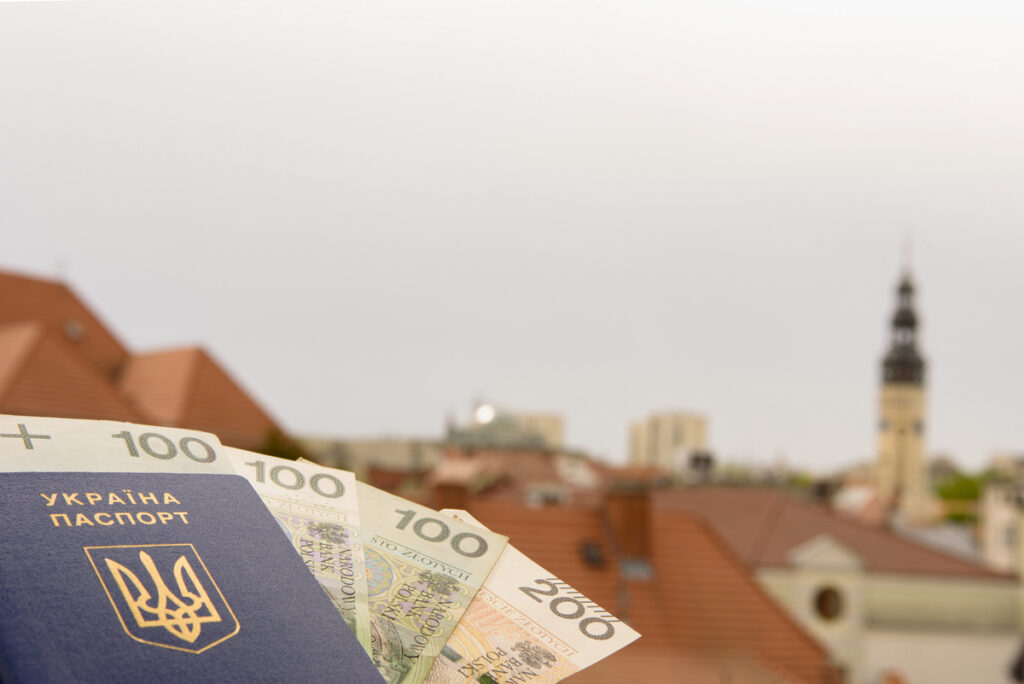
In Poland, a special law was prepared and adopted during the Law and Justice (PiS) government in March 2022 as a rapid response to Russia’s invasion of Ukraine. It broadly regulated assistance-related issues for Ukraine as well as the reception of a large number of refugees, including social benefits.
According to Poland’s Ministry of the Interior and Administration, a law of this nature will no longer be needed four years after the start of the invasion. Assistance to defending Ukraine has been systematized and is based on various international instruments, such as PURL or bilateral agreements, while refugees from Ukraine residing in Poland largely work and support themselves.
Follow our coverage of the war on the @Kyivpost_official.
Another issue concerns strictly political aspects. Since the parliamentary elections in 2023, the issue of Ukraine has increasingly appeared in election campaigns, along with politicians’ use of worsening social sentiments. This reached its peak during the presidential campaign in the first half of 2025, when candidate Karol Nawrocki announced that if elected president he would not extend aid in its current form and would not sign the law.
In practice, however, after minor amendments were introduced, he signed the proposal into law while announcing the need for a broader correction. This correction was then implemented by Donald Tusk’s government in a nod to popular opinion.
What can Ukrainians living in Poland expect?
Other Topics of Interest
Security Guarantees for Ukraine ‘Largely Finished,’ Witkoff Says
It came as the UK, France and Ukraine signed a joint declaration of intent to confirm details of a so-called postwar “Multinational Force” to safeguard any potential peace agreement.
Above all, conditions applicable to all foreigners legally residing in Poland. Full access to healthcare benefits will end: only those who are insured and pay health insurance contributions will retain it. Free services will be granted to pregnant women, in emergency situations, and to children under the age of 18. The 800+ program (800 złoty, equal to $222, paid monthly for each child) will also be adjusted – from now on, receiving it will be conditional on taking up employment.
This should not negatively affect Ukrainians living in Poland. Indeed, the vast majority already meet these conditions. According to some, however, it may improve social moods or at least halt their deterioration. Part of society’s frustration was fueled by the privileged status of Ukrainians, even if in numerical terms it was marginal and existed largely in theory.
Ukrainian refugees will likely lose refugee status in favor of transitioning to standard temporary residence cards and subsequently permanent residence. Due to their large number, shortened procedures should be expected. A sudden influx of applications – from 900,000 to as many as 1.5 million people – could paralyze public offices.
The political climate of Polish-Ukrainian relations
While relations between Prime Minister Tusk’s liberal government and President Zelensky are good, the situation on the Polish right is more complicated.
The December meeting between the President of Ukraine and President Nawrocki broke a period of cordial coolness that had lasted since the beginning of the Polish president’s term. Both sides benefited from the meeting. Right-wing opposition parties in the Polish parliament, meanwhile, are competing for an anti-Ukrainian electorate, although within the PiS anti-Ukrainian narratives are weaker than they used to be.
Nevertheless, there is a consensus within the Polish mainstream on continued assistance, including supplying Ukraine with additional MiG-29 fighter jets in exchange for sharing military technologies. In Warsaw there is a prevailing belief in the need to pursue more partnership-based – or in some circles, transactional – relations with Kyiv.
For part of the political class, Ukraine’s situation is seen as sufficiently stable and secure that expectations of reciprocity are emerging – for example, regarding exhumations at sites of the Volhynia massacres (Ukraine has issued further positive permits) or sharing knowledge related to military technologies. For Ukraine, this does not entail any political or financial costs.
Moving away from the special law on assistance to Ukraine that has been in force for four years should not negatively affect relations – nothing will change for most people. It may therefore help curb anti-Ukrainian sentiments. Work on the changes is still ongoing, and they will enter into force in the spring of this year.