

There is a strong chance that if the math lines up, the next Estonian president will be elected by the Riigikogu, political commentator Tarmo Jüristo said.
The process to elect Estonia’s next president starts at the end of summer. How long it lasts hinges on how quickly a unifying candidate is found, but the current incumbent, Alar Karis, has said that it would take a minor miracle for him to run.
The president is not elected directly by the people, but by the Riigikogu in the first instance.
Speaking to Terevisioon, Jüristo, who heads up the Liberal Citizen Foundation (SALK), said that while Isamaa is currently the most-supported party, what matters here is the number of seats the party has. At 11, this makes it less influential when it comes to putting forward a candidate, at least in the initial Riigikogu stages.
“Their leverage at the Riigikogu is not good, but at the electoral college, which also includes representatives of local government,” Jüristo noted.
Despite the poor showing at the 2023 Riigikogu elections, Isamaa had turned things around by October last year and the local elections, to become the second most-voted-for party nationwide, getting greater representation at the local government level across Estonia’s 79 municipalities than any other party.
This means that if the Riigikogu voting stages prove inconclusive and the presidential election moves to the regional electoral colleges, Isamaa will have a greater representation.
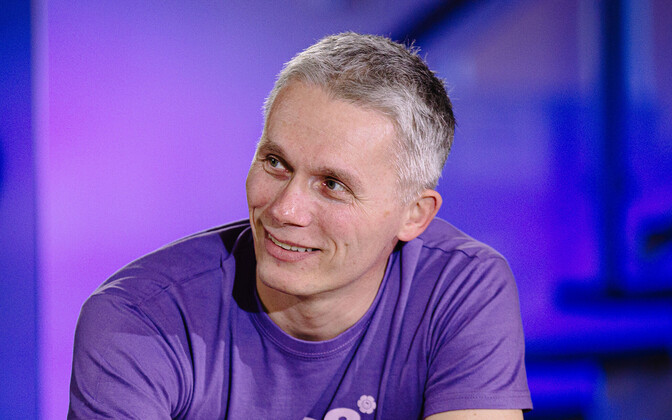 Liberal Citizen Foundation (SALK) Director Tarmo Jüristo. Source: Ken Mürk/ERR
Another factor is which party is in office and which is not. Reform and Eesti 200 are in government, and precedent has it that a governing party cannot also pick the president too. There is no constitutional bar to this happening, but since at least a two-thirds majority at the Riigikogu (68 votes) is needed to elect a president, and the coalition has 51 seats, this outcome is unlikely.
“When the prime minister’s party has the largest faction in the Riigikogu, the other parties think that a different type of candidate should be found. Our president has less power than in some other countries, but still has a clear role in the functioning of the state and democracy. The president must balance the different sides in parliament. Hence the logic that the president should be someone independent of the governing coalition,” Jüristo explained.
That said, if Reform-Eesti 200 were to reach an agreement with the Social Democrats (SDE), who were in office too until last spring, this would almost make up enough votes to pass the two-thirds majority threshold. Only a couple more votes, most likely from independent MPs, would then be needed.
In any case, “one way or another, a compromise candidate has to be found,” Jüristo added.
“Presidential elections are a bit like electing a pope – you need to find a candidate who causes the fewest contradictions. If someone is strongly opposed to a particular candidate, that is a major issue for that person,” he went on.
Foreign policy is not the Estonian president’s sole role, despite the focus put on it both recently in Karis’ presidency and, in particular, during Lennart Meri’s time in office (1992 to 2001).
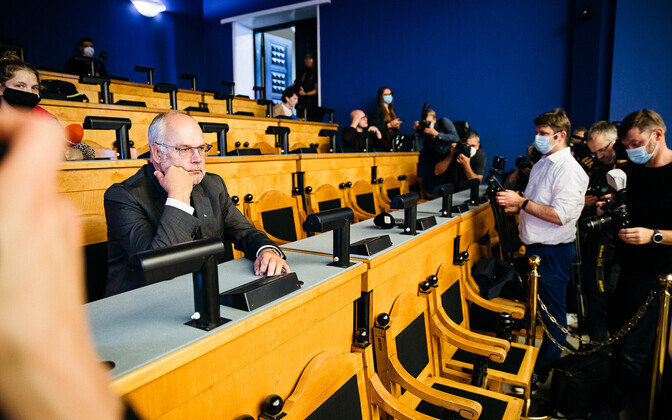 Alar Karis awaits the result of the second ballot, August 31, 2021. He was elected with 72 votes in favor at the 101-seat chamber. Source: Priit Mürk/ERR
“Lennart Meri was a classic example where that role was very prominent. But a president has different roles. In addition to foreign policy competence, there is also the safeguarding of the constitution. It is difficult to find a person who would fulfil all of these roles equally well,” Jüristo noted.
Much hinges on individual factors. How the head of state performs and gives substance to these roles, he added.
This does not mean that potential presidents should promote themselves too much. In fact, candidates who did so, particularly early on in the process, have historically not fared well in presidential elections. “Instead, those people who have a serious chance have not started campaigning early,” Jüristo said.
If voting at the Riigikogu proves inconclusive, the process moves to an electoral college, drawn from the regions and convening in Tallinn. If this too draws a blank, the process moves back to the Riigikogu, ultimately ending in a vote by the council of elders. This council is made up of the Riigikogu speaker, their two deputies, and the heads of each party faction in the Riigikogu, currently six. Kersti Kaljulaid, president 2016-2021, was elected by the council of elders.
Karis ran unopposed in the 2021 election, when there was a notable dearth of potential candidates. He received a majority of 72 in the second ballot.
Presidents are limited to two, five-year terms, consecutive or non-consecutive.
—