
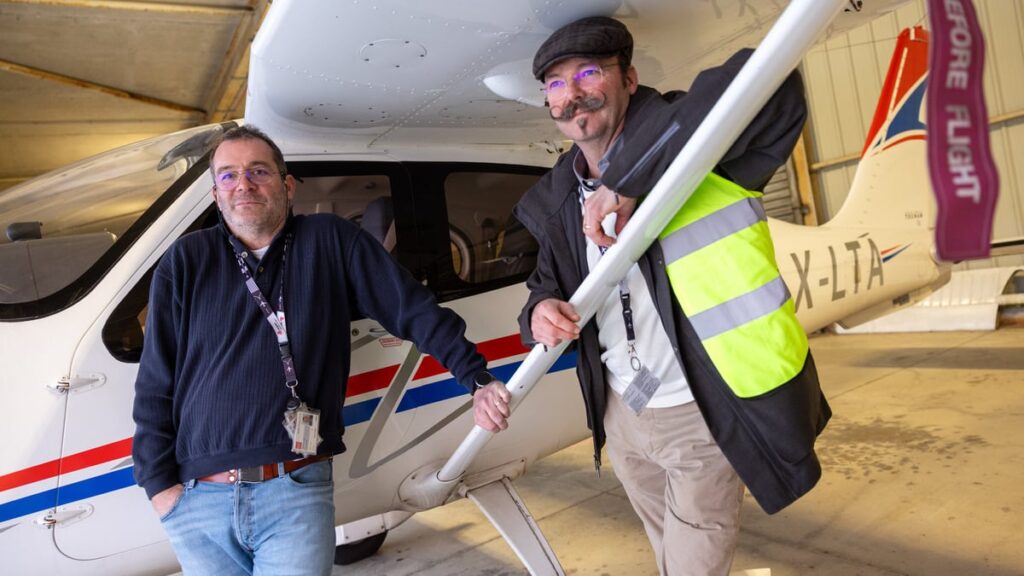
Luxembourg’s only school training a new generation of commercial airline pilots turned to the court on Wednesday to fight its shutdown by the state regulator over what leaders of the Luxembourg Flight Training Academy (LFTA) call inflated and unjustified safety claims.
The non-profit organisation, suspended for the second time in less than two years, is seeking a judicial order overturning a decision by Luxembourg’s Directorate of Civil Aviation (DAC) and restoring the career trajectory of 28 students, LFTA President Frank Mack said in an interview.
“There’s a persecution of some sort that I can’t explain. Nobody in his rightful mind would present a candidate for an exam [to qualify as a pilot] if he wouldn’t fulfil the criteria,” the full-time pilot for Luxembourg freight airline Cargolux said.
Mack and other LFTA leaders described the body responsible for ensuring aviation safety and security as inefficient and haphazard. The DAC imposed new rules and applied them retroactively to training performed months earlier and it demanded changes to training procedures, waited months to evaluate revisions, then demanded further changes, group officials said.
Luxembourg Flight Training Academy President Frank Mac (l.) and Accountablity Manager Norman König sit inside a flight simulation machine at the group’s offices on the Findel airport grounds © Photo credit: Christophe Olinger
“To pronounce a suspension, you need to base it on safety of flight, which is clearly not the issue at hand here,” Mack said of the DAC’s 10 December decision. “We’re talking errors in recordings and training files. We’re talking hours and minutes which were not recorded in the correct format or whatever. I mean, we’re down to this level of reproach.”
Also read:Luxembourg will need a new airport in long term, transport minister says
The DAC offered no reasons why it suspended the LFTA’s training efforts “until further notice”. The reasons for the LFTA suspensions in December and for about three months in 2024 were confidential, as are details of why the DAC lifted the earlier suspension, a DAC spokesperson said. The DAC did not respond when asked what factors justified secrecy over transparency.
The mobility ministry, which oversees the DAC, did not respond to LFTA complaints relayed by the Luxembourg Times. The DAC did not respond to a request to interview its director, Laura Könner, about the recent suspension decision.
“The utmost priority of the ministry and DAC is aviation safety,” the regulator’s spokesperson said.
Regulator shortcomings
The LFTA holds assets worth hundreds of thousands of euros including a dozen propeller-powered training planes and two flight simulators. The non-profit group grew out of the less-demanding pilot training that the related non-profit Aéro-Sport said it has offered for more than 75 years.
The DAC’s shortcomings, according to the LFTA, include the regulator:
-
retroactively applying new DAC rules to earlier training flights that, first, training flights should leave from Luxembourg, then after June this year, that training flights should also return to Luxembourg;
-
using public but imprecise flight-tracking websites to dispute the accuracy of LFTA flight routes and takeoff times;
-
requiring unexplained updates and changes to an operations manual which had just been approved in March 2025;
-
failing to respond to teaching manual updates submitted in early in 2025;
-
mandating updates to other training materials, then after changes were made and submitted to the DAC’s review, requesting further revisions – a process repeated at least six times.
“Everything they ask, we try to abide, we try to talk to them. But if you send something in, no answer. Or it’s like, ‘change this detail, and then it’s good.’ You change the detail, and you get another detail to change. It’s systematic,” said Olivier Majeres, the LFTA’s chief flight instructor and a pilot for a Latvian-based company that leased aircraft and crews to other airlines.
LFTA leaders admit they failed to notify the DAC that it started sharing a larger, two-engine plane with a Belgian flight school, which led to the academy’s three-month suspension in 2024.
Also read:Luxembourg’s Cargolux grabs available old jets to add to ageing fleet
The incident didn’t involve safety since the aircraft was maintained according to European Union Aviation Safety Agency guidelines, was used by other EASA-approved flight schools, and flown to and from other European airports, said Norman Koenig, the LFTA’s accountability manager, responsible for ensuring that the students and instructors are properly trained and the operations are efficiently managed.
“I think it’s very important to emphasize that it’s about documentation,” said Koenig, a Cargolux pilot for more than two decades before a medical condition ended his career. “It was simply not correctly documented. […] So, the suspension in 2024, in my opinion, was as well not really appropriate.”
Also read:Pilot satisfaction in rapid descent at Luxair
Other than the instruction that Luxair and Cargolux give their pilots on their specific aircraft types, the LFTA is the only school in Luxembourg training pilots to fly commercial airliners. A French school’s affiliate in the Grand Duchy charging roughly the same fees was declared bankrupt in September.
Rising demand
The world’s airlines are expected to create a huge demand for commercial pilots as India and the Middle East markets grow and experienced fliers reach retirement. Jet-builder Boeing estimates global demand for 660,000 new pilots by 2044.
Luxembourg Flight Training Academy training centre and offices are inside the fence surrounding the country’s Findel airport. © Photo credit: Christophe Olinger
Europe currently has a pilot surplus, with new graduates sidelined or working for very low pay as they try working off heavy educational debts, according to the European Cockpit Association, a Brussels trade association for airline pilots. That surplus is expected to reverse and Europe could face a shortage of 19,000 pilots by 2032, management consulting firm Oliver Wyman predicted in 2022.
“It is a long and expensive process and there are limited opportunities for training,” said Benny Mantin, a logistics and supply chain management professor at the University of Luxembourg.
Also read:Construction on Findel airport’s new €100m fuel farm gets underway
The LFTA has one paid instructor and three other paid staff. Its management and instruction primarily by unpaid volunteers allows them to train an aviation beginner to become qualified to pilot commercial airliners for less than €80,000, Majeres said. That’s a third less than the Lufthansa Group’s cockpit training programme and an even bigger discount compared to schools that charge €140,000.
“What we try and do is generate the next generation of Luxembourgish pilots, which – having gone through the whole exercise myself – I would have been unable to fund and to do it on my own without” the training institution that became the LFTA in 2015, Mack said.
A half-dozen pilot hopefuls training at the LFTA did not respond or declined to comment when asked via LinkedIn how the suspension would affect their plans. One student whose training progress was blocked by the LFTA’s 2024 suspension left Luxembourg for a school in Spain’s Canary Islands.
Also read:Luxair starts training the pilots it needs to keep flying
Luxembourg freight airline Cargolux and national passenger carrier Luxair employ multiple pilots trained by the LFTA, but both companies said their aircraft staffing would not be impaired by the suspension. Cargolux only recruits experienced pilots with at least 1,500 hours of commercial flight time, the company said.
“That said, we hope Luxembourg will continue to develop adequate capacities to train future pilots,” Executive Vice President of flight operations Claude Zehren said in a statement.