
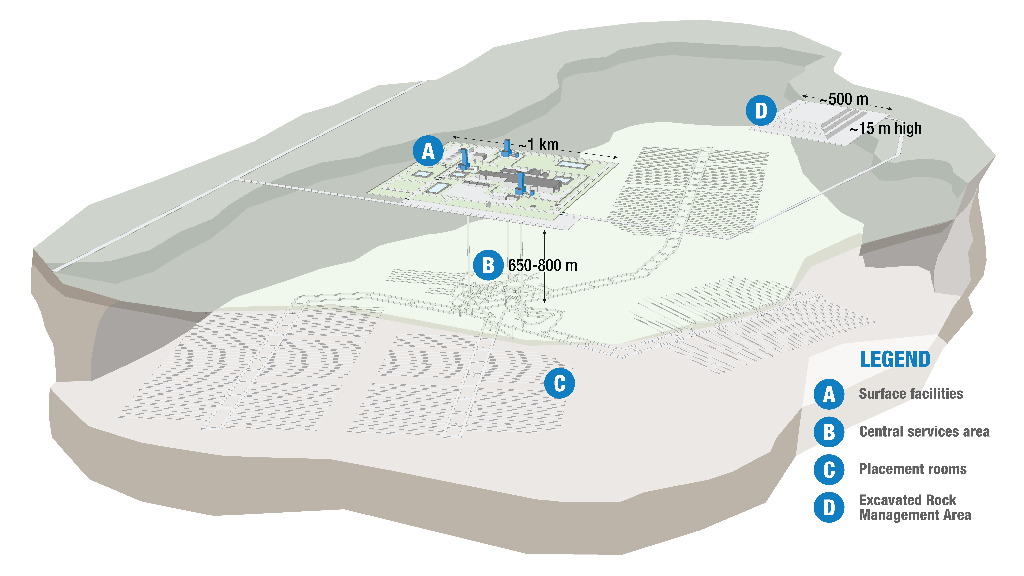
IGNACE, ONT. — The Nuclear Waste Management Organization (NWMO) has announced the “Initial Project Description” for the proposed deep geological repository for Canada’s used nuclear fuel project is now posted to the Impact Assessment Agency of Canada website.
This marks the start of the regulatory process and also signals the progression of the project from planning to independent review. Indigenous groups and the public will also have another opportunity to provide feedback on the megaproject.
The Initial Project Description details the deep geological repository’s purpose, need and expected benefits, and it explains how the project will be implemented, a release notes. It also provides a preliminary assessment of potential impacts and describes measures to avoid or mitigate them.
“For the NWMO, submitting the Initial Project Description represents more than a regulatory requirement,” commented Allan Webster, NWMO Vice-president of regulatory approvals, in a statement. “It is a shared starting point that brings together engineering, environmental, Indigenous knowledge and community perspectives to guide how the project moves forward through impact assessment, licensing, design optimization, construction and operations.”
In November 2024 Wabigoon Lake Ojibway Nation (WLON) and the Township of Ignace agreed to enter the regulatory decision-making phase as potential host communities for the repository.
In May 2025, the NWMO announced the five companies that will design and plan the repository. WSP Canada Inc., Peter Kiewit Sons ULC (Kiewit), Hatch Ltd., Thyssen Mining Construction of Canada Ltd. and Kinectrics Inc. will work on facility infrastructure design and engineering, mine design, mine construction planning, nuclear management advising, nuclear systems and facilities design.
A byproduct of generating nuclear energy is used nuclear fuel. While Canada’s used nuclear fuel is managed in interim storage at reactor and laboratory sites, it won’t be appropriate over the long-term, a release states. The deep geological repository design uses a series of engineered and natural barriers that work together to contain and isolate used nuclear fuel between 650 and 800 metres underground, the NWMO describes.
A Integrated Project Delivery model will be used for the build, with the companies and the NWMO working as one team.
In addition, throughout its life, the project will remain subject to the Impact Assessment Act, the Nuclear Fuel Waste Act, the Nuclear Safety and Control Act, and numerous other federal and provincial licensing and regulatory requirements.
The NWMO intends to place copies of the summary of the Initial Project Description at the following locations:
- Township of Ignace Municipal Office, 34 Hwy 17 W
- Ignace Public Library, 36 Hwy 17 W
- City of Dryden, 30 Van Horne Ave
- Dryden Library, 36 Van Horne Ave
- Dryden Native Friendship Centre, 74 Queen Street