
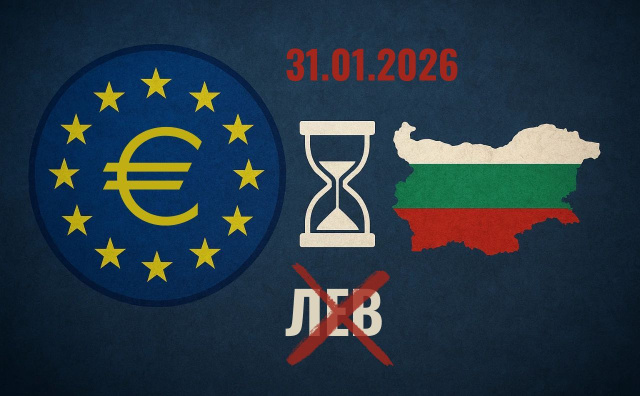
The Ministry of Finance has clarified that the one-month period of dual circulation of levs and euros in Bulgaria will not be extended and will officially conclude on January 31, 2026. The announcement comes in response to public speculation suggesting that amendments to the Law on the Introduction of the Euro in the Republic of Bulgaria (ZVERB) might prolong the transition period. The ministry firmly denied such claims, emphasizing that no meetings have been held or planned regarding any extension.
According to the ministry, the one-month period was established in the law to provide citizens with adequate time to adapt and exchange their levs while minimizing logistical challenges and additional costs for traders, who would otherwise need to maintain both currencies for longer. The period was determined following a public consultation and was reviewed and agreed upon by the Coordination Council for Bulgaria’s Preparation for Membership in the Eurozone. This council includes representatives from the Bulgarian National Bank (BNB), the Financial Supervision Commission, state institutions, consumer organizations, NGOs, academic experts, as well as the European Commission and the European Central Bank.
The ministry noted that in other countries adopting the euro, the maximum dual circulation period has generally been one month, with the most recent members, Lithuania, Latvia, Estonia, Slovakia, and Slovenia, opting for even shorter periods of two weeks. Only Malta and Cyprus chose a one-month transition.
After the dual circulation period ends, citizens can continue to exchange levs for euros at the BNB, commercial banks, and Bulgarian Post offices. The BNB will provide the service indefinitely, while banks and Bulgarian Post offices will exchange currencies without fees until mid-2026, and remain obligated to do so until the end of the year.
The Ministry of Finance urged the public to rely on official sources for information, including the dedicated euro website https://evroto.bg and the BNB website, to avoid confusion or misleading claims about the transition period.