
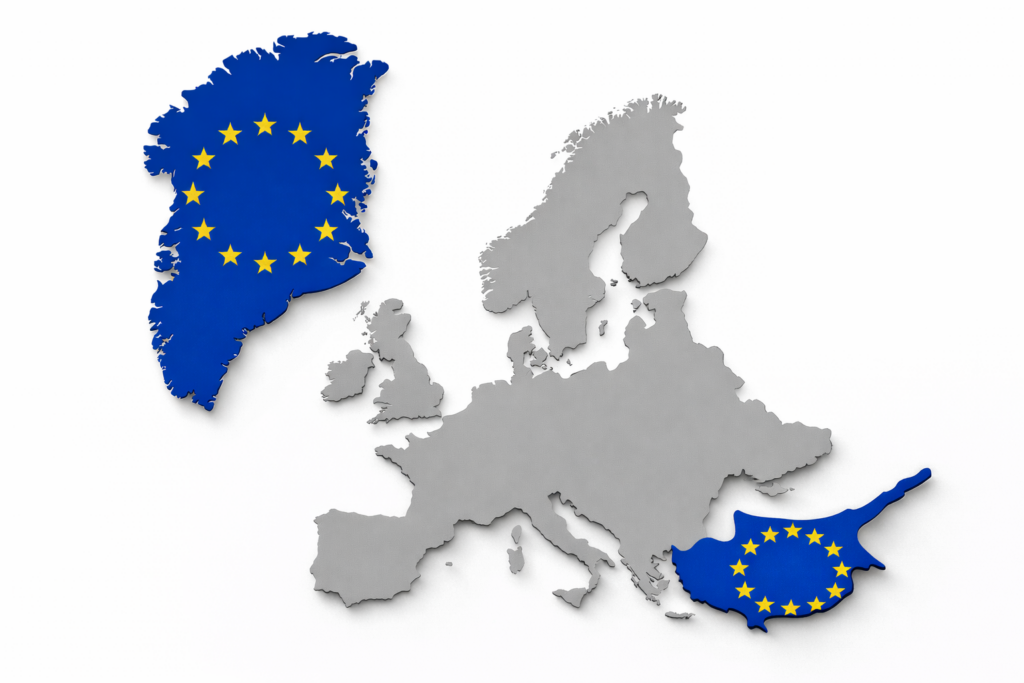
For half a century, Cyprus carried the cost of Europe’s hesitation. What was tolerated there hardened into routine, and what became routine escaped scrutiny. Today, the same logic is being tested elsewhere. From the Eastern Mediterranean to the Arctic, the question is no longer whether sovereignty is challenged, but whether Europe is willing to enforce it before erosion becomes irreversible. And in an era shaped by President Trump, where leadership is increasingly measured in transactions, alliances endure only where power chooses restraint over leverage.
Cabinet note, circulating quietly across Europe: the line is clear. Greenland belongs to Greenlanders. Borders inside NATO are not bargaining chips.
Europe has seen this before. Cyprus has lived it for five decades. A military fait accompli hardened into permanence through civilian means: infrastructure, utilities, settlement, dependency. Varosha reset facts on the ground. The European Court of Human Rights recognizes Turkey’s effective control. Europe condemned, adjusted, and moved on. Law stayed on paper. Dependence became reality.
Sovereignty eroded by accumulation, not by declaration.
What Cyprus reveals in full, Greenland now shows in outline. In the occupied north, irreversibility was built into daily life through water, electricity, data, and administration. Control embedded in routine. In Greenland, the tools differ but the logic holds: basing rights, capital, critical minerals, connectivity, narrative. Not conquest, but conversion. Not flags, but functions.
Cyprus also exposes Europe’s reflex. For years the Union managed around occupation instead of confronting it: frameworks renewed, mandates extended, assistance programmed. The result was operational complicity, an illegality stabilized by procedure. The risk for Greenland is not coercion, but repetition. When Europe defaults to management over enforcement, pressure hardens into fact before it is even named.
The distinction matters, because not every use of power is illegitimate, but not every claim of legitimacy endures.
Venezuela is a different legal file. A narrowly defined extra territorial operation against a regime functioning as a criminal enterprise, accused of narco terrorism and cross border harm, may be argued as self defense under the UN Charter, but only under strict necessity and proportionality, and only with evidence tested openly. Sovereignty is not a license to export predation. If a state is unwilling or unable to halt an imminent and continuing threat, force may be lawful to neutralize it, temporarily and without territorial claim. The moment security language shifts to control, reimbursement, or resources, legality collapses into extraction.
Liberation is not a transaction.
Wealth belongs to the people, not as payment, collateral, or prize.
Greenland has no such trigger.
There is no criminal regime, no cross border threat, and no claim of unwilling or unable. Greenland is a self governing democracy within the Danish Realm, anchored in binding constitutional arrangements that recognize the Greenlandic people’s right to self determination under international law. Its future cannot be reframed as another state’s strategic necessity. When pressure is applied here, it is not law enforcement but leverage. Security language is paired with money, investment, and inevitability. Not annexation by force, but by function.
This is the same method Europe knows from Cyprus. What Ankara built in the occupied north through infrastructure, utilities, and dependency, Washington is now testing in Greenland through basing rights, capital, strategic connectivity, and narrative. Different actors, different theaters, identical logic.
Not conquest, but conversion. Not flags, but functions.
Sovereignty is not seized; it is outcompeted, until alternatives feel risky, lonely, and implausible.
The pattern was visible long before recent statements from President Trump. Permanent diplomatic presence in Nuuk. Expanded basing arrangements. Strategic infrastructure. Capital deployed with consent and alliance comity. These were not signals but facts, built through signatures and budgets, and therefore harder to reverse. Europe responded procedurally. Washington acted. Presence and capital shaped outcomes.
Two months ago, in High North News, I set out the case that Greenland would become Europe’s next sovereignty test.
The test is now live. Not because of rhetoric, but because dependency accumulates faster than law. Polls and podiums buy time. Basing, investment, and connectivity create gravity. Soft annexation is not about flags, but about making the alternative, distance from the United States, feel risky, lonely, and expensive.
Cyprus matters in Jerusalem. Greenland matters too, behind closed doors.
Israel never outsourced sovereignty. Not as doctrine, but as survival. Alliances endure only when they do not replace the freedom to decide, deter, and act. Guarantees hold until they become conditional. Under President Trump, American power remains decisive but is framed more openly through deals, returns, and measurable advantage. That shifts the ground beneath allies. This is no longer a theoretical debate, but a strategic reality. Europe is rediscovering what Israel learned long ago: autonomy is not separation from allies; it is what keeps alliances credible when interests are priced. Delay has a cost. Sovereignty left unused does not wait patiently, even among friends.
Europe must now act on its own law. The guarantee over Cyprus has shifted: Turkey violated it, Britain walked away, and responsibility now rests with Europe. Cyprus is EU territory under occupation, and that occupation must end. The same clarity is required in the North. Greenland, though outside the Union since 1985, is European in law, people, and consequence, and it is not for sale. A Union that tolerates broken guarantees in Cyprus and ambiguity in Greenland declares sovereignty negotiable.
Power delayed is power denied.
Shay Gal is a senior strategic advisor and analyst specializing in international security, defense policy, geopolitical crisis management, and strategic communications. He served as Vice President of External Relations at Israel Aerospace Industries (IAI), and previously held senior advisory roles for Israeli government ministers, focusing on crisis management, policy formulation, and strategic influence. Shay consults governments, senior military leaders, and global institutions on navigating complex geopolitical landscapes, shaping effective defense strategies, and fostering international strategic cooperation. His writing and analysis address international power dynamics, security challenges, economics, and leadership, offering practical insights and solutions to today’s global issues.