
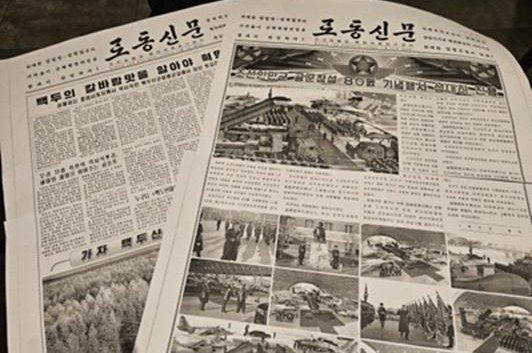
A copy of North Korea’s Rodong Sinmun is seen in the North Korean materials room at the National Library of Korea in Seoul. Photo by Asia Today
Jan. 7 (Asia Today) — South Koreans have been able to view North Korea’s official newspaper, Rodong Sinmun, at designated public locations without special procedures since Dec. 30, a move researchers have welcomed while some scholars urge guidelines for younger readers.
The paper is available at 181 sites including the Ministry of Unification’s North Korea Information Center, the National Library of Korea and university libraries, the report said. Visitors can read the physical copies on site, though photography is restricted.
A reporter who visited the National Library of Korea in Seoul on Tuesday said staff directed him to a North Korea materials room where issues of Rodong Sinmun were organized by date and could be turned page by page. Other North Korean publications, including The Pyongyang Times and Minju Joson, were shelved nearby, the report said.
The story described the newspaper’s content as broadly covering politics, society and the economy but centered on leader Kim Jong Un’s activities and the Workers’ Party’s policy line, with little of the incident, accident or critical reporting common in South Korean newspapers.
The report said the front page typically begins with messages from Kim and party resolutions supporting them, then frames subsequent coverage around people “responding” to those directives. It cited repeated honorific phrases praising the party and leader, and noted that the paper often uses laudatory modifiers and verbs such as “proclaimed” instead of neutral attributions like “said.”
The newspaper also gives heavy space to photographs, with some pages filled with multiple images, the report said. Even when figures are presented, the story said they are commonly followed by evaluative language crediting party policy or leadership rather than sourcing data.
A 26-year-old reader at the library told the reporter the phrasing becomes predictable after a few headlines and sentences, adding that the writing style stands out more than the details.
Kim Seok-hyang, an emeritus professor of North Korean studies at Ewha Womans University, said the paper functions as the Workers’ Party’s official organ and is aimed less at informing than at repeatedly emphasizing party direction. She called the opening for research purposes positive but said social discussion and guidelines are needed if children and adolescents encounter it, citing a risk of misunderstanding and prejudice if the paper is read without context.
Kim Yong-hyun, an emeritus professor at Dongguk University, said opening the paper is unlikely to lead to more public admiration for North Korean ideology and that excessive concern is unnecessary, describing the publication as a direct reflection of the North Korean regime’s mindset.
— Reported by Asia Today; translated by UPI
© Asia Today. Unauthorized reproduction or redistribution prohibited.