

I’m not sure if it’s just because I’ve reached that age, but over the past few years I’ve noticed a growing trend of Americans drafting to the IDF after graduating college, many of them having completed college in the United States. In Israel, the standard draft path begins after high school, with most Israelis drafting around eighteen or nineteen, depending on whether they do a preparatory program beforehand. Especially for an Oleh Chadash, drafting at twenty-three or older is outside the typical army path.
I recently visited one of my childhood friends, Ethan, on his draft day, in the same place where I found myself almost four years earlier. For me, being there again carried a sense of nostalgia, and the realization that I could no longer fathom drafting from scratch. It is the same feeling many people experience after completing college, when careers, families, and life goals are already taking shape, and the idea of returning for full service can feel like putting life on hold.
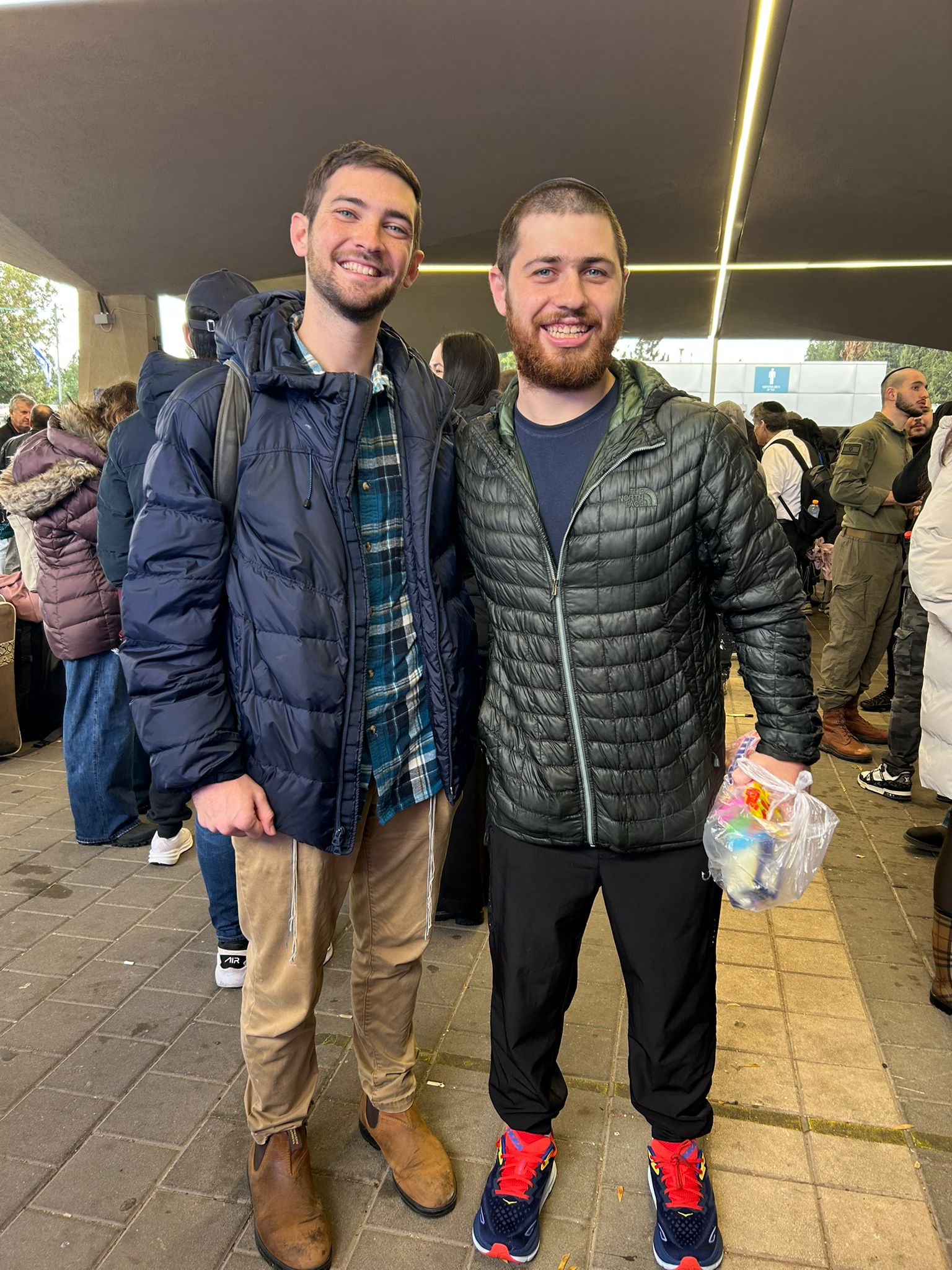
Photo Courtesy of Author
But when I asked Ethan whether he felt he was pushing off “starting life” in order to draft, he said. “I reject the premise of the question.” Despite already having a degree and being ready to “start his life,” he told me that he didn’t see this as pausing anything at all. In his eyes, this was the opposite of a pause. It was an experience that was key to moving to, adjusting to, and building a life in Israel. He saw it as something that would advance his life in many ways more than any job, degree, or experience, even in Israel, could do for him.
Don’t get me wrong, I think making the decision to move to Israel at any stage of life is commendable and deeply purposeful, no matter what stage of life you’re in and what your personal journey looks like. The challenges that come along and individual priorities make every person’s trajectory unique and special. Just the ability to make it here should not be taken for granted. There is no single path that defines what a “real” Israeli life must look like. Not everyone who makes Aliyah has the ability to serve in the army, and many live rich, connected, and meaningful lives here without it.
That said, there is a tremendous advantage in actively prioritizing integration and attempting to break in and adjust culturally. It opens you up to so many more opportunities and experiences, lets you meet so many interesting people, and gives you the ability to understand your home and the people around you from the inside. Another friend of mine who recently drafted after college, Eidan H., explained it simply. “I knew I wanted to live in Israel, but I was kind of nervous, even scared, to just jump in with a rudimentary handle on the language, no support system, and no cultural ties. I knew the army would give me the softest landing possible and provide me with all of those things and more.”
I have always believed that the most ideal time to make Aliyah is right after high school, when there is little standing in the way. But it is certainly not too late a few years later, and drafting or national service can be one of the most effective and meaningful ways to break in. While integration may be harder when one has a family to focus on, it should at least remain a priority, especially for young kids growing up. It does not require becoming the stereotypes like wearing sandals year-round or calling everyone “achi,” but a genuine and intentional willingness to live comfortably among the people around you, in your own way and at your own pace.

Photo Courtesy of Author
From my experience, things that may seem menial are the ones that have deep effects. Being able to function in a Hebrew-speaking environment, helping someone on the street with confidence, or even figuring out how to buy a car are all small milestones that show a bigger picture when put together. When I bought my car, the man selling it to me told me his family’s story of escaping from Iran, a regular guy I had just met, yet someone I was immediately able to connect with and exchange life stories with. And then there are the subtler adjustments, like realizing that Israelis are not angry at you, they’re just speaking from a passionate place in a loud voice. It is a kind of authentic connection that only becomes possible once you are comfortable enough to meet and understand Israelis where they are, in their language and in their everyday lives. None of these moments are particularly groundbreaking, but they are the everyday experiences that turn your new country into your home.
The events of October 7th were one of the biggest tragedies of our nation in our lifetime. But a positive outcome was those first months of the war, when the connection between Jews around the world to those in Israel was deepened. If there is something redeeming to be taken from that period, it’s the reminder of that inner, natural pull we felt to all be united. and this opens you to the parts of the nation you didn’t yet know you were missing. I believe that taking that extra step and genuinely striving to be part of the whole nation, adds far greater meaning to the purpose of Aliyah.
I chose to highlight those who drafted later as an example of not just taking on a “harder path,” but choosing one of the clearest, most demanding, and most formative paths to integration available. It demonstrates its importance, even though it sits outside both the conventional Israeli and American trajectories. “Many have careers, wives, and families, but I think that if I didn’t serve now, I would end up regretting it for the rest of my life. Pushing off starting a family was definitely a hard decision, but taking a year and a half with some frigid weeks in the field and blistered feet from a few kilometers of trekking is worth not having a lifetime of regret.” Eidan told me.
For anyone in the process of making Aliyah, or even considering it, Aliyah, in its best form, is experienced when you embrace everything it brings, and the entire mission behind it. With this mindset, the journey becomes empowering rather than scary or stressful, and a step forward rather than a pause in “real life.” With this mindset, the journey becomes empowering instead of scary and stressful, and a step forward instead of a pause in “real life.” “Plus,” Eidan added, “defending Am Yisrael is a nice bonus.”
Brian Racer grew up in Teaneck, New Jersey and made Aliyah in 2020. After learning in Yeshivat Lev Hatorah for a year and a half he drafted to the IDF as a Lone Soldier, serving as a sharpshooter in the Nachal Brigade and subsequently returning to be a Madrich at his Yeshiva. He is currently pursuing a major in Communications and Political Science at Bar Ilan Univeristy while simultaneously learning in their Kollel. He is married to his amazing wife Meira and currently lives in Givat Shmuel.