
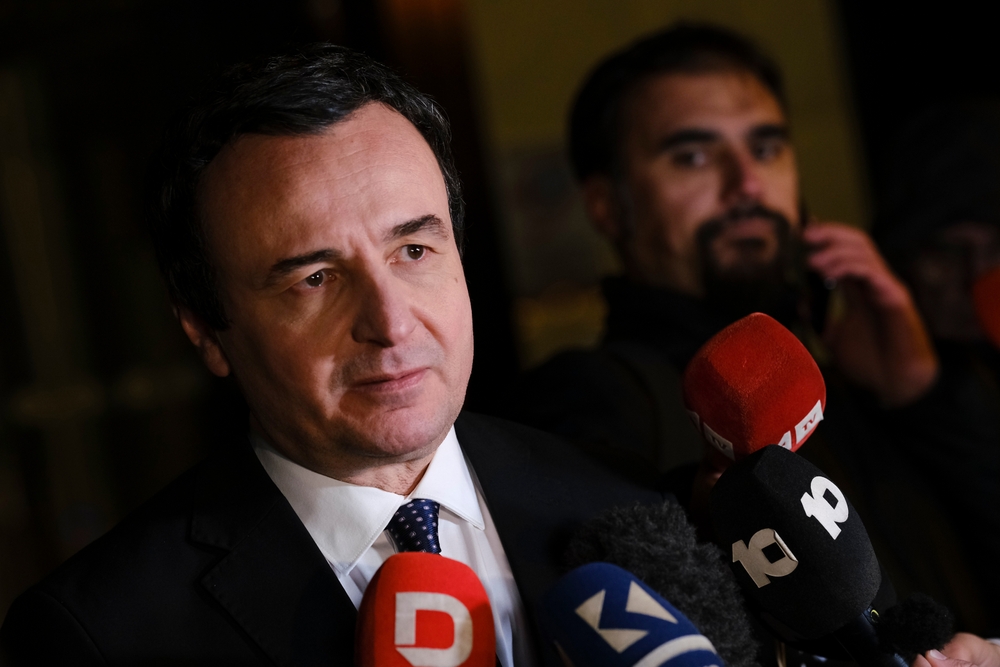
The snap parliamentary elections in Kosovo ended with a convincing victory for Vetëvendosje (Self-Determination Movement – LVV).
The party of the acting prime minister, Albin Kurti, won 51.01% in the December 28 vote, or over 485,000 votes. According to preliminary data from the Central Election Commission (CEC), which is in the final phase of vote counting, Kurti became the most-voted candidate in these elections with over 400,000 votes.
This represents a significant increase compared to the regular parliamentary elections of February 9, 2025, when LVV had received 42.30%. With this result, LVV has also surpassed its 2021 result, when it won 50.2%.
The Democratic Party of Kosovo (PDK) ranks second with 20.24%, managing to maintain its vote level compared to the February elections. Meanwhile, the Democratic League of Kosovo (LDK) suffered the largest decline, winning only 13.26%, down from 18.27% in the February elections. In this way, the party led by Lumir Abdixhiku lost over 45,000 votes.
The Alliance for the Future of Kosovo (AAK), on the other hand, managed to maintain its support, winning 5.5% of the vote.
According to these results, LVV is expected to have 57 MPs in the tenth legislature, followed by PDK with 22 seats, LDK with 15 seats, and AAK with 6.
This convincing victory paves the way for the Self-Determination Movement to constitute the arliament and form the new government, processes that were not achieved for nine months during 2025, due to the failure to secure a simple parliamentary majority of at least 61 MPs.
How is LVV’s growth explained?
Political analyst Shemsi Jashari did not expect such an electoral result. He offers this assessment while citing the outcome of the February 2025 elections, LVV’s responsibility for the political blockade, and public accusations of corruption against government officials.
According to Jashari, several factors have overturned the voting logic for political parties.
“The main ones include the use of the state budget in the distribution of various subsidies, mainly social ones for children, women, and pensioners. This influenced a large number of citizens who benefited financially shortly before the elections to decide to support LVV. Another factor is the large-scale arrival of the diaspora, which has not faced the actual governance, has not experienced the lack of progress at the country level, but has been a spectator from abroad,” Jashari told OBCT, adding that the opposition failed to demonstrate the real socio-economic situation in Kosovo.
Another political analyst, Egzon Osmanaj, also considers the result surprising. The biggest surprise, according to him, was the movement of voters from opposition parties toward the party in power.
“What happened here is that in the February 2025 elections we had a shift of votes from the ruling party to opposition parties; nine months later, the opposite occurred. This is surprising because for nine months the blockade was attributed to the winning party (LVV), as it bore the main burden of creating a parliamentary majority, forming the government, and unblocking the situation—but we did not see such progress,” Osmanaj told OBCT.
A reason that, according to Osmanaj, influenced the retention of votes by LVV was also the noticeable softening of Albin Kurti’s rhetoric during the December campaign toward rival parties.
What is expected next?
Once the new government is formed, analyst Jashari says it should urgently focus on boosting the economy affected by inflation and improving citizens’ welfare. At the same time, he calls for attention to foreign policy as well.
“The government should focus first on improving Kosovo’s image vis-à-vis its allies, rebuilding the broken bridges of cooperation with our traditional allies, returning to strategic dialogue with the United States of America, and—certainly in coordination with our allies—considering how to approach the dialogue with Serbia, an issue that has become an obstacle to Kosovo’s membership in international organizations,” Jashari assesses.
Meanwhile, analyst Osmanaj views the coming years as decisive for Kosovo, given unprecedented developments in the global order and the fluctuation of traditional alliances.
Consequently, he sees it as essential for the Government’s engagement to occur on two levels.
“Kosovo must be careful in preserving relations with its allies, especially the United States of America, the United Kingdom in Europe, and Turkey in the East—these are the three main partners in the field of security. This is the first point Kosovo should focus on, because the approaches and positions of these allies are changing every day, especially those of the U.S. Second, domestically, it should focus on creating political stability within the country to avoid institutional crises,” Osmanaj further assesses, emphasizing as a positive element Albin Kurti’s softened approach toward opposition parties.
Osmanaj says that to avoid other potential crises, other parties also need to show constructiveness. This is because immediately after the constitution of the Assembly and the formation of the Government, the country faces the election of the president, a process that requires a two-thirds majority.
The current president, Vjosa Osmani, sees her mandate expire in April this year, while she is seeking another term as head of state. So far, political parties have not made their positions public regarding the bid for a second term.
If they fail to reach a compromise on the issue of the new president, Kosovo will face a new electoral cycle.