
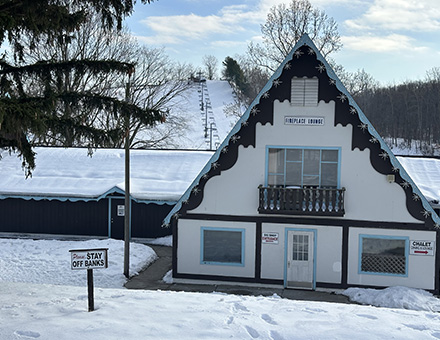
On the cusp of turning 65, the Wiseman family’s Swiss Valley has done more than persevere, it’s found a Perfect future. This is part 1 of Andy Bigford’s Revival Road Trip.
Knowing what you don’t know is critical to any successful endeavor. It can also help save the life of an endangered ski area in this weather-challenged corner of southwestern Michigan.
Jamie Stafne (nee Wiseman), along with her sisters Missy and Susan, was born to a first-generation small ski area operator, the larger-than-life owner of tiny Swiss Valley, a 225-foot hill located halfway between Chicago and Detroit in the far bottom left of the mitten, just above Indiana. Never coddled or spoiled, they grew up in a home located steps from the lodge, wearing ski boots instead of shoes. Jamie became the marketing director and the daughters all contributed to the frontside of the business, which includes 200 winter employees this season. Swiss’ signature black diamond run is named “Three Sisters.”
But, when it came to on-hill operations without their father—like checking the ball bearings on a chairlift, increasing pump capacity, or expanding water storage—Jamie and her sisters needed advice. One crisis came when both the year-round maintenance and lift managers resigned at the same time, but the Wisemans kept pushing forward. “Fear can be an extreme motivator,” Jamie says.
Through the turmoil of dealing with a struggling, needy ski area along with some of life’s heaviest challenges, Jamie usually had a quick answer to the thorniest question of all, the oft-shaky future of Swiss Valley:
“We are going to keep this going as a ski area, and we are going to figure out what to do.”
Perfect Union
The “figuring out” finally came to fruition last summer after Jamie had spent years courting her neighbor to the south, Chip Perfect—the 2025 recipient of the NSAA Lifetime Achievement Award and owner of Perfect North Slopes, Ind. Chip and his team from Perfect North’s well-oiled operation agreed to buy Swiss Valley and come work their magic.
It helped that Swiss had strong seasons when the fickle weather cooperated, attracting impressive skier visits during the pandemic and delivering a strong EBITDA. The purchase price was undisclosed, but it was a pretty good payday for 57 years of blood, sweat and tears. The sale was announced in March 2025, and one can presume the Perfect family will eventually invest more in capital improvements than it paid for the resort.
And those improvements began almost immediately. Working against the clock, Swiss was able to double its snowmaking pump capacity, bring in a fleet of SMI fan guns, install Axess RFID gates, dramatically expand and modernize the rental fleet, and even do renovations to the lodges and Swiss’s tiny village. It also installed two conveyor lifts to replace rope tows at the critical beginner area, where hundreds of thousands of Michiana newbies have been introduced to the sensation of sliding on snow for the past six-plus decades.
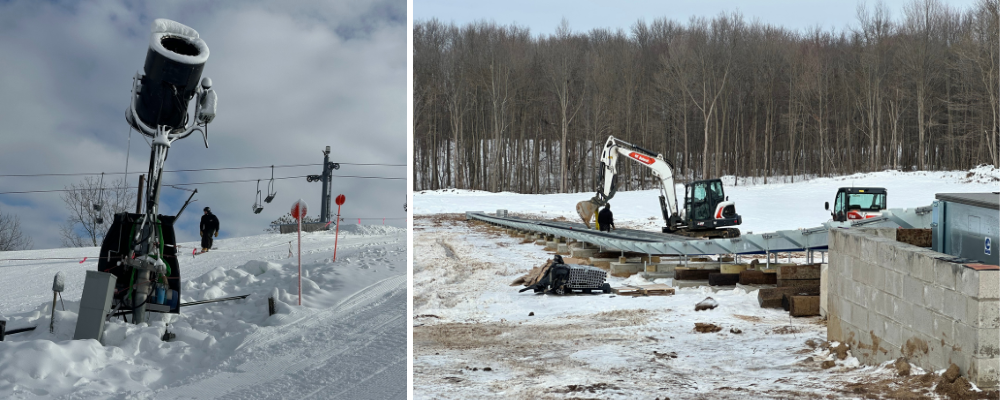 Left to right: SMI fan guns; New magic carpet installation.
When Swiss opened to the public on Dec. 11, 2025, almost a month earlier than during the weather-shortened winter of 2023-24 (a season of just 49 days), it did so with plentiful natural snow and a forecast calling for zero-degree windchills over the weekend. The 60-acre area was essentially 100 percent open, its three chairlifts spinning, its terrain parks buffed, and all the trails covered with a healthy three- to four-foot snowmaking base.
It wasn’t until that night when Jamie, who Chip has asked to stay on “indefinitely” as GM, knew this was absolutely the right move. Why? Cold temps and wind had already hardened the surface for night skiing, and you could hear the grinding sounds of skis and boards…and maybe a little grumbling from guests. Perfect North snowmaking and mountain project guru Daniel Lewis “Boonie” Neff had made the trip to Swiss Valley to help consult (as he did when Perfect bought Timberline, W.Va., in 2019, using his veteran staff to lead the resort thorough a renovation and resuscitation). Boonie saw a customer need at Swiss and had a quick solution: “We need to turn the guns on.”
With that, he brought smiles back to the skiers and riders—and incurred an expense that “Big Jim” would never have entertained.
That won’t happen every night, of course, but it was an example of positive change.
An Original Entrepreneur
Jim Wiseman, aka “JW” or “Big Jim,” was the archetype of a small owner-operator when he took over Swiss in 1968, after it had begun its journey as Little Switzerland in 1961. A former high school principal turned Harley-riding snow farmer, jack of all trades, and doer of deals, he bought numerous land parcels in surrounding Cass County for his Wiseman Oil Company. His prized “Boneyard,” a glorified trash heap where he dumped his worn-out equipment, was valued at a small fortune for its scrap metal alone.
At 6 feet 3 inches tall and 225 lbs., “He was very large and in charge,” as Jamie puts it. He had very little ski experience (few did), but he knew what the customer wanted and how to deliver it—especially when the incoming cash well exceeded the money going out. “I don’t own Swiss,” Big Jim would frequently say, “it owns me.” Another Big Jim-ism: “Desire will create the ability.”
Swiss was perfectly positioned for the ski boom that ensued—it operated a plastic summer ski deck in the 1970s and once had toboggan runs—but keeping this capital-intensive business going in the later years, through the erosion of local industry, climate change, and escalating costs, was exceedingly problematic. Most challenging was the onset of Jim’s dementia, which led Jamie and her sisters to slowly but surely assume control of the area from 2017 onward (JW passed away in December 2021).
This was not easy, and indeed it’s every son and/or daughter’s nightmare. Arguments and ultimatums ensued, but the daughters always got through it. Also assisting was Jim’s life partner of 30 years, Linda Benthin, who along with the daughters would become a co-owner.
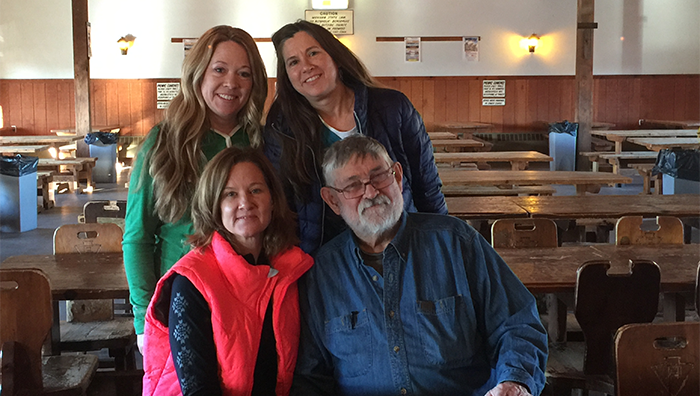 Jim Wiseman with his daughters, Jamie, Missy, and Susan.
Coming Out from the Cold
Swiss had already done a lot of heavy lifting. The far-flung rope tows had been replaced by three chairlifts (two quads and a triple, all Halls) as the ski area underwent the common Midwest growth plan of expansion by going up, not out. Decades ago, JW had moved 1.5 million cubic yards of soil to create much more vertical and two larger peaks among the many hillocks.
The first advice to Jamie and her sisters upon taking control of the ski area was to bring the business above board. The taxman wasn’t savvy to most of the formative goings-on in the ski business, when cash was king. Big Jim’s daughters made Swiss legit, and they also poured every loose dollar back into maintenance (deferred for many years) and growth capital, whenever they could. Snowmaking investments and major lift maintenance ensued, as did the opening of its first new trail in 40 years, an advanced glade run called “Weezy’s Way.”
Most important was that their Midwest ski industry colleagues had become “obsessed” with ensuring that Swiss stay alive, according to Jamie. They would do anything to help the cause, including Larry Wollum, who had designed and installed the original Hall chairs and now offered advice. Nubs Nob’s Jim Bartlett and Tim Meyer of Caberfae consistently lent their considerable expertise. Even the nearby “archrival” ski areas, Bittersweet and Timber Ridge, chipped in.
“They kept taking my calls,” laughs Jamie, even when she was asking, “What kind of oil should I buy?”
A Torrent of Support
Probably the most obsessed, and undoubtedly the most helpful, was lifetime loyalist and Swiss supporter Joe Cousins, who became the resort’s unofficial adviser. When the girls and Linda had to forego their own personal spending to plow more money back into the ski area, Joe kept repeating, “You’ll more than get it back.”
Cousins was right, as he usually is; he knows more about the (sometimes seedy) underbelly of the U.S. ski business than virtually anyone in the country. He had started working in the resort business in 1974 and began selling snowmaking pumps out of Denver in 1986. One of his first customers was golfer-turned-ski-entrepreneur Tim Boyd, who was building up Hidden Valley in Missouri (among others) and would eventually sell his 17-area, publicly traded Peak Resorts empire to Vail Resorts for $264 million in 2019.
Cousins founded Torrent Engineering and Equipment 25 years ago, and it was headquartered an hour’s drive south of Swiss in Warsaw, Ind. Torrent went on to provide the sophisticated know-how and hardware to power snowmaking at virtually every resort in North America, from Stowe to Sun Valley. (Now semi-retired, Cousins sold Torrent to SMI, which is headquartered in nearby Midland, Mich.)
His on-site knowledge and expertise were invaluable to the Wiseman daughters. But in the end, it was Jamie’s copious note-taking that pushed the deal forward.
The Close
Chip Perfect had given her a polite but firm “NO” when she pressed him as a suitor, but he’d also kept the door slightly ajar, allowing that he would “never say never.” In the summer of 2024, at the Midwest Ski Areas Association annual conference at Treetops in Gaylord, Mich., Jamie outlined her case in detail to Perfect North general manager and Chip’s trusted advisor, Jonathan Davis.
Jamie didn’t know it, but an intrigued Davis had followed her all the way to Swiss on his trip south back to Lawrenceburg. He surveyed the gleaming lifts, the impressive state of the infrastructure and facilities, the opportunity for an expanded season, for more terrain and lifts, for tubing, for summer operations. He called Chip from his car. “There’s not a weed in the parking lot. I think we can manage this.”
That’s when the bargaining began, with Chip’s questions focusing on water and power. With Joe’s help, Jamie had resolved the water storage issue, and now she attacked the growing utility challenge. The ski area had suffered several brownouts, so she arranged a meeting with Midwest Energy and Communications (including NDAs over any potential sale). She showed them exactly what Perfect North was doing and what she planned to do as well. The power company bought in, and an MEC engineer showed up on-site the next week to begin the upgrade.
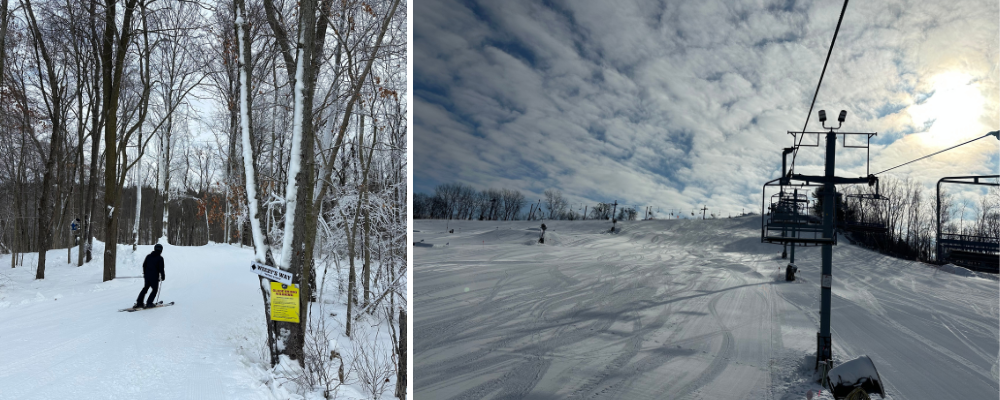 Left to right: Newly gladed trail, Weezy’s Way; Chair 3 with views of the adjacent terrain park.
The Future
Jamie then went to her meticulously organized files, pulling up four pages of detailed notes from a long-ago 2006 MSAA conference at Crystal Mountain in Michigan. The seminar, led by two industry icons, covered EBITDAs, valuation multiples, sales strategies and this advice: “The buyer wants to realize the upside, not the seller.” The ski area had averaged just over 60 operating days a season in the winter climate erosion of the last decade, even suffering through closures of one- to two-weeks for each of the past four winters. The upside was a one-third extension of the ski season—and the ringing of cash registers.
The MSAA seminar was entitled “Exit Plans,” and the presenter was Chip Perfect (along with Tim Boyd).
“We chose Perfect North because they are a family, they had a similar beginning, they know how to make it snow in southern Indiana, and their management team is awesome,” Jamie says. “The impact they had on our industry was undeniable. They treated their employees well and would do the same for ours.
“We wanted what they had. We knew they would not fail. They would honor the legacy.”
The former editor-in-chief of SKI magazine, Andy Bigford grew up skiing at Swiss Valley, Mich. He is offering monthly reports from the road as he works on the third installment in the Ski Inc. book series. Chronicling big and small resorts for 40-plus years, Bigford has edited or written six books, including collaborating on Chris Diamond’s Ski Inc. books. Next stops on the Revival Roadtrip: Sundance, Utah; Wild Rose, Wis.; and Black Mountain, N.H.