

Gas transit tariffs across Central and Eastern Europe have diverged sharply for 2026. Following the total cessation of Russian gas transit through Ukraine last year, newly implemented gas transmission tariffs for 2026 reveal a massive financial burden for some CEE countries.
While some Western European markets benefit from stable LNG supplies and steady pipeline connectivity, landlocked CEE nations are grappling with the high costs of under-utilized infrastructure, according to Kpler. In Austria, the regulator E-Control has sanctioned average transmission tariff increases of approximately 79 per cent for the 2026 calendar year. Similarly, Slovakia’s TSO, Eustream, has increased tariffs by roughly 15 per cent. This increase have pushed Slovakian transit costs to approximately one euro per megawatt-hour, nearly double the rates seen in parts of Western Europe. The market intelligence firm also noted that expensive gas imports through the Austrian and Slovakian corridors were driving Ukraine to seek cheaper alternatives. The ‘northern route’ via Poland or Lithuania has emerged as a more cost-effective gateway for regional supply.
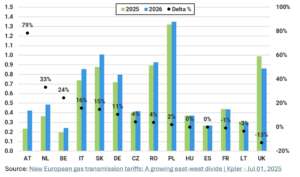
The graphic shows 2026 gas transmission tariffs. Bars represent the arithmetic average of all entry & exit points in every country. (Source: Kpler Insight via LinkedIn/Szabolcs I. Ferencz)
It is important to note that Slovakia’s gas transmission network was historically built to funnel Russian gas to Western markets, and it is now severely under-utilized following the halt of Ukrainian transit. Although the country still imports Russian gas, the shift to southern deliveries via Hungary has left the vast grid more expensive to maintain.
While most EU countries have largely decoupled from Moscow, Hungary remained a significant outlier. Amidst this regional volatility, Hungary has leveraged its unique position. By maintaining pipeline access to Russian gas via the TurkStream route, Hungary’s TSO, FGSZ, has bucked the trend of under-utilization. Preliminary data for 2025 shows that Hungary’s total commercial gas deliveries surged 17 per cent to 17.15 billion cubic metres (bcm), according to Ferencz I. Szabolcs FGSZ CEO. Hungarian local consumption also saw a 4.7 per cent growth, with totaling around 8.8 bcm for the year.