
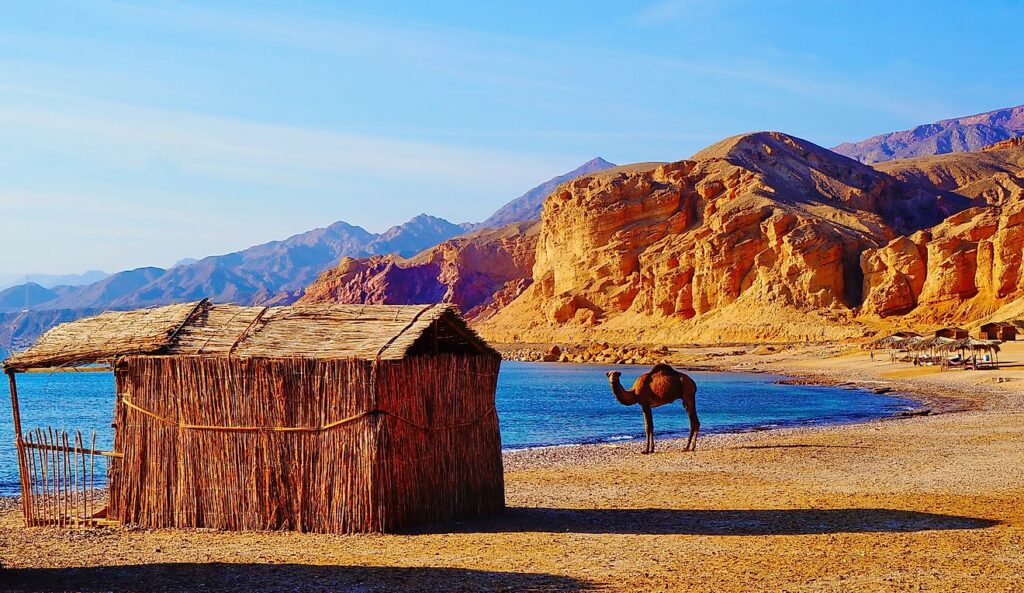
The Sinai Peninsula is a land bridge that connects the Middle Eastern part of Asia with North Africa. When people think about the Sinai, the first thing that often comes to mind is the Biblical story of Exodus, when the ancient Israelites, who had just been freed from bondage in Egypt, journey to Mt. Sinai, where Moses receives the Ten Commandments from God.
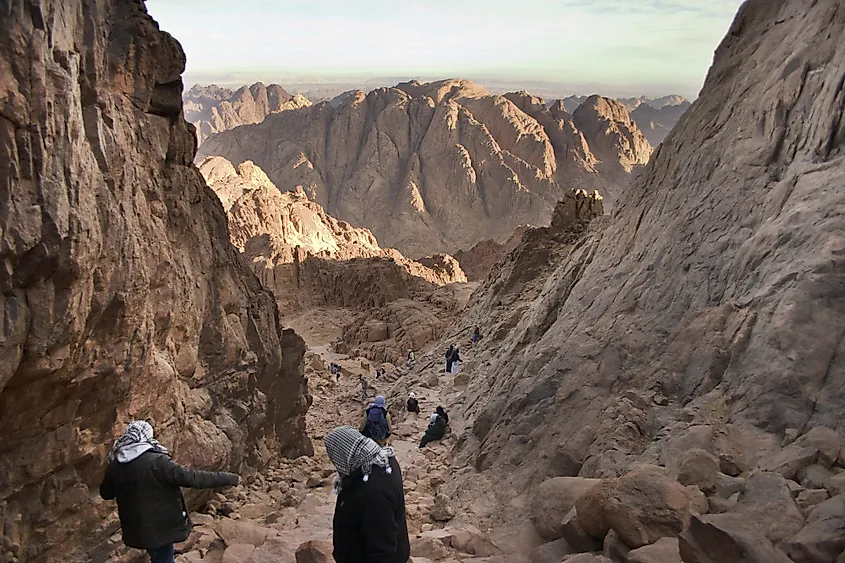 Climbing Mount Sinai, Egypt.
But there is a lot more to the Sinai Peninsula than just a Bible story. Over the centuries, the Sinai has figured prominently in the history of the Middle East. Today, the peninsula is a popular tourist site, though unfortunately, it is also popular with people who have criminal intentions.
Contents:
Geography
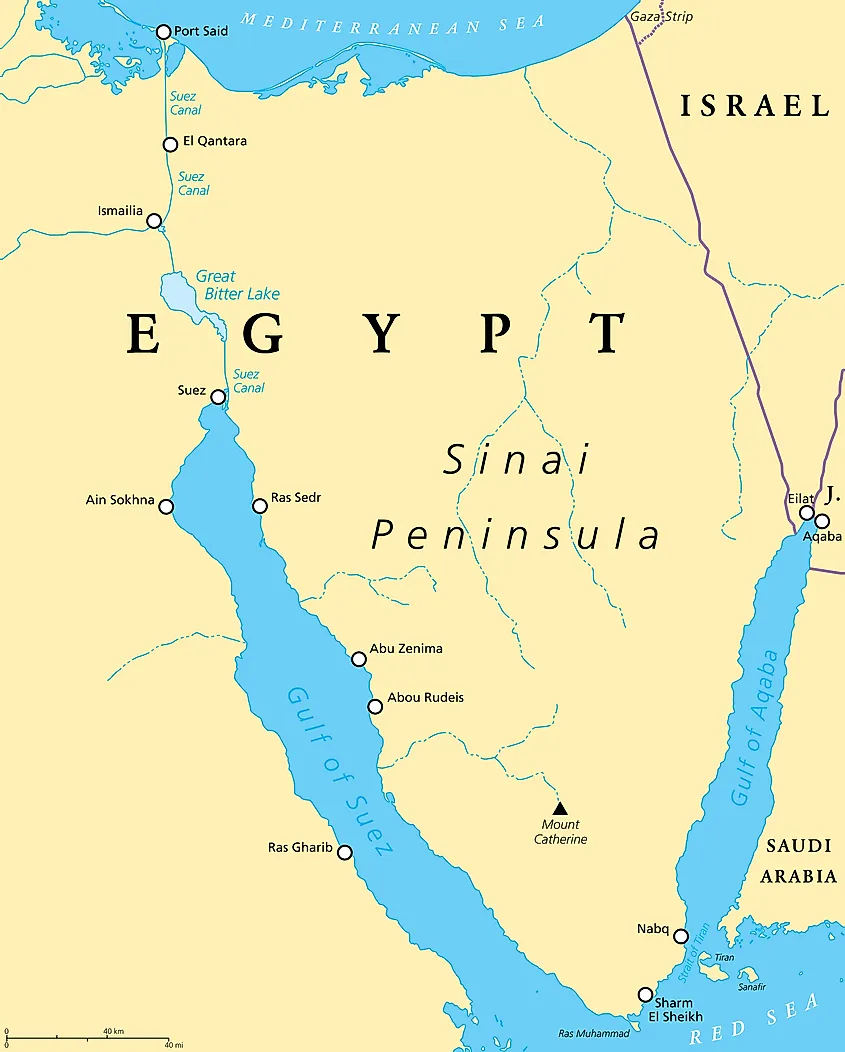 Map showing the location of the Sinai Peninsula in Egypt.
The Sinai Peninsula, part of Egypt, is triangular in shape and, as previously mentioned, serves as a land bridge between the Middle Eastern portion of Asia and North Africa. The peninsula is bordered to the north by the Mediterranean Sea and to the east by Israel and the Gaza Strip. To the west of the Sinai Peninsula is the Suez Canal, across which lies the African part of Egypt. The Sinai is bordered to the southwest by the Gulf of Suez and to the south by the Red Sea. The Gulf of Aqaba borders the Sinai in the southeast. The total land area of the Sinai is approximately 60,000 sq. km.
 Dahab, Sinai Peninsula, Egypt, Mountains and Coast of Red Sea
The Sinai Peninsula can be divided into three main geographic regions. The northern area features sand dunes, fossil beaches, and dried river beds called wadis. The terrain here is mostly flat and uniform, although sand and limestone hills are present in the Gebel Maghara (Mt. Maghara) region. The central part is dominated by the el-Tih Plateau, which consists of limestone highlands extending southward until they reach the third region. This southern region mainly contains granite and volcanic rocks, with granite and basalt escarpments descending into the Red Sea and Gulf of Aqaba. Notably, the eastern boundary of Sinai runs along a geological fault zone known as the Great Rift Valley, which runs from the upper Jordan River through the Red Sea into Africa.
Flora And Fauna
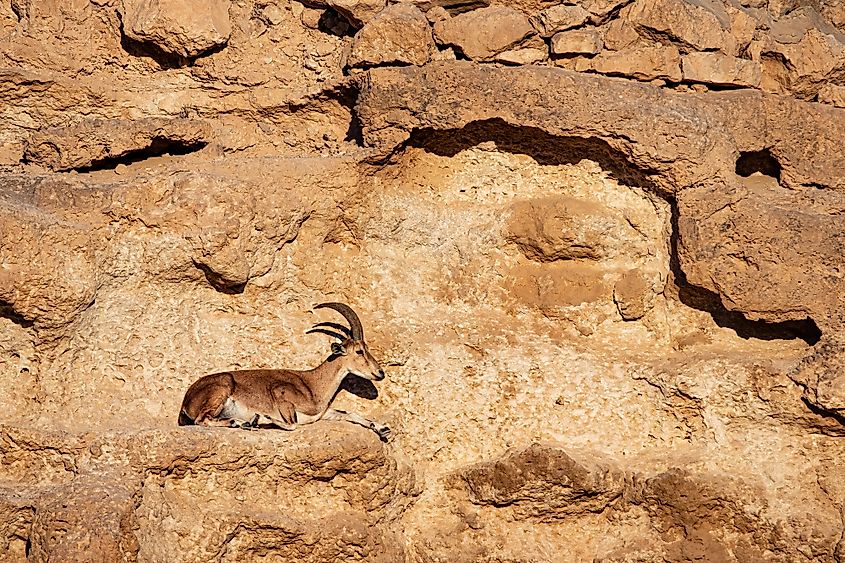 The Nubian ibex is a desert-dwelling goat species found in mountainous areas of the Sinai Peninsula.
Although the climate of the Sinai Peninsula is very hot and dry, it is not devoid of life. Indeed, it is home to many species of mammals, snakes, other reptiles, and birds. The mammal species that are commonly found in the Sinai are leopard, ibex, and Golden Spiney Mice. There are also several species of snakes found on the Sinai Peninsula, most of which are poisonous. These include Carpet Vipers, Black Cobras, and Horned Vipers.
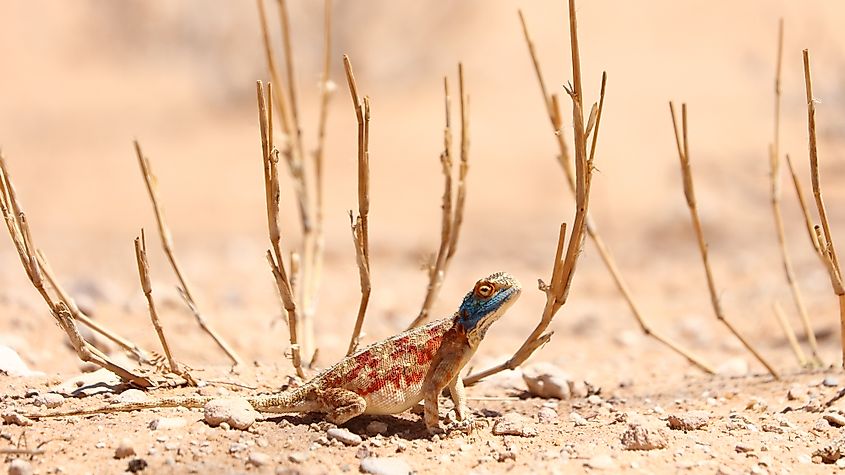 Blue-headed agama.
Lizards, such as the blue-headed Agama, are also found in the Sinai. In many cases, the peninsula’s mammals and snakes camouflage themselves to blend in with the desert terrain. The coastlines of the Sinai are where most of the Peninsula’s bird life is found. Some of the Sinai Peninsula’s most interesting wildlife is found not on the peninsula itself but underwater, among the coral reefs that dot the Sinai coastline.
The People Of The Sinai Peninsula
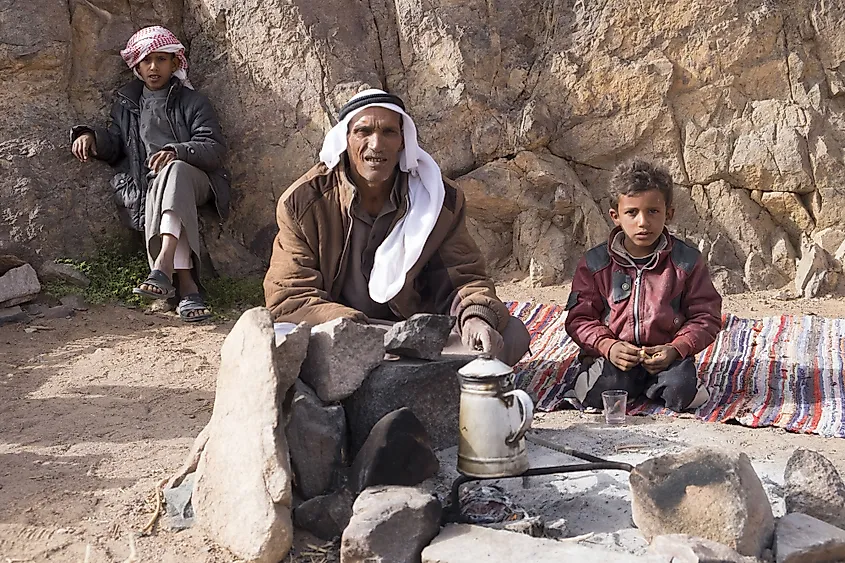 The Bedouin family, father and two sons, in the desert on the Sinai peninsula in Egypt. Editorial credit: Mykhailo Koifman / Shutterstock.com
Archaeological evidence shows that humans inhabited the Sinai Peninsula as far back as 200,000 years ago. Throughout history, many ancient peoples either settled there or passed through. These include the ancient Egyptians, as the Sinai was part of the Egyptian Pharaohs’ domain in ancient times. According to the Bible, the ancient Israelites traveled through the Sinai deserts on their way to Canaan, in present-day Israel. Religious texts of Judaism, Christianity, and Islam mention several groups living in the Sinai, such as the Horites (mountain dwellers), Rephaim (giants), Edomites (descendants of Esau), Amalekites, and Midianites—nomads from the Arabian Peninsula. Additionally, a community of Hellenized Egyptians resided in the Sinai for many centuries.
 Locals in the street of Dahab, Egypt. Editorial credit: Sun_Shine / Shutterstock.com
Today, the Sinai is mostly inhabited by Arab Egyptians and Bedouins. The Bedouins are the oldest population on the peninsula, having lived there for over 2000 years. They are mostly descendants of Bedouins who migrated to the Sinai from the Arabian Peninsula, though there is a group known as the Jabaleya, whose origins are in the Balkan Peninsula. Most of the Bedouins who inhabit the Sinai are members of seven tribes, collectively known as the Tawara federation. They are traditionally a nomadic people, meaning they move frequently from place to place, though most now have permanent homes. About 600,000 people in total currently live on the Sinai Peninsula.
Brief History
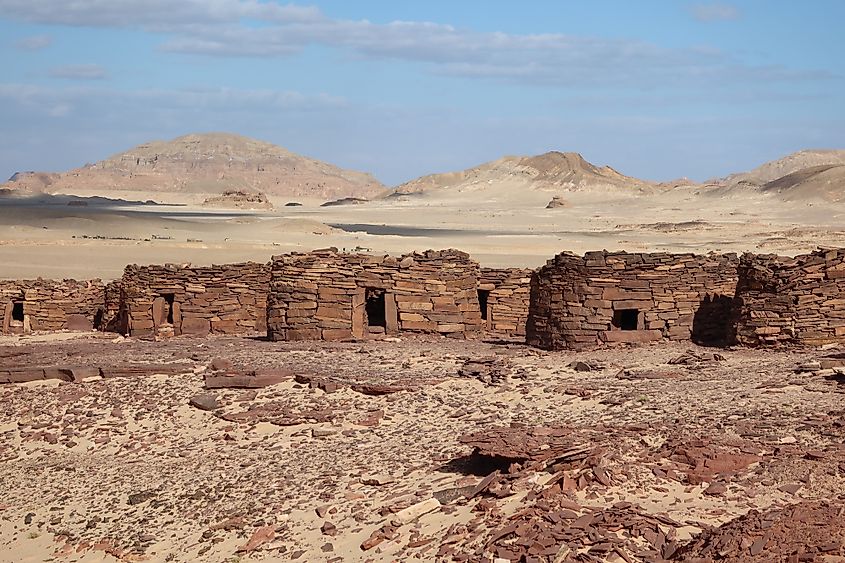 Old stone made Nawamis structures in Sinai in Egypt.
The name “Sinai” is said to come from an ancient lunar deity called Sin. In ancient times, the Sinai Peninsula was nicknamed the Land of Turquoise, because turquoise, along with copper, was mined there. Indeed, people migrated to the peninsula during the Early Bronze Age in search of valuable minerals. Thus, the region became a popular place for ancient mining operations. These mining operations eventually caught the attention of Egypt’s pharaohs, who brought the Sinai under Egyptian control around 3000 BCE. The Sinai also served as a military route between ancient Egypt and the powerful civilizations of the Fertile Crescent.
 Saint Catherine’s Monastery at the foot of Mount Sinai, Sinai Peninsula, Egypt, Middle east. It is the oldest working Christian monastery in the world and the most popular tourist attraction on the peninsula.
All the patriarchs of the Bible, including Moses and even Abraham before him, are believed to have lived in or at least passed through the Sinai Peninsula. The Israelites’ Exodus has been dated to around 1400 BCE. According to the Bible, the Israelites spent 40 years wandering the deserts of the Sinai before arriving in the land of Canaan (present-day Israel). Successive ancient empires have used the Sinai to invade and conquer Egypt, including the Assyrian, Persian Achaemenid, and Macedonian empires. The last ancient empire to control the Sinai was the Roman Empire. The Sinai remained under the control of the East Roman Empire after the fall of the West Roman Empire in 476 CE. Around 550 CE, the Roman emperor Justinian ordered the construction of a monastery on what was believed to be the Mt. Sinai mentioned in the Bible. The monastery became known as St. Catherine’s Monastery.
The Sinai Peninsula would remain under the control of the East Roman Empire almost continuously until the 7th century CE, when the forces of the rapidly expanding Muslim Caliphate pushed into the Sinai on their way to conquer Egypt. Thus, the Sinai became Muslim territory, and its people were converted to Islam. In the 16th century, the Sinai came under the rule of the Ottoman Empire, the last of the Islamic Caliphates.
In the late 19th century, Egypt, including the Sinai Peninsula, became part of the British Empire. British rule in Egypt would last until 1922, when the country was granted independence. However, the Suez Canal, which separated the Sinai Peninsula from the rest of Egypt, remained under British control. In 1956, Egyptian President Gamal Abd al-Nasser, attempted to nationalize the canal and proclaimed Egypt’s sovereignty over it. Shortly thereafter, British, French, and Israeli forces attacked Egypt. The Suez Canal Crisis ended with the withdrawal of foreign troops from the Sinai, while the Egyptians retained control over the vital and strategic canal.
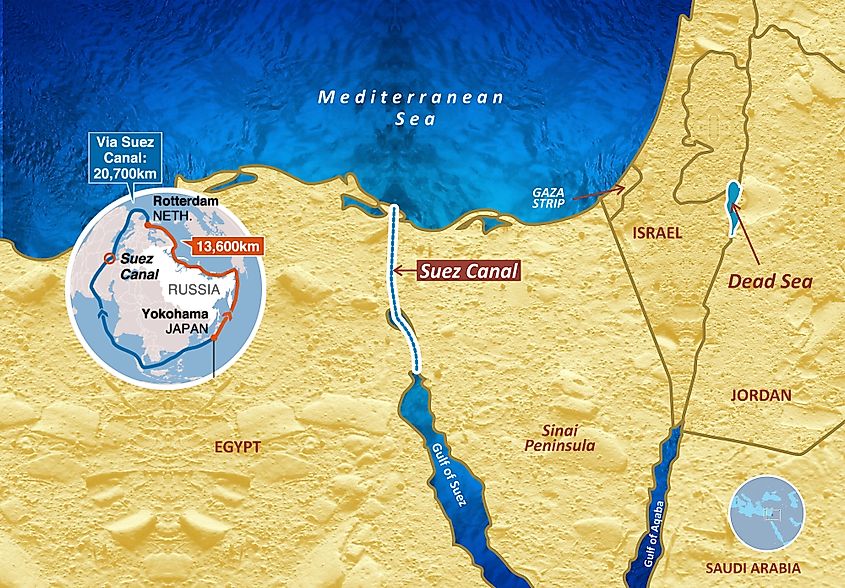 Suez Canal waterway connecting the Mediterranean Sea to the Red Sea.
Eleven years later, the Six-Day War occurred between Israel and its Arab neighbors, including Egypt. During this brief conflict, Israel invaded and took control of the Sinai Peninsula. The war concluded with Israel controlling the entire territory. In 1973, Egypt launched the Yom Kippur War, also called the October War, to regain the Sinai. The conflict ended with a ceasefire, enabling Egypt to reopen the Suez Canal, which had been closed since 1967. In 1979, Egypt and Israel signed a peace treaty, agreeing that Israel would withdraw from Sinai in exchange for peace. By 1982, Israel had fully pulled out, returning the Sinai Peninsula to Egyptian control.
The Sinai Peninsula Today
Today’s Sinai Peninsula is sparsely populated. Law and order on the peninsula is sometimes non-existent, which is why the area is very popular with criminal elements, including terrorists and smugglers. There are periodic clashes between Egyptian government forces and fighters belonging to terrorist groups like Al-Qaeda and the Islamic State. Since 2007, the Egyptian government has been enforcing a blockade on the Gaza Strip, which lies adjacent to the northeast of the Sinai, and is currently ruled by an Islamic militant group called Hamas. Thus, the Egyptians have tried to prevent the smuggling of weapons and other materials into the small Palestinian enclave.
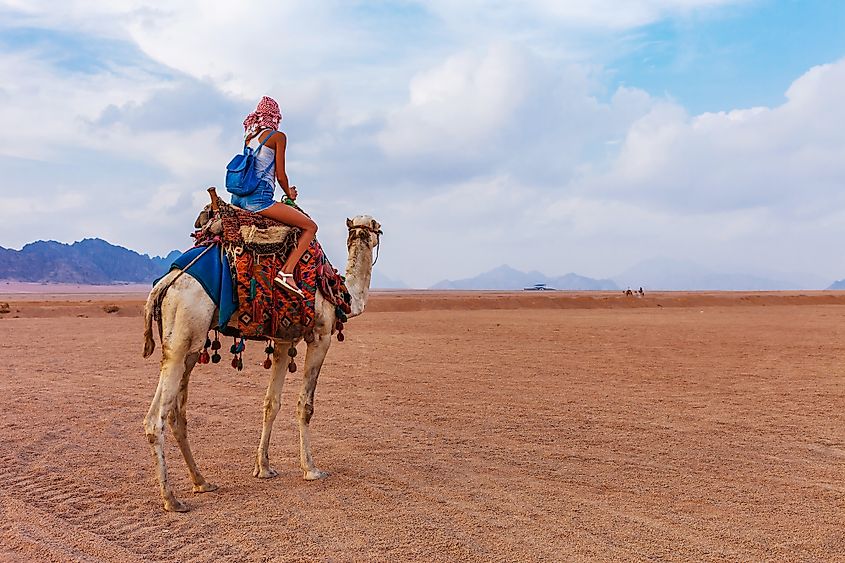 A tourist riding a camel in the Sinai Desert, Sharm el Sheikh, Sinai Peninsula, Egypt.
Not everything about the Sinai Peninsula, however, has negative connotations. Indeed, the Sinai has become very popular with tourists, including those who come to see St. Catherine’s Monastery on Mt. Sinai. The Sinai is also popular with tourists seeking an underwater adventure that often involves snorkeling or scuba diving in the crystal-blue waters along the Sinai coasts, which contain beautiful coral reefs and an abundance of marine life.