
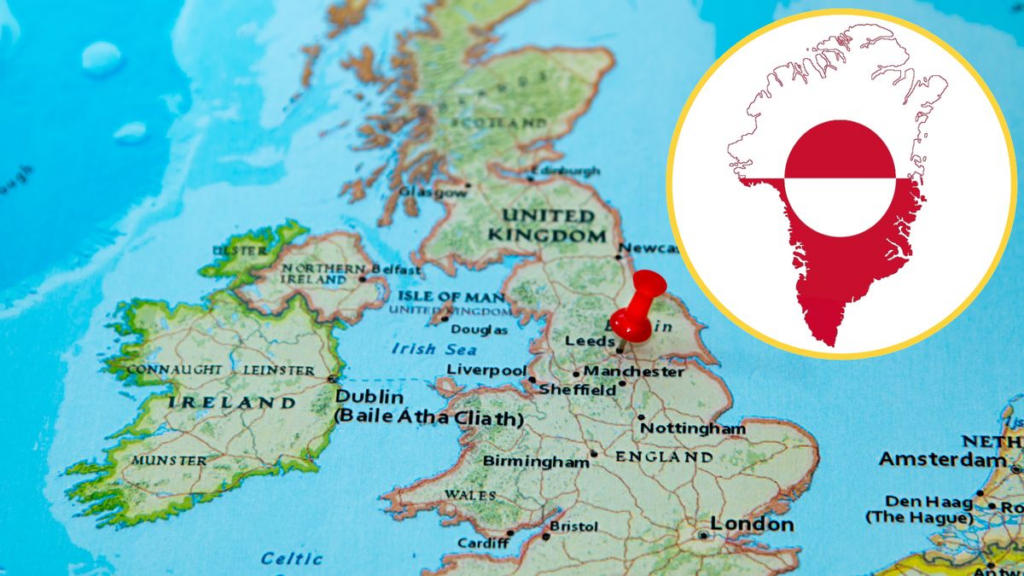
- Rumors online said a long-standing agreement gave the United Kingdom first right of refusal should Denmark decide to sell Greenland.
- The rumor came from reports that cited former Danish Minister for Greenland Tom Høyem, who said there had been such a deal between Denmark and the U.K., agreed upon after World War I. Høyem based his claims in part on a 2007 historical report commissioned by the Danish government that said the U.K. had “unilaterally” imposed that the Danish government consult the British government before selling Greenland in exchange for recognizing Denmark’s sovereignty over the territory.
- A British journalist, Martin Rosenbaum, said — after researching documents in the British National Archives — that while the U.K. had requested the Danish government give the British government the “right of pre-emption” in case Denmark wanted to be rid of Greenland, Denmark had refused to agree to it, and it had never responded when the U.K. asked to be consulted.
- Snopes could not see the documents in the National Archives, though we saw the historical report from 2007. As such, we left the claim unrated.
- Still, Høyem told Snopes that such an agreement would have no validity today, “only historical.” In other words, even if such an agreement existed, it would not be enforceable.
As speculation intensified that, after capturing Venezuelan President Nicolás Maduro in January 2026, the U.S. might focus next on acquiring Greenland, a rumor circulated that a longstanding agreement gave the U.K. first right of refusal should Denmark decide to sell the territory.
Several posts on social media, dating back to early 2025, shortly after President Donald Trump took office for the second time. One such post said the U.K. had “secured a promise that if Denmark ever sold Greenland, the UK would have the first right to buy it or be consulted” (archived):
The rumor stemmed from Janurary 2025 reports in The Telegraph, The Times and NPR, each of which cited Tom Høyem, Denmark’s former and final Minister of Greenland (this ministerial post no longer exists).
Days after those reports were published, on Feb. 10, 2025, Martin Rosenbaum — a British journalist who specializes in freedom of information requests — published research he carried out in his country’s National Archives. He said his work revealed that while the U.K. had attempted to attach a “right of pre-emption” should Denmark decide to be rid of Greenland in exchange for recognizing Denmark’s sovereignty over the territory, the effort had failed.
To verify this rumor, Snopes spoke to Høyem by phone and asked Rosenbaum questions via email. We also reached out to the British Library, the National Archives, the U.K.’s Foreign, Commonwealth and Development Office and Denmark’s Ministry of Foreign Affairs, seeking sources and documents to back the claim. The National Archives said consulting the documents in question required an in-person visit.
Snopes was able to see a report that said the U.K. had “unilaterally” imposed that the Danish government consult — as opposed to offer first right of refusal to — the British government before selling Greenland in exchange for recognizing Danish sovereignty over the territory. We could not see documents stored in the British National Archives. As such, we left the claim unrated. What we could confirm is that even if such an agreement existed, it would be unenforceable today.
The history
Høyem told Snopes in a telephone interview that his source was a historical report commissioned in 2007 by the Danish government on the status of Greenland.
In 1917, the U.S. and Denmark ratified a convention that would give Denmark “dominion and sovereignty” over Greenland. In exchange, Denmark agreed to sell to the U.S. islands in the “West Indies” — now known as the U.S. Virgin Islands.
After World War I ended in 1918, Denmark sought recognition of its sovereignty over Greenland from the allied powers who had just won the war — including the United Kingdom. Canada, which had yet to reach full legal independence from the U.K. (this happened with the Canada Act of 1982), had expressed interest in acquiring Greenland, due to its geographical proximity.
In 1920, Denmark formally asked the British government to recognize its sovereignty over Denmark.
Rosenbaum echoed this event in his report, sharing a note he said he found in the National Archives. Dated March 16, 1920, from the Danish Legation in London, the note read:
Having submitted to my Government the contents of Your Lordship’s note No.158073/W/30 of December 11th 1919 with regard to the recognition by the Powers of Danish sovereignty over Greenland I have the honour once more to revert to the same matter, the King’s Government having decided to obtain a final settlement of this question by submitting it to each of the Principal Allied Powers separately. –
I have accordingly been instructed to submit to His Britannic Majesty’s Government a request for the official recognition of His Danish Majesty’s Sovereignty over the whole of Greenland.
The U.K.’s conditions
The British government replied, saying it would agree to recognizing Denmark’s sovereignty over Greenland if, in exchange, the Danish government committed to giving the British government “the right of pre-emption” — that is, the first right of refusal if Denmark chose to part with Greenland. Rosenbaum posted the written reply from the Foreign Office, dated May 19, 1920 (emphasis ours):
Sir,
I have the honour to acknowledge the receipt of your Hote of the 16th of March (No. 58/30/6.2) requesting the official recognition by His Majesty’s Government of His Danish Majesty’s Sovereignty over the whole of Greenland.
The Danish Government will, I am convinced, readily understand that the geographical position of Greenland makes the question of its ownership a matter of great importance to the British Empire as a whole and to Canada in particular. His Majesty’s Government therefore feel obliged, after the most careful consideration of the matter, to attach to their recognition of Danish sovereignty over Greenland the condition that, should Denmark sver wish to dispose of the island, she would grant the right of pre-emption to the British Empire. Should your Government be willing to give a guarantee to this effect in the form of an exchange of lhotes, His Majesty’s Government are prepared at once to recognize officially Danish sovereignty over Greenland.
I have the honour to request that you will be so good as to submit this matter to your Government and to acquaint me due course with their reply.
I am informing the Governments of France, Italy, Japan and the United States of America of the attitude taken up on this question by His Majesty’s Government.
Rosenbaum said via email that according to his research, “The Danes clearly rejected outright any agreement to give the UK right of first refusal in the event of sale.” His article includes said response dated July 20, 1920, pulled from the National Archives:
The King’s Government direct me to observe that there is absolutely no intention of selling Greenland and that there is no prospect that such a sale will ever become actual. Accordingly the King’s Government on grounds of principle regret that such a guarantee cannot be given as such an undertaking might imply the possibility at some future date of the question of sale being raised in some form.
This, Rosenbaum says, came after the U.S. was notified of the U.K.’s request and disagreed with it.
Different narratives
The U.K. then asked to at least “be consulted” should Denmark seek to be rid of Greenland. A note from the Foreign Office dated Sept. 6, 1920, read (emphasis ours):
WITH reference to your note No. 202/30/B.2, concerning the official recognition by His Majesty’s Government of His Danish Majesty’s sovereignty over Greenland, which you were good enough to address to me on 20th July, I have the honour to inform you that His Majesty’s Governmen Government recognize His His Danish Majesty’s sovereignty over Greenland, but in view of its geographical proximity to the Dominion of Canada, His Majesty’s Government must reserve their right to be consulted should the Danish Government at any time contemplate the alienation of this territory.
The Danish government did not reply to this request, according to Rosenbaum, who said this showed the two countries never struck such a deal.
But according to the report Høyem based his claim on, the U.K. had imposed the condition to be consulted “unilaterally” (Page 15, translated by Snopes, emphasis ours):
Another indicator of the vulnerable sovereignty was that Denmark at the same time encouraged England to recognize Denmark’s sovereignty over the island, but recognition only came after a series of difficult consultations, which included, among other things, Canada and the USA, and was then accompanied by a unilaterally invoked right by the British side to be consulted if Denmark wanted to sell Greenland.
In other words, it is possible Denmark took the U.K.’s condition not as something it could negotiate, but as a non-negotiable demand without which the U.K. would not recognize Denmark’s sovereignty over Greenland.
The same report indicated that following a dispute between Norway and Denmark, the Permanent Court of International Justice in The Hague (established by the League of Nations, it preceded the International Court of Justice) granted Denmark sovereignty over Greenland.
Asked what validity such a deal would have today, Høyem said, “It has no worth, it is only historical.” In other words, even if such an agreement existed it would not be enforceable.
For further reading, Snopes verified the claim that a former official of Trump’s White House, Katie Miller, posted a map of Greenland overlaid with the U.S. flag.