
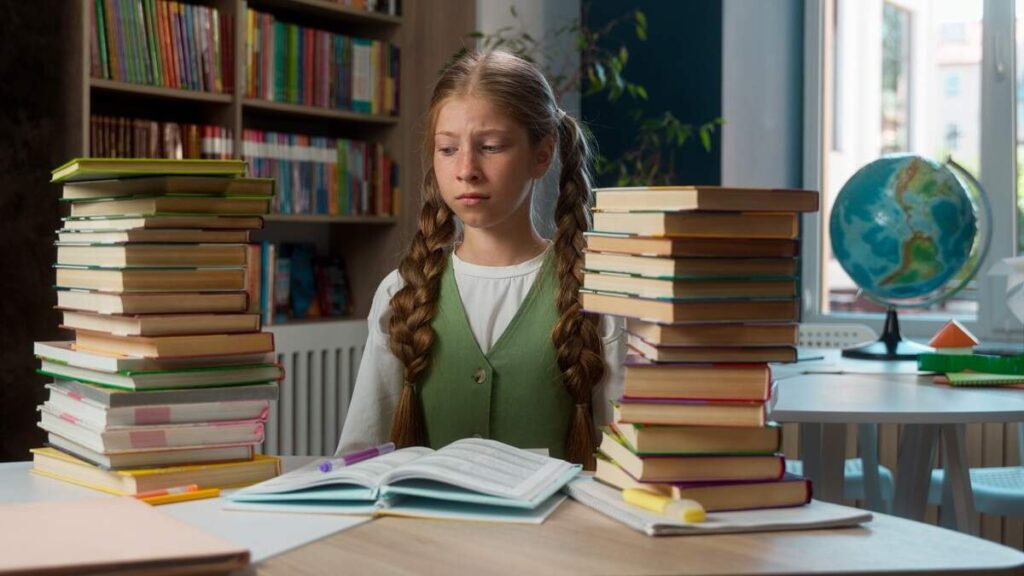
As the education ministry, teaching unions and the national parents’ council seek to tackle what some have labelled an “overburden” of homework on Luxembourg’s primary school pupils, a child psychiatrist at the CHL (Centre Hospitalier de Luxembourg) has said that burnout among children is not just caused by stress at school.
“We are seeing more and more cases,” Dr Ghazi Dali told Virgule. But he is adamant that this type of burnout “is not just school-related, but multifactorial”, and that on the whole, people have been paying more attention to their mental health since the Covid pandemic.
Also read:Luxembourg’s youngest pupils at risk of ‘burnout’ from homework overload
Dali explained that he has seen cases of burnout related to excessive homework demands, and says they are on the increase. Symptoms include “exhaustion, lack of motivation, tiredness at the start of the day or lack of commitment to schoolwork”, Dali said.
But he also emphasised that it is difficult to precisely acknowledge a particular trend. “Because we don’t know whether it’s the prevalence that’s increasing or whether it’s because more cases are being detected and talked about.”
Don’t wait to seek help
Dali recommended that parents don’t wait to seek help if they have doubts about their child. “It’s advisable to call in a professional to find the right words. Sometimes a burnout will be called something else, people will remain vague, with no adequate response to help the child,” he said.
“Children will never say they are in burnout, but they will show it,” Dali explained. It is important to observe and noticeable changes in their behaviour. “Any break with habits can be a clue. It could be a child who was very quiet who becomes boisterous, or the opposite, a restless child who becomes very calm. Things like this should make parents question what is going on.”
Don’t be overly performance-oriented and, above all, be attentive to any change in a child’s behaviour
Dr Ghazi Dali
Child psychiatrist, CHL
When burnout at school is confirmed, the first thing to consider is that their mental workload needs to be reduced. “You have to identify the pace you’re imposing on the child and see what you can reduce it. Don’t hesitate to suggest breaks, reduce demands, don’t be overly performance-oriented and, above all, be attentive to any change in a child’s behaviour,” Dali said.
In addition to consulting a practitioner, parents should mobilise all the resources and levers at their disposal, including communicating with teaching staff. “Sometimes, despite the recommendations made by a child psychiatrist, there is still resistance, because our recommendations are not binding,” Dali acknowledged.
Also read:Dramatic rise in Luxembourg schoolchildren with autism spectrum disorders
“Some people will continue to think that certain children are lazy and don’t want to work,” he added. But he also warned against an approach that would involve blaming only the teachers. “The relationship between parents and the school also comes into play and can put pressure on children, it’s very complex.”
Pressure not necessarily only from teachers
Dali remains confident that insoluble cases are rare and said that in 80% of cases, solutions are found. In general, when a child feels heard, “that can already help a lot”, he explained. What many people see as an all-consuming cult of pushing children to achieve high performance “is much more prevalent among parents than at school”.
Parents always want their children to be better than they are. It’s a legitimate feeling, but sometimes it can lead to pressure
Dr Ghazi Dali
Child psychiatrist, CHL
“Parents always want their children to be better than they are. It’s a legitimate feeling, but sometimes it can lead to pressure. Their fears will put pressure on them, whether consciously or not,” Dali said. “The burden is not just academic with this kind of burnout. If you enrol your child in music theory, a football club, chess club … It’s not academic, but it has everything to do with performance. And it can create an overload.”
That sort of environment can create a harmful downward spiral. “You have to look at well-being rather than results, and remember that the most important thing is the person’s well-being and comfort,” the doctor said. “There’s no point in having a very good result when you can be satisfied with a good result if it goes hand in hand with well-being.” If suffering is the cost of obtaining a better performance, then it makes no sense, he said.
Finally, it is vital not to downplay a child’s discomfort by saying that “he’ll get some rest later or that he’ll understand when he’s older”. The risk, in the long term, would be to leave the children with noticeable traces of harm.
“When we deal with this type of case, we really try to identify the expectations of each individual, and sometimes this is linked to explicit expectations on the part of the parents that create pressure,” Dali said. “For example, if you’re born into an environment where everyone has a higher intellectual profession and all the older children before you have excelled at school, inevitably, as the youngest or second youngest, you’re going to take it on board that this is a standard to be achieved and that not succeeding is bad. And you put yourself under pressure!”
These are all factors that need to be considered on a case-by-case basis and informed external advice sought as early as possible, the psychiatrist concluded. But long waiting lists and rising demand are putting psychiatric care in Luxembourg under increasing pressure, so parents may have to be patient.
(This article was first published by Virgule. Machine translated with editing by Duncan Roberts.)