
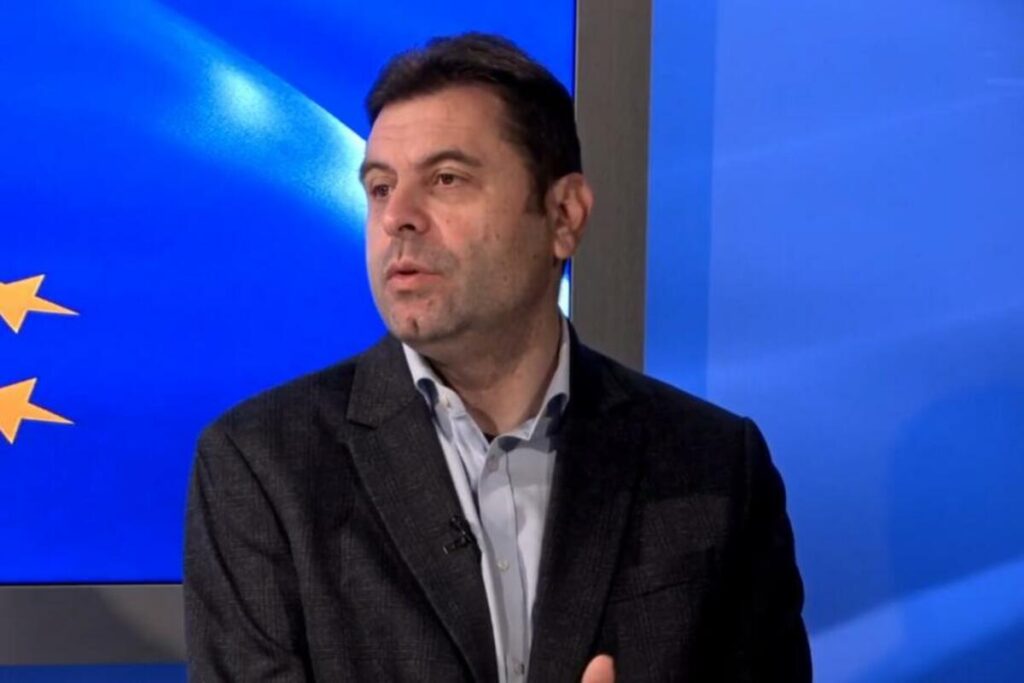
The current government can complete accession negotiations, but it cannot bring Montenegro into the European Union (EU), said the president of the Social Democratic Party and one of the leaders of the European Union, Ivan Vujović, stating that the next parliamentary elections are therefore crucial.
In an interview with the MINA Agency, Vujović said that he expects numerous obstructions on Montenegro’s European path this year.
Asked how important the upcoming parliamentary elections are for the success of the ratification process of Montenegro’s EU accession treaty, Vujović said that they are crucial.
“This government can complete the negotiations, but this government cannot bring Montenegro into the EU,” Vujović believes.
He said that a government with such constituents and balance of power can complete the negotiations, primarily thanks to external factors and the enormous support of the EU.
“If deviations, problems in the system, as well as numerous forms of non-transparency and illegality had occurred ten years ago, Montenegro would, according to the then enlargement policy, have been on the EU blacklist,” Vujović said.
He believes that the next parliamentary elections will be one of the most important since 90, because the process of European integration will not be completely completed, but at best brought to the final phase, which is crucial.
Vujović said that “anti-European political actors, primarily the former Democratic Front (DF) of Andrija Mandić and Milan Knežević, will do everything this year to sabotage Montenegro’s path towards the EU.”
According to him, anti-European political actors are raising the issues of amending the Constitution, the Serbian language, and dual citizenship with the intention of sabotaging the European path, because they are aware that these topics will produce polarization and instability that will negatively reflect on Montenegro’s European path.
“If by some unfortunate coincidence these parties are still in power in 2027, be sure that some countries, especially some of our neighbors, will not look favorably on it and will have difficulty ratifying Montenegro’s membership in the EU,” Vujović assessed, adding that Montenegro needs a truly pro-European government, devoid of destructive political factors.
When asked whether he believes that Montenegro will succeed in closing all remaining negotiation chapters by the end of this year, including the most complex ones – chapters 23, 24 and 27, Vujović answered in the affirmative.
He added that he believes more in the enthusiasm and enormous support of Brussels than he believes in the capacities, substantial political will and willingness of the Government to engage in the process of reforms that are necessary for the country to close the chapters and enter the EU.
“Twenty-one chapters is a big deal. If we know that we have closed 12 so far, the conclusion would be that it is simply impossible, but given the circumstances and the strong support of the EU, I think it is a realistic thing,” said Vujović.
Speaking about Chapter 23 – Judiciary and Fundamental Rights and 24 – Justice, Freedom and Security, he said that the EU will seek measurable results and that the focus will be on non-selectivity in processing cases of corruption and organized crime.
“It would not be good if the entire story about the fight against corruption and crime were reduced to cheap political marketing by some political entities and if the impression was created that this fight was selective. It must be essential and therefore the prosecutor’s office must be free from any kind of political and party pressure,” Vujović pointed out.
When asked whether he believes the current government has the political will to implement the reform activities needed in the area of the rule of law, he answered in the negative.
Vujović said that Democratic Montenegro wants to completely take over the security sector from the party’s perspective.
“We see examples of party-based cleansing of the police, the Army and the entire security sector. We know what the political profile of Democratic Montenegro is, if there is a party in Montenegro that is synonymous with clientelism, party employment and a rather Stalinist form of dealing with political opponents, then it is Democratic Montenegro,” Vujović said.
He assessed that it is “very dangerous for such a party to have a monopoly in the security sector and for it to exclusively dictate reform processes in that sector.”
Asked how encouraging the announcement of the start of drafting the treaty on Montenegro’s accession to the EU in the first half of this year is, Vujović pointed out that this is another indicator that the Union strongly supports Montenegro.
“The start of drafting the accession treaty is a significant wind at our back,” said Vujović, adding that the EU thus wants to show that the enlargement process is alive.
According to him, this is another indicator that Montenegro is practically being pushed towards the EU, while “there are forces in Montenegro that are in the opposite rhythm, that are doing completely different things and sabotaging that process in numerous fields.”
“So, 2026, even as an election year, will most likely be very challenging, and therefore I expect numerous obstructions on the European path,” Vujović said.
Responding to the question of what else should be the state’s priority this year, besides closing negotiation chapters, he said that he sees numerous challenges and that EU membership will bring many benefits, but that it will not solve all problems.
Vujović assessed that the health care situation is catastrophic, that “we are living on debt,” that inflation is too high, and that the money that citizens receive is practically worthless.
“We see the state of affairs in our institutions, that party recruitment has reached unprecedented proportions, we see what is happening in Pljevlja and what happened at the Durmitor ski resort. We see several deaths in just two months in hospitals in Montenegro,” Vujović said.
He added that if just one of these things had happened ten or 15 years ago, protests would probably have been organized, but that is not the case today.
Vujović asked how it was possible for the Parliament of Montenegro to adopt a huge number of laws in a short time, at the very end of last year.
“We have seen around the Constitutional Court, that is a special story now, we lost a year and a half to finally get the Constitutional Court in the form it is in today, under the complete control of Andrija Mandić,” Vujović assessed.
He said that the Europe Now Movement (PES) is building legitimacy on the European story ahead of next year’s elections “because their story about the economy has failed.”
“Internally, they are increasingly marginalized by Mandić and the DF in a political sense. We will see the results of the elections. PES had over 25 percent in 2023, it is a hypothetical noun that they could be close to that. We will see how much Mandić, who had 14 or 15 percent, will have,” Vujović said.
Responding to the question of how he sees the European Union’s activities in the coming period, he said that it is a non-partisan political platform that has brought a new quality to the political scene.
“If we had not entered the formation of the European Union, the opposition scene would look much worse today, although it still does not look ideal, far from it. Numerous criticisms by a part of the opposition public about the opposition’s activism in general are justified,” said Vujović.
He added that they sent a message through the European Union that they want to bring together everything that is progressive and best on the Montenegrin political scene, without fitting it into party frameworks.
“And that is why we especially emphasize that the European Union is not just the sum of three parties, or some other parties that will, I hope, be part of the European Union,” said Vujović.
He pointed out that they are instituting the fourth pillar – non-partisan.
“We will strive to make the European Union a political platform that will be the biggest positive surprise in the 2027 elections. We have no illusions that we can be the strongest, but I am certain that we will reach double-digit percentages when it comes to support in the elections,” said Vujović.
As he emphasized, the stronger the European Union is in these elections, the greater the certainty of the quality of political changes in Montenegro.
Asked to comment on the initiative of President Jakov Milatović to call a referendum on the introduction of open electoral lists, Vujović said that this is certainly a democratic standard to which the state must strive.
“I find it very healing that people are talking about this, because it is something that we will have to accept as a standard in the near future,” added Vujović.

News