Im pretty sure the US standard is often the most outdated or the worst in general.
Briham86 on
Kimchi is great, but please, don’t use this to promote it. Please. RFK Jr. is an evil crackpot shitbag. You do not want his endorsement. You do not want him or this administration to stain kimchi’s reputation. Trust me on this.
Radiant_Desk_2257 on
옛날에는 김치 하면 외국인들은 생소한식품이고 냄새난다고 하던데 지금은 권장식품으로하다니 태어나고 볼일이야
EPanda108 on
Why would anyone care what the US dietary guidelines recommend? I’m confused.
ApplauseButOnlyABit on
Kimchi is good, but no one should be taking recommendations from a guy with worms in his brain.
The same recommendations say that you should eat fatty high cholesterol meats more than anything else, but also says that you should avoid high cholesterol fatty foods.
They are not health experts, and the US should not be a source of health information for anyone at this point.
ouroboros_winding on
RFK Jr and MAHA are right about a lot of things actually (see recent guidelines encouraging < 10g sugar per meal, for instance), it’s just that they’re disastrously wrong about a few very very important things, such as vaccines and pasteurization. Generally speaking they think everything natural = good, everything processed/artificial = bad.
Ok_Contract_1363 on
#boileveryredditor
Charlie2and4 on
The US is swimming in corn sugar and saturated fats. This is a little bit of good news.
Secure-Tradition793 on
These days I’m not sure it’s good to be recommended by the US govt. I wouldn’t be surprised if they recommend consuming kimchi the “other” way in to reach the gut faster.
ebolaRETURNS on
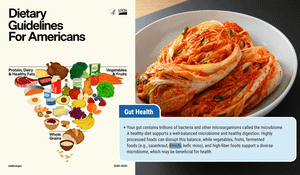
It’s too bad this sits along side recommendations for lots of red meat and beef tallow, discrediting it. I think there’s something to kimchi’s benefits as probiotic (I find it easier to integrate than yogurt).
uglybutt1112 on
The new US food guideline is really built for body builders. Extensive meat recommendations. Of course RFK, the guy in charge of it is a steroid user.
3uphoric-Departure on
On the opposite end, I remember reading something about how eating preserved Asian vegetables increases your risk of cancer

12 Comments
Im pretty sure the US standard is often the most outdated or the worst in general.
Kimchi is great, but please, don’t use this to promote it. Please. RFK Jr. is an evil crackpot shitbag. You do not want his endorsement. You do not want him or this administration to stain kimchi’s reputation. Trust me on this.
옛날에는 김치 하면 외국인들은 생소한식품이고 냄새난다고 하던데 지금은 권장식품으로하다니 태어나고 볼일이야
Why would anyone care what the US dietary guidelines recommend? I’m confused.
Kimchi is good, but no one should be taking recommendations from a guy with worms in his brain.
The same recommendations say that you should eat fatty high cholesterol meats more than anything else, but also says that you should avoid high cholesterol fatty foods.
They are not health experts, and the US should not be a source of health information for anyone at this point.
RFK Jr and MAHA are right about a lot of things actually (see recent guidelines encouraging < 10g sugar per meal, for instance), it’s just that they’re disastrously wrong about a few very very important things, such as vaccines and pasteurization. Generally speaking they think everything natural = good, everything processed/artificial = bad.
#boileveryredditor
The US is swimming in corn sugar and saturated fats. This is a little bit of good news.
These days I’m not sure it’s good to be recommended by the US govt. I wouldn’t be surprised if they recommend consuming kimchi the “other” way in to reach the gut faster.
It’s too bad this sits along side recommendations for lots of red meat and beef tallow, discrediting it. I think there’s something to kimchi’s benefits as probiotic (I find it easier to integrate than yogurt).
The new US food guideline is really built for body builders. Extensive meat recommendations. Of course RFK, the guy in charge of it is a steroid user.
On the opposite end, I remember reading something about how eating preserved Asian vegetables increases your risk of cancer