
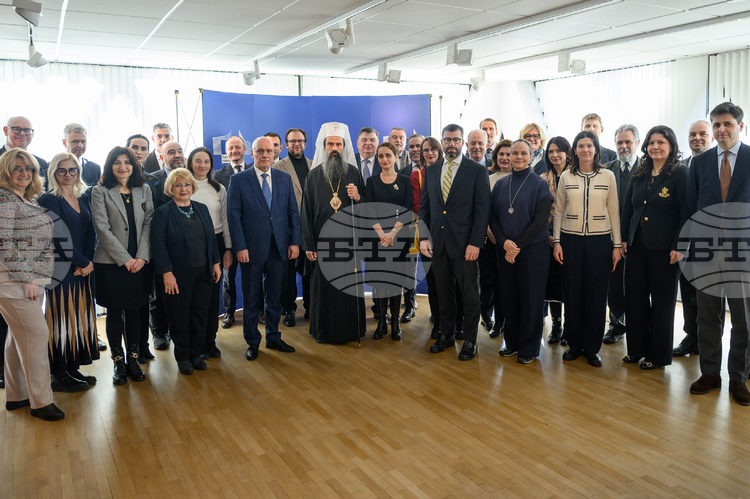
The head of Bulgaria’s central bank told EU ambassadors in Sofia on January 9 that in addition to being a formal institutional step, Bulgaria’s accession to the euro area is the culmination of a long process of economic integration, policy alignment and shared responsibility — a process that unfolded under conditions that were not always easy. Dimitar Radev spoke to the EU diplomats at a meeting organized by the European Commission Representation in Sofia, which also involved ambassadors of EU candidate countries, the Bulgarian National Bank (BNB) reported on its website.
Radev recalled that in recent years, Bulgaria has experienced periods of internal political turbulence, marked by fragmented governance and repeated electoral cycles. “[N]evertheless, macroeconomic and financial stability were preserved. At the same time, it would be inaccurate not to acknowledge that fiscal discipline — traditionally a strong anchor of our economic policy framework — came under pressure. In this sense, euro area membership should not be viewed as a reward for past performance, but as a framework that strengthens responsibility and reinforces incentives to pursue a prudent and forward-looking macroeconomic and fiscal stance,” the BNB Governor stated.
He went on to note:
“In practical terms, Bulgaria has functioned as a de facto euro area economy for many years. The currency board arrangement, anchored to the euro, aligned expectations and shaped policy choices in a manner comparable to participation in the Economic and Monetary Union — albeit without representation in its decision-making bodies. Euro adoption resolves this long-standing institutional asymmetry by aligning responsibility with representation.
“This transition takes place against a backdrop of heightened global uncertainty. Geopolitical tensions, economic fragmentation, supply-side shocks and financial volatility continue to test economies and institutions alike.”
Radev argued that Europe’s role in this context is central. He said: “The euro area is not merely a monetary system; it is an anchor of stability in an increasingly complex global system. Its strength lies in rules-based cooperation, institutional depth and coordinated action. Enlargement of the euro area, when grounded in genuine preparedness, reinforces these qualities and strengthens the integrity of the common framework.”
“Bulgaria approaches euro area membership with a clear sense of responsibility. We do not view our participation in the European Central Bank and the Eurosystem as protection from the need for adjustment, but as a commitment to discipline, consistency and constructive engagement — especially under more demanding and challenging circumstances,” the BNB chief said.
Noting the presence of the head of the Bulgarian Orthodox Church, Patriarch Daniil, at the meeting, Radev said: “This should be understood not in a confessional sense, but as a reflection of institutional continuity and public trust. Bulgaria, like many European societies, values symbols of stability and permanence — the same logic that underpins our monetary framework and is reflected in the design of Bulgaria’s euro coins, which integrate national heritage into the common European currency.”
On January 1, 2026, Bulgaria joined the euro area, becoming its 21st member. The euro is now legal tender in the country. The BNB Governor becomes a voting member of the Governing Council of the European Central Bank, and the Bulgarian Finance Minister joins the Eurogroup, the informal body bringing together the finance ministers of the countries whose currency is the euro. Bulgaria’s monetary policy has moved out of the currency board regime maintained since 1997 and has become part of the euro area’s monetary system, which comprises another 20 countries with a combined population of over 357 million.