

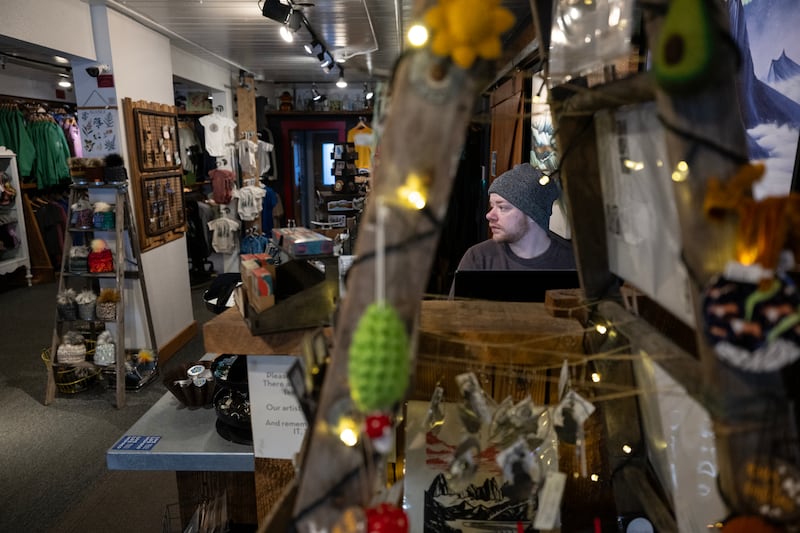
 Andrew Demma works behind the counter at Dos Manos Gallery in Anchorage on Friday. (Marc Lester / ADN)
As Anchorage’s Dos Manos Gallery nears its 20th year in business, co-owner Stephanie Johnson said it feels like an accomplishment. The anniversary comes with some caveats.
Following many years of growth, Johnson started to notice a dip in sales during the 2024 holiday season. By the end of 2025, numbers had slid by 12%. Some customers, expressing a need to make more thoughtful purchases, came in more than once before choosing a gift this Christmas, she said. Cheaper items sold more quickly.
Johnson said Mayor Suzanne LaFrance’s 3% sales tax proposal may hurt business in the short-term if customers, already apprehensive about spending, decide to further cut back. In a wider conversation about declining affordability in Anchorage, other business owners worry that stacking costs will influence whether some residents decide to eat out at restaurants and shop at small businesses, many of which are contending with cost increases of their own.
“The first place that people cut back on is things that aren’t necessities,” Johnson said. “And we, aside from my belief that beautiful things are necessary in life, don’t sell anything that people have to have.”
LaFrance unveiled the new sales tax proposal in November, and over the past few months, she has repeatedly emphasized its timeliness. Following a decade of steadily declining state funding, LaFrance has presented Anchorage residents with two options as the municipality’s budget outlook becomes more grim: pursue a new source of revenue or cut public services.
The Assembly will consider the sales tax measure following a continued public hearing on Tuesday. The measure would need to pass the Assembly before heading to an April ballot for voters.
[What is the Anchorage sales tax proposal? And is it likely to head to voters?]
A summary of economic effects shared with the Anchorage Assembly explored how the municipality expected households, based on their income level, to shoulder a sales tax. Less data was available on the possible ramifications of a sales tax on local businesses and their customers.
It’s a sector much more difficult to measure, said Ian Mills, a research and data manager at the University of Alaska Center for Economic Development. The center studied a similar sales tax concept that ultimately failed to garner Assembly votes and make it onto the ballot last year. The impact of LaFrance’s proposal depends on exactly what individuals purchase and tax exemptions, which remain vague at this stage of the process, he said.
Clues about how Anchorage’s business community is faring in the current economy are present in the results of a “Quick Pulse” survey conducted by the Alaska Small Business Development Center at the start of 2025. Instead of “prioritizing growth and efficiency” like the year prior, businesses spent the first four months of the year managing the rising costs “driven by political uncertainty.”
Prior to 2025, political uncertainty — this time driven by tariffs and market fluctuations — had never made it to the survey’s list of the top 10 barriers to business, the report stated. The uncertainty created significant concerns among some business owners around the need to raise prices to keep up.
The Anchorage Chamber of Commerce surveyed members on the sales tax proposal late last year and has yet to publicly release the results. The Anchorage Chamber did not comment for this story.
Assembly member Daniel Volland, who represents the downtown area, said he has not heard much from the local businesses in his district. He said it is a “stark difference from last year’s community-led sales tax conversation,” where there seemed “quite a bit” of support from the downtown business community.
“That seems to have fizzled,” he said. “It makes me wonder what sort of outreach the mayor’s team has done on their reworked proposal.”
Adding to the squeeze
Even with Dos Manos customers’ “general sense of concern or fear” about spending, Johnson said she can still see the benefits of a sales tax. The $176 million city leaders expect the sales tax to generate would be split between addressing a growing infrastructure backlog, property tax relief and creating more affordable housing and child care.
“I don’t want to keep learning, vibrant younger people go live somewhere else because other cities offer more options,” she said. “How the sales tax may or may not contribute to that, I can’t say for certain. But failing to invest in our community is probably not going to help us in the long run.”
Not all businesses agree a sales tax could eventually boost business in Anchorage. James Strong, the owner of grab-and-go lunch spot and bakery Sweet Caribou, said he has raised prices on an annual basis to adjust to the increases in minimum wage, and when he started offering mandatory paid time off.
It costs $17 for all lunch bowls and sandwiches. He anticipates raising prices again this year to keep up with inflation.
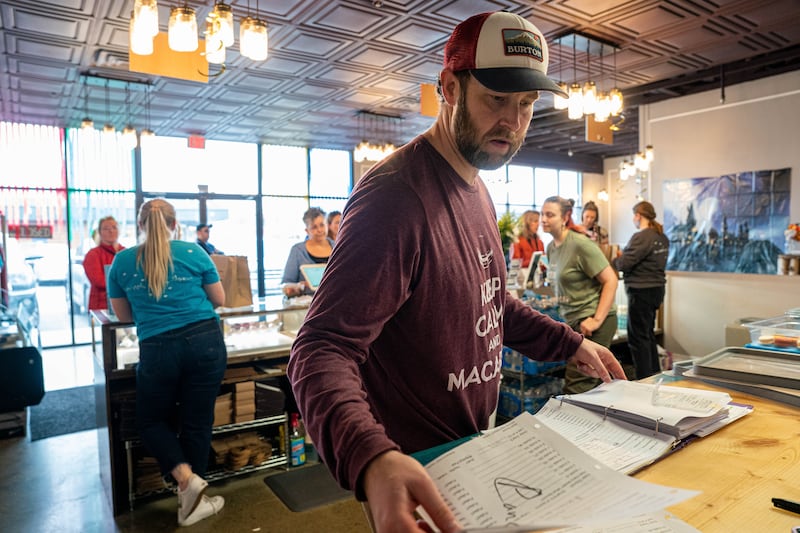 Sweet Caribou and Bema Coffee owner James Strong helps his staff with the lunch rush on Sept. 22, 2022. (Loren Holmes / ADN)
“The price that we have to charge to be able to make it is getting to a point, particularly in the food service industry, where it is cost-prohibitive to eat out,” he said.
Cost increases have not only influenced who’s able to afford to eat there, but how much money his staff takes home after shifts. As a large portion of his employees’ wages comes from tips, he expects customers to adjust to a sales tax by simply tipping less, he said.
Residents remain conflicted on LaFrance’s proposal. West Anchorage resident Riley Creed said she opposed the tax as it puts more pressure on “Alaskans who are already nickel and dimed.” If it were to pass, she expected her family would “heavily limit” recreational activities, outings to restaurants and luxury spending.
Muldoon resident Shawn O’Donnell said because the proposal exempts most necessities from the sales tax, it will not be a “financial burden.” The current proposal includes exemptions for most groceries, rent and mortgages, gasoline, utilities and medicine and medical services.
Erin Baldwin Day, who represents Midtown on the Anchorage Assembly, said residents have told her that with inflation and rising prices, a sales tax would “add to the squeeze.” But most also acknowledge having the revenue available to reinvest in Anchorage is worth the additional 3%, she said.
“Their take is Anchorage really needs to invest in itself in order to continue to be an attractive place for people to do business,” she said.
The Assembly meets at 5 p.m. on Tuesday at the Loussac Library.