
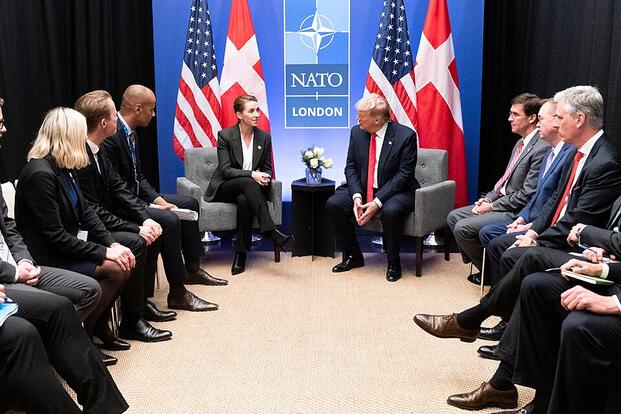
Denmark deployed soldiers to both Iraq and Afghanistan when America launched the Global War on Terrorism. Fifty of their soldiers never came home.
President Donald Trump now refuses to rule out using force to seize Greenland from Denmark. White House Press Secretary Karoline Leavitt stated that “utilizing the U.S. military is always an option” to acquire the Arctic territory.
Stephen Miller, Trump’s deputy chief of staff, questioned Denmark’s right to Greenland on CNN and declared that “obviously, Greenland should be part of the United States.”
Miller asked “by what right does Denmark assert control over Greenland?”
Denmark has controlled Greenland since 1721. This was 55 years before the United States existed as a nation. The United States briefly occupied Greenland during World War II after Germany invaded Denmark in 1940, but returned control to Denmark when the war ended in 1945.
Miller added that “nobody is going to fight the United States militarily over Greenland” and argued that “the United States is the power of NATO” and therefore “Greenland should be part of the United States.”

Vice President JD Vance, Secretary of Defense Pete Hegseth, and White House Deputy Chief of Staff Stephen Miller deliver remarks while meeting with National Guard troops positioned at Union Station as part of the D.C. Safe and Beautiful Task Force, Washington, D.C., Aug. 20, 2025. (DoD photo by U.S. Navy Petty Officer 1st Class Alexander Kubitza)
Denmark Refuses
This is not Trump’s first attempt to acquire Greenland. In August 2019 during his first term, Trump proposed purchasing the island, calling it “a large real estate deal.”
Danish Prime Minister Mette Frederiksen called the idea “absurd” and said “Greenland is not for sale.” Trump canceled his planned state visit to Denmark over her response.
Frederiksen recently warned that any U.S. military action against Greenland would mean “the end of NATO.” She told reporters that NATO’s Article 5, the mutual defense clause stating that an attack on one member is an attack on all, would make a U.S. invasion of Greenland an attack on Denmark itself, theoretically obligating other NATO members to defend Denmark against the United States.
European leaders rallied behind Denmark. France, Germany, Italy, Poland, Spain and Britain declared that Greenland “belongs to its people” and that only Denmark and Greenland can decide their future. Polish Prime Minister Donald Tusk warned that NATO would “lose its meaning” if one member attacked another.
Trump told reporters that America needs Greenland for national security. The island guards critical Arctic shipping routes. Greenland also contains vast deposits of rare earth minerals essential for smartphones, batteries, and military technology, resources currently dominated by China.
Trump claimed Greenland is “covered with Russian and Chinese ships,” though Danish officials disputed this, noting that neither Russia nor China maintains warships in Greenland’s waters.
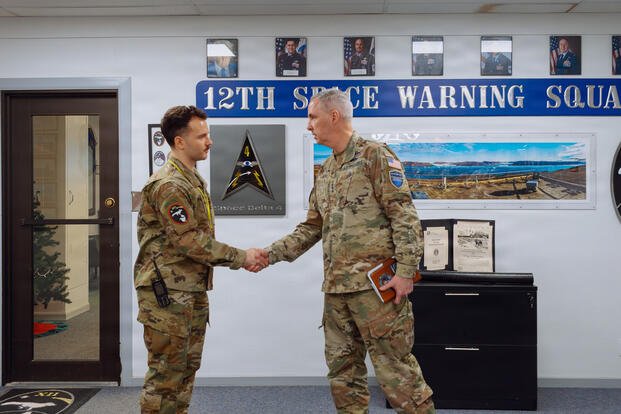
Gen. Stephen Whiting, commander, U.S. Space Command, coins Capt. Bartholomew Winn, Mission Support Flight commander assigned to 12th Space Warning Squadron, during a tour of the 12 SWS facilities at Pituffik Space Base, Greenland, Dec. 6, 2025. During his visit, Whiting toured facilities, received mission briefs, and met with personnel, underscoring the base’s critical role in the command’s mission, Arctic operations, and mission readiness. (U. S. Space Command photo by Senior Airman Erica Paculan)
The United States already maintains a significant military presence in Greenland on Pituffik Space Base, formerly known as Thule Air Base, located 750 miles north of the Arctic Circle. Established under a 1951 defense agreement between the United States and Denmark, the base serves as a critical early warning station for ballistic missiles and space surveillance operations.
The agreement grants the U.S. military permanent rights to operate the installation while respecting Danish sovereignty over Greenland. Approximately 150 U.S. Space Force personnel are currently stationed there.
Greenland is a self-governing territory within the Kingdom of Denmark with a population of 57,000, mostly Indigenous Greenlanders. Greenland Prime Minister Jens-Frederik Nielsen called the U.S. position “completely unacceptable” and demanded respect for international law.
This situation carries particular weight given Denmark’s military record as part of NATO. Danish soldiers fought and died in both Afghanistan and Iraq alongside American forces. They deployed to the most dangerous combat zones and suffered high casualty rates given their small size. Danish veterans suffered from PTSD and other issues stemming from the conflicts.
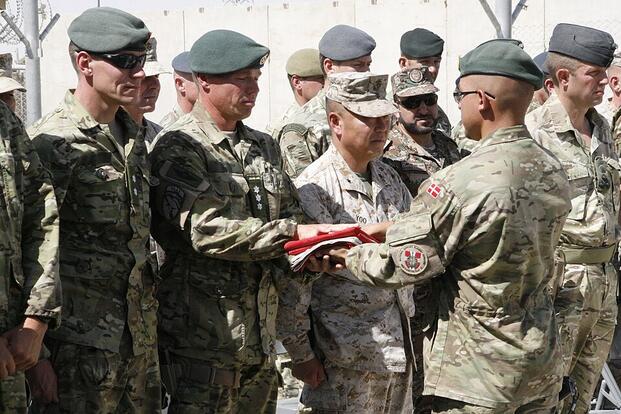
A soldier with the Danish Contingent presents the Denmark flag to Danish Army Col. Micheal Thogersen, DANCON commander, during a flag-lowering ceremony aboard Camp Leatherneck, Helmand province, Afghanistan, July 21, 2014. (Wikimedia Commons)
Helmand Province In Afghanistan
Denmark’s deepest military commitment came in Afghanistan. After September 11, 2001, Denmark pledged support for the U.S. By 2006, Danish forces had moved into Helmand Province in southern Afghanistan, which would become the deadliest battleground of the 20-year war.
In August 2006, Danish troops found themselves besieged at the Musa Qala district center for three weeks. The Danish squadron held their position under relentless Taliban assault until a relief force of 500 coalition troops fought through to assist them. Danish soldiers suffered several casualties in combat operations over the years.
Sophia Bruun was 12 years old on September 11, 2001. She joined the Danish military as an adult and volunteered for a deployment to Afghanistan. Private Bruun then joined a patrol on June 1, 2010. The 22-year-old was manning a machine gun on an armored Piranha vehicle near Girishk when a roadside IED detonated. She died instantly.
Just weeks earlier, she had stayed at her gun position during a Taliban attack, providing covering fire while treating wounded comrades. She had already chosen what her gravestone would say if she died in combat.
It reads “Sophia – wanted to make the world a better place.”
Sgt. Jacob P. of the Jutland Dragoon Regiment was wounded twice but refused evacuation both times. On January 5, 2012, a sniper’s bullet struck his right shoulder. Jacob stayed at his position, located the enemy fighter through his tank’s optics, and killed him. The sniper had already killed five British soldiers.
Three weeks later, three more bullets hit Jacob. He remained at his post directing his crew to eliminate the insurgents. His loader plugged the shoulder wound with his finger to stop the bleeding.
Maj. Gen. John Toolan, commanding general of U.S. forces in southwest Afghanistan, visited Jacob in the hospital. “You’re not only going to go down in Danish lore,” Toolan told him, “But you’re going to go down in USMC lore.”
In June 2009, 700 Danish soldiers participated in Operation Panther’s Claw, one of the war’s largest offensives. Danish Leopard 2 tanks supported British and Afghan forces pushing into Taliban strongholds in close-quarters combat.
Though smaller than their coalition counterparts, the Danes provided vital military assistance and helped the locals build schools, roads, and helped guard infrastructure projects.
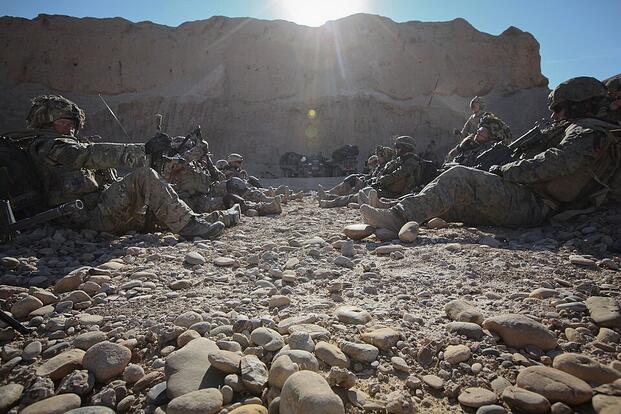
British soldiers from 2nd Battalion, The Rifles and Danish soldiers from the Danish Battle Group enjoy down time before beginning a long day of patrolling in the district of Nahr-e Saraj, Helmand province. Alongside the Afghan National Army and Afghan Uniformed Police, the coalition servicemembers executed Operation Shamali Kamarband, an Afghan-led clearing operation of various routes and compounds in the area. (Wikimedia Commons)
Deployment to Iraq
The Iraq War, on the other hand, divided NATO. France and Germany refused to join the 2003 invasion, even going as far as joining Russia in condemning the conflict. They questioned the intelligence about weapons of mass destruction and argued the war lacked international legitimacy.
Denmark joined anyway. Prime Minister Anders Fogh Rasmussen committed troops to the U.S.-led coalition. The small nation sent a battalion to Basra Province in southern Iraq. At peak strength, Denmark deployed more than 500 soldiers. They fought from 2003 to 2007.
U.S. President George W. Bush praised Denmark’s contributions when speaking with Rasmussen in 2004. “The moms and dads of those troops need to know they’re performing brilliantly,” Bush said. “They’re good, strong soldiers who bring great credit to your country.”
Lance Corporal Preben Pedersen of the Jutland Dragoon Regiment became the first non-U.S., non-British coalition soldier killed in Iraq. He died on August 17, 2003. He was 34 years old.
Six more Danish soldiers died over the next four years. Private Martin Hjorth was killed in combat on October 6, 2006. Private Henrik Nøbbe died in another ambush on May 14, 2007. First Lieutenant Bjarke Kirkmand, Private Jesper Nielsen, and Lance Corporal Kim Wadim were all killed by IEDs.
Denmark’s own War Inquiry later revealed that Danish politicians discussed the Iraq deployment primarily in terms of maintaining good relations with the United States. The mission itself was considered secondary to demonstrating solidarity with America.
Danish forces maintained a presence in Iraq as part of the NATO Mission in Iraq and Operation Inherent Resolve. Danish soldiers are still deployed to the region alongside their American allies.
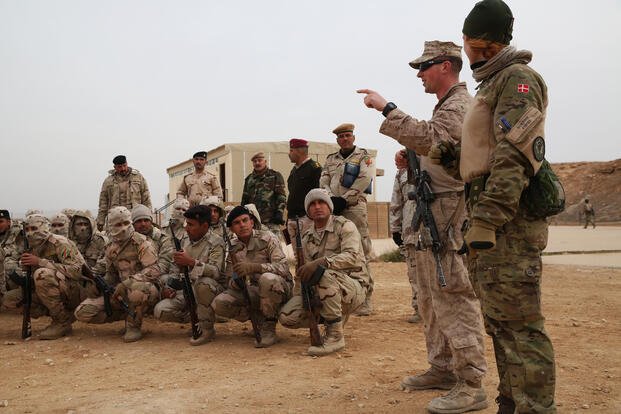
U.S. Marine Chief Warrant Officer 2 Juan Rodriguez, Special Purpose Marine Air Ground Task Force – Crisis Response – Central Command, and Danish 1st Lt. Daniel Cramer, both with Task Force Al Asad, teach a Counter-Improvised Explosive Device class to Iraqi Army officers, aboard Al Asad Air Base, Iraq, Jan. 30, 2015. Coalition forces from TF Al Asad are facilitating a six-week training program for Iraqi soldiers in an effort to build partner capacity and help Iraqi security forces degrade and defeat Daesh. (U.S. Marine Corps Photo by Cpl. Carson A. Gramley/ Released)
The Casualties
Denmark lost 43 soldiers in Afghanistan between 2002 and 2014. Combined with seven killed in Iraq, Denmark suffered 50 military deaths in support of U.S.-led operations.
For a nation of 5.8 million people, the casualty rate was devastating. Denmark’s death rate reached 8.62 per million citizens. Only the United States at 21.06 per million and United Kingdom at 9.49 per million exceeded that figure. Denmark suffered the third highest casualty rate per capita of all NATO nations that fought in both wars.
Between 2002 and 2021, Denmark deployed 18,000 troops to Afghanistan. At peak deployment, Denmark maintained 760 soldiers in Helmand Province. They deployed tanks, F-16 fighters, special forces, and infantry units. They were not simply providing security in both conflicts, they were actively going out and engaging enemy combatants alongside U.S. troops.
U.S. Secretary of State Condoleezza Rice visited Denmark in December 2008 after two Danish soldiers were killed in combat. She told Danish officials that “Denmark has been a terrific ally in this fight against terrorism and in support of democracy and freedom.”
President Barack Obama thanked Denmark in 2012 for its “extraordinary contributions” in Helmand, noting that Danish troops operated “without caveat” and had “taken significant casualties.”
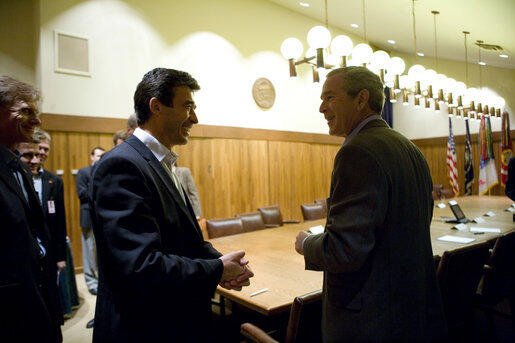
President George W. Bush and Prime Minister Anders Fogh Rasmussen of Denmark meet at Camp David Friday, June 9, 2006. White House photo by Eric Draper.
NATO Spending and Arctic Defense
Denmark failed to meet NATO’s 2 percent GDP defense spending guideline for years. The country spent approximately 1.3 percent of GDP on defense through most of the 2010s, reaching 1.65 percent by 2023. This came despite Denmark’s combat deployments and casualty rates in Iraq and Afghanistan.
Officials in the Trump administration have cited Denmark’s spending shortfall when questioning Denmark’s commitment to the alliance and its ability to defend Greenland. Trump outright told reporters that “Denmark is not going to be able to” protect Greenland from outside threats.
In 2024, Denmark finally reached the 2 percent threshold. The Danish parliament approved significant defense increases, committing to reach 3.22 percent of its GDP by 2025. At the 2025 NATO summit, Denmark committed to the alliance’s new target of 5 percent over the next decade.
The additional funding includes major equipment purchases. Denmark is acquiring CV90 infantry fighting vehicles, air defense systems including Patriot and IRIS-T batteries, and 27 F-35A fighters to replace its aging F-16 fleet.
Denmark also announced nearly $2.3 billion in spending specifically for Arctic defense capabilities, including three new Arctic naval vessels, two long-range surveillance drones, and enhanced satellite capacity for Greenland.
Denmark extended conscription to include women starting in 2027 and increased annual conscript numbers from 4,700 to 7,500. Given recent tensions with Russia, Denmark has shown it is willing and capable of pursuing the defense of Europe with the assistance of the U.S.
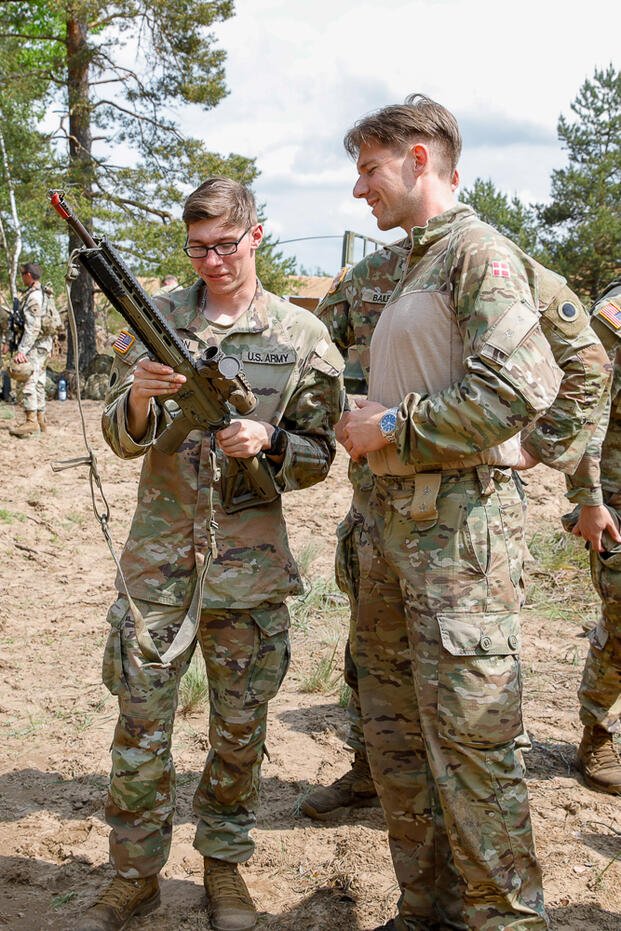
U.S. Army Spc. Andrew Gagnon, an infantryman with Charlie Company, 1st Battalion, 125th Infantry Regiment, 37th Infantry Brigade Combat Team, Michigan Army National Guard and a Danish Armed Forces officer share knowledge of weapons and deployment tactics during Exercise Baltic Viking at Camp Ādaži, Latvia, June 6, 2025. The exercise provided U.S. and NATO soldiers the opportunity to exchange ideas and strategies, improving interoperability among allies and enhancing their lethality on the battlefield. (U.S. Army photo by Staff Sgt. Joseph Novak)
Alliance Under Pressure
The Trump administration’s position on Greenland represents an unprecedented challenge to NATO. No NATO member has ever threatened military action against another member state since the alliance’s founding in 1949. White House statements that military action remains “an option” against a NATO ally have no modern precedent.
If the United States were to attempt military action against Greenland, Denmark would face the choice of whether to invoke NATO’s Article 5 mutual defense clause. Under Article 5, an armed attack against one NATO member is considered an attack against all members.
The alliance has invoked Article 5 only once, after the September 11, 2001 terrorist attacks, when NATO allies including Denmark deployed forces to Afghanistan in support of the U.S.
Senator Chris Murphy stated that NATO countries would have to defend Greenland under Article 5 if the United States under Donald Trump attacked. “We’re laughing, but this is not actually something to laugh about now because I think he’s increasingly serious,” Murphy said.
Senator Ruben Gallego introduced legislation to prohibit the use of military funds for any action against Greenland.
Danish Prime Minister Frederiksen has pointed to Denmark’s military record in response to recent White House statements.
“For many years, we have stood by the Americans in very difficult situations,” she said, referencing Danish deployments in Iraq and Afghanistan where dozens of Danes were killed.
European defense analysts at institutions including the Royal Danish Defense College and European Policy Centre have warned that NATO members must now privately consider contingency planning for scenarios they previously considered unthinkable, including what defending Denmark from the United States would require.
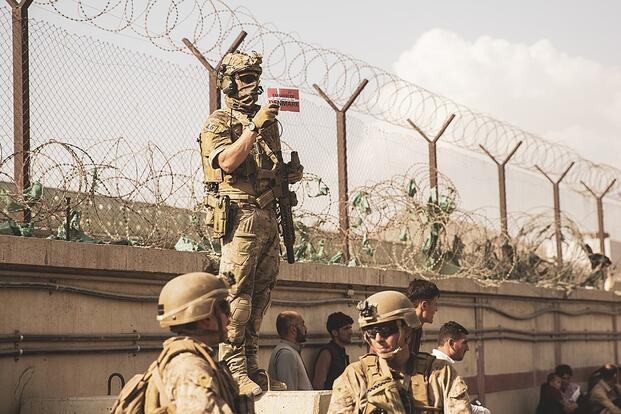
Danish soldier at Hamid Karzai International Airport during the 2021 Kabul Airlift. (Wikimedia Commons)
Denmark joined the Iraq War when major European allies refused. Danish families buried seven soldiers who died in Basra Province fighting America’s war. In Afghanistan, Denmark deployed forces to Helmand Province and lost 43 soldiers over 12 years of combat in a conflict that arose after the U.S. was attacked. These commitments were made based on alliance obligations and the promise of mutual defense.
Critics on both sides of the Atlantic now question what right the U.S. has to threaten an ally who volunteered to fight alongside American soldiers in two different conflicts. Denmark deployed tens of thousands of troops to Afghanistan and Iraq over two decades and suffered the third-highest per capita casualty rate in NATO.
In return for their sacrifices, the U.S. government is floating the idea of taking and annexing Greenland, a territory Denmark has controlled for longer than the U.S. has even existed.
The United States threatening to seize Greenland by force from an ally that lost 50 soldiers in Iraq and Afghanistan destroys American credibility around the world. Every nation that depends on U.S. protection is taking note. So is every adversary.