
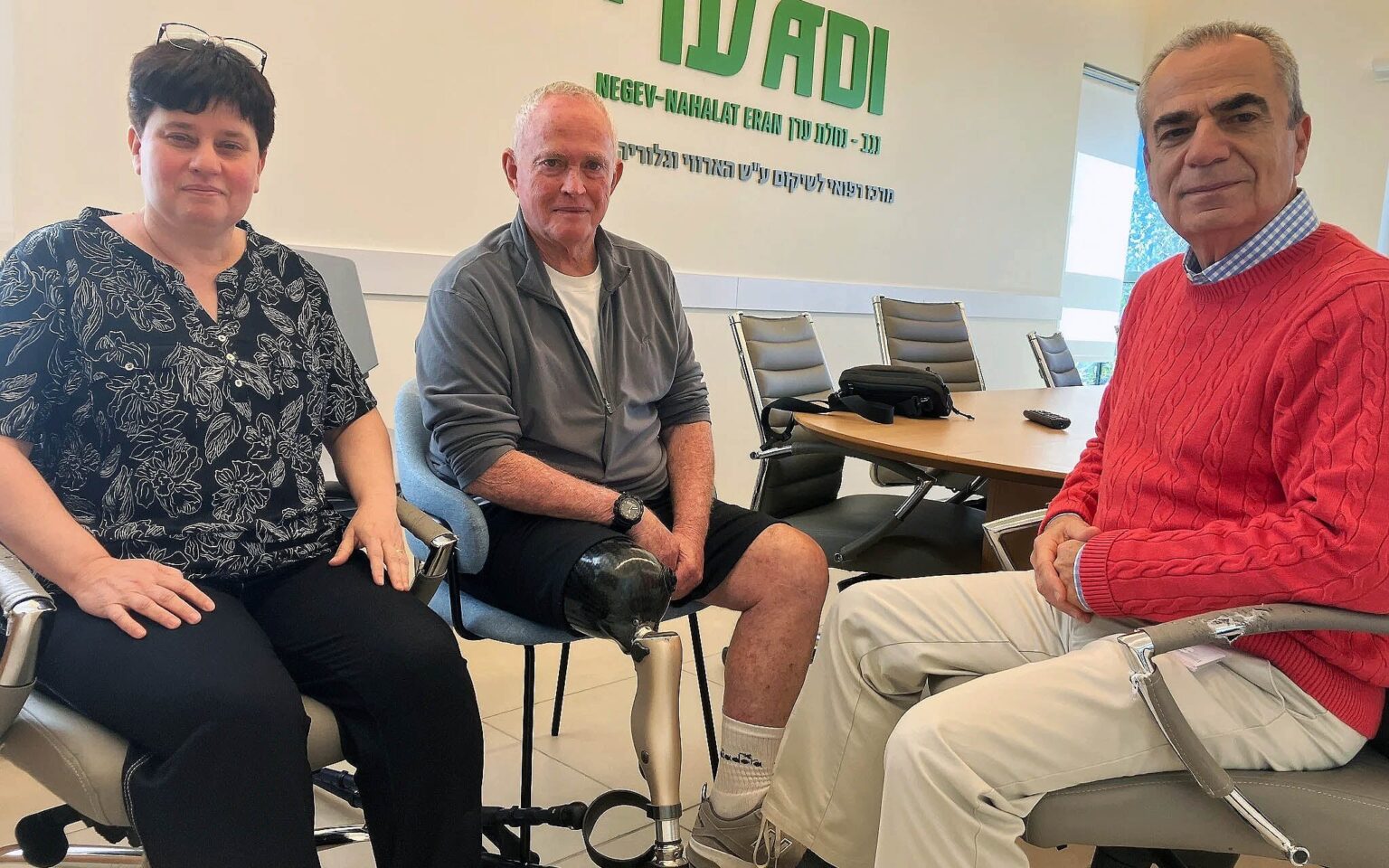
ADI NEGEV — Baruch Cohen, 74, the former security coordinator at Kibbutz Magen, lost his right leg while fighting against dozens of Hamas terrorists who had infiltrated the kibbutz from Gaza during the onslaught of October 7, 2023.
Cohen said that now, whenever he is in a crowd of people, he first looks at their legs.
“I can tell if they have prosthetics and are amputated above the knee or below the knee, even if they’re wearing pants,” Cohen told The Times of Israel at the ADI Negev-Nahalat Eran rehabilitation village, about 40 minutes from Beersheba, where he is an outpatient.
A retired lieutenant colonel in the paratroopers, Cohen and his team were credited with repelling waves of invading terrorists intent on perpetrating a mass slaughter at Kibbutz Magen. But during the fighting he was shot in the leg, and eventually had it amputated. He spent months in rehabilitation and was fitted with a prosthetic leg, but remained in “terrible pain,” he said.
It was not until Cohen flew to Chicago in August 2025 for a new prosthetic leg that he began to feel some relief. The new limb he got there, he said, “even has cushioning so I can drive for hours and I’m not in pain.”
With the opening of the School of Prosthetics and Orthotics at the ADI Negev rehabilitation village, Israel now has a specialized facility of its own for amputees like Cohen, who said “nobody is happier” about it than he is.
A Defense Ministry spokesperson said it paid for the expenses of Cohen’s trip abroad to receive his prosthetic leg and also funded trips for prosthetic fittings for the other 87 recent amputees.
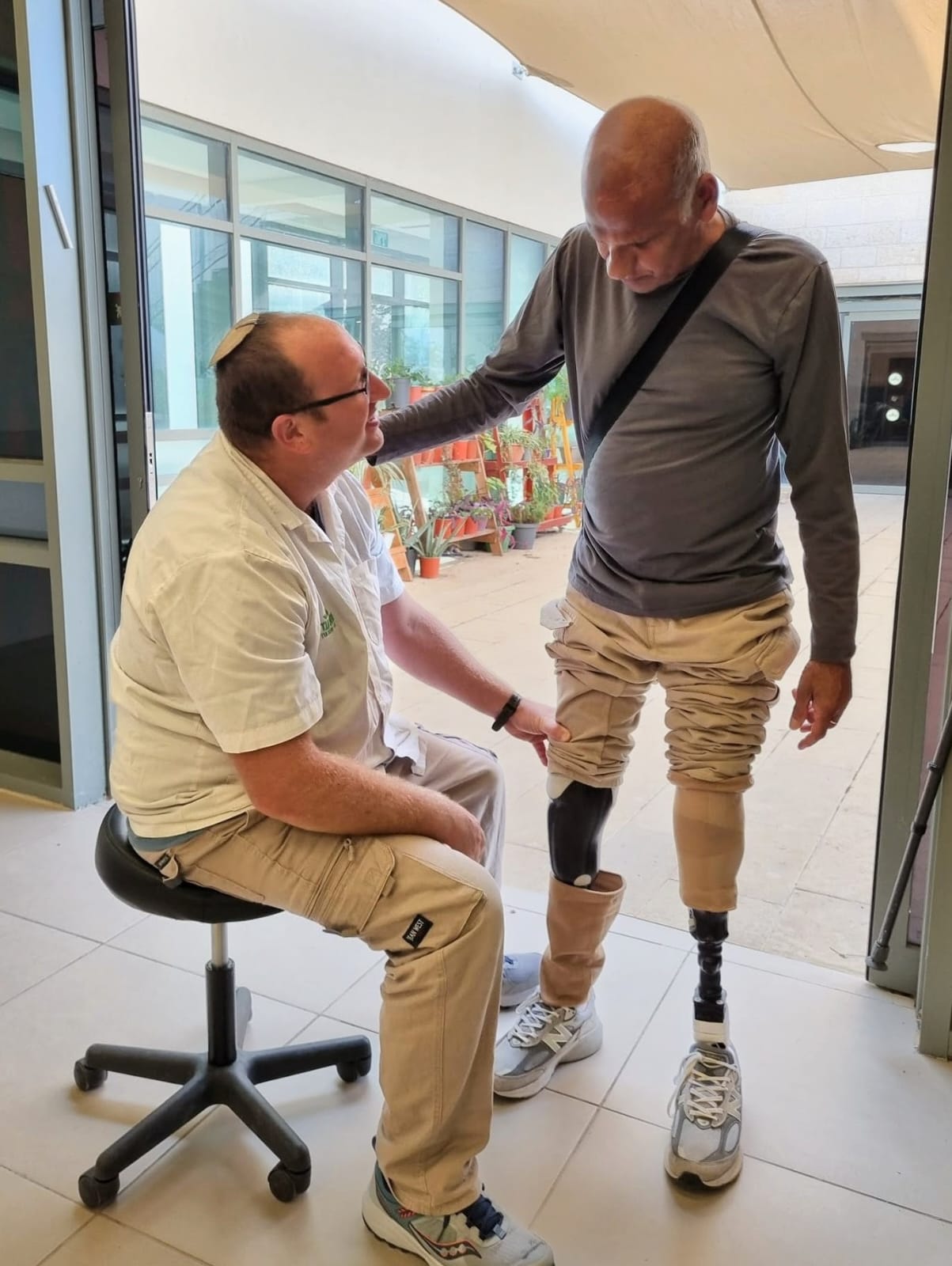
Shaul Raziel, left, a physical therapist at the Kaylie Rehabilitation Medical Center at ADI Negev-Nahalat Eran, who is a student at the village’s School of Prosthetics and Orthotics, examines a war-wounded double amputee from southern Israel. (Courtesy)
There are currently 1,061 amputees in Israel who lost limbs in injuries from military activities, including 88 troops wounded in fighting against Hamas in Gaza and Hezbollah on the border with Lebanon since October 7, 2023, the Defense Ministry says.
According to ADI Negev, there are roughly an additional 18,000 amputees in Israel, a figure that includes those disabled due to illness, accidents, and civilians wounded in war and terror attacks.
Until November, though, when the institute opened in conjunction with Ben-Gurion University’s Recanati School for Community Health Professions, there had never been a formal educational training program for certified prosthetists and orthotists, or CPOs, in Israel. The school does not yet have a formal name.
“There’s no reason why amputees have to travel abroad for prosthetics at the highest level,” said Dr. Tzaki Siev-Ner, director of ADI Negev’s Kaylie Rehabilitation Medical Center and head of the school, speaking to The Times of Israel in his office. “The start-up nation should have advanced prosthetics.”
The new school, which offers a master’s degree program, is recognized by the International Society for Prosthetics and Orthotics and receives funding from the Health Ministry, the Jewish Federations of North America, and Jewish National Fund-USA.
Siev-Ner said the school will give students the academic knowledge to build prosthetics and orthotics using advanced materials and computerized technology.
“It will be an incubator for innovation and entrepreneurship in prosthetics and orthotics,” he said. “It sounds ambitious, but I’m standing behind it.”
Yael Dotan-Marom, the school’s academic director, who has been working with amputees for many years, said that the school is her “mission.”
The program runs five days a week for two years. Students receive a stipend and a full tuition waiver.
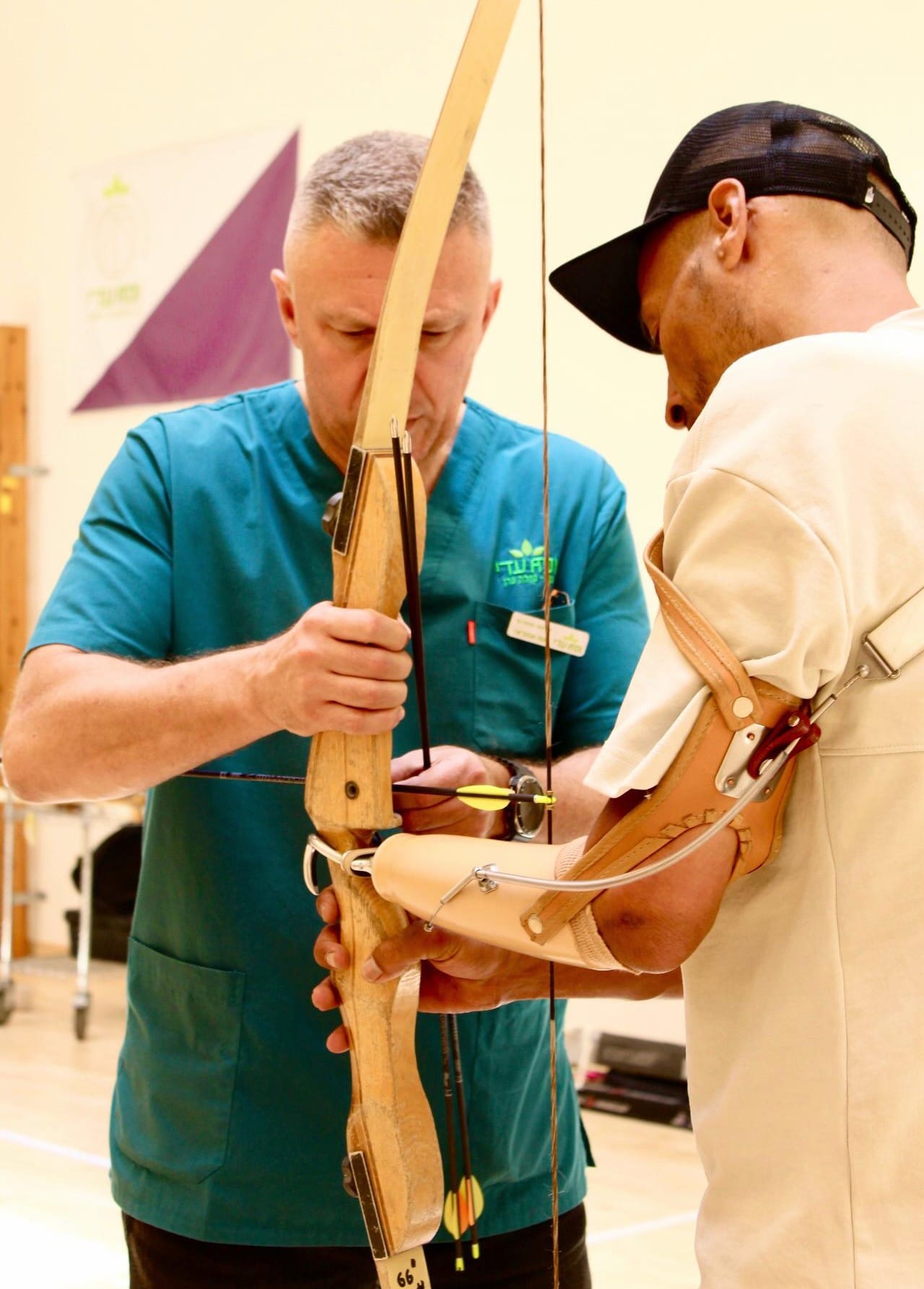
At the ADI Negev-Nahalat Eran sports therapy complex, a physical therapist helps a patient with a prosthetic arm prepare for an adapted archery session. (Courtesy/ADI Negev-Nahalat Eran)
The school’s first cohort has 12 students, of whom seven are physical therapists, and five are occupational therapists. Two of them have suffered war injuries themselves, five are women, and one is an Arab Israeli.
“Having diverse students is very important to me,” Dotan-Marom said.
Among them is Alexander Yurovitsky, 39, a physical therapist who said he always wanted to study prosthetics because his grandfather, a Russian war veteran, fought against the Nazis and was amputated below the knee.
“I always saw his prosthetic leg as kind of cool, in a way,” Yurovitsky said.
He had explored studying to become a CPO abroad, but ruled it out because it was too expensive.
“As soon as I heard I’d gotten into the school, I dropped everything in Haifa and moved to southern Israel,” he said.
‘I couldn’t give them what they needed’
The school is situated on the ADI Negev campus, set on 40 leafy acres just outside Ofakim, about 25 kilometers (15 miles) west of Beersheba.
There, the students learn to be CPOs and work with some of the 400 residents as well as hundreds of outpatients.
There are currently five certified CPOs in Israel, all trained abroad. Siev-Ner said that the majority of technicians working with prostheses learned their trade from mentors rather than in an accredited program.
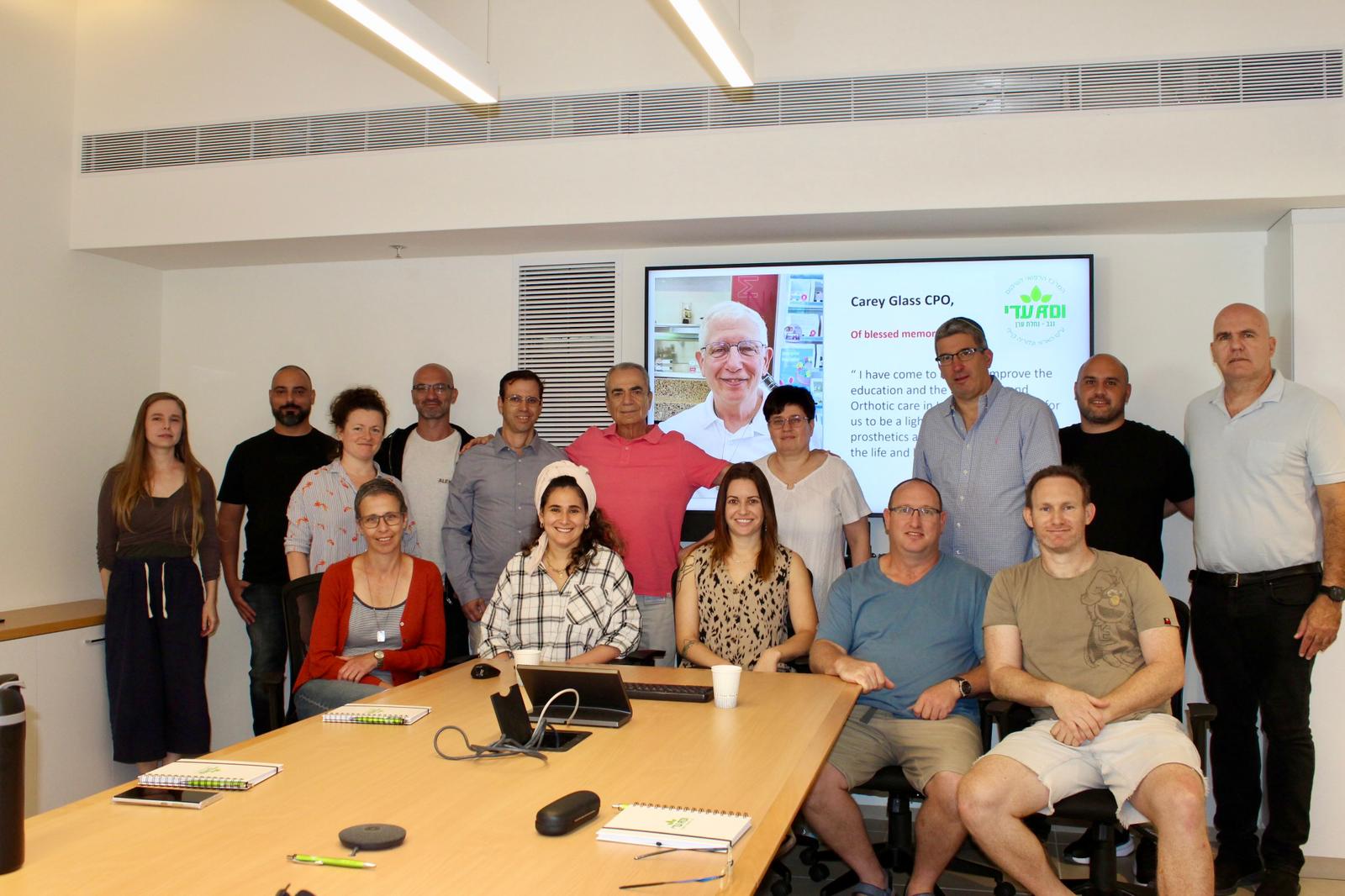
The first 12 students of the School of Prosthetics and Orthotics at ADI Negev-Nahalat Eran, in conjunction with Ben-Gurion University of the Negev. Dr. Tzaki Siev-Ner, the head of the school, is in red; to his left, Yael Dotan Marom, the school’s academic director. In the background is a photo of the school’s clinical adviser, New Jersey native CPO Carey Glass, who died one week before the school’s opening. (Courtesy)
Prof. Yigal Flekht, head of the Recanati School for Community Health Professions at Ben-Gurion University, said the school will “develop expertise in a critical and highly needed field in Israel, to help streamline and shorten the rehabilitation process for the injured.”
A prosthesis is an artificial appliance that substitutes for a missing body part. Orthotics are used to support or stabilize a body part during acute or long-term injury to the bone and soft tissue. Orthotics can also be used to aid a patient with a neurological condition such as cerebral palsy or multiple sclerosis.
Utay Ostrei, 49, an occupational therapist at Soroka University Medical Center in Beersheba, said that he became even more aware of how “critical” orthotics were during the war.
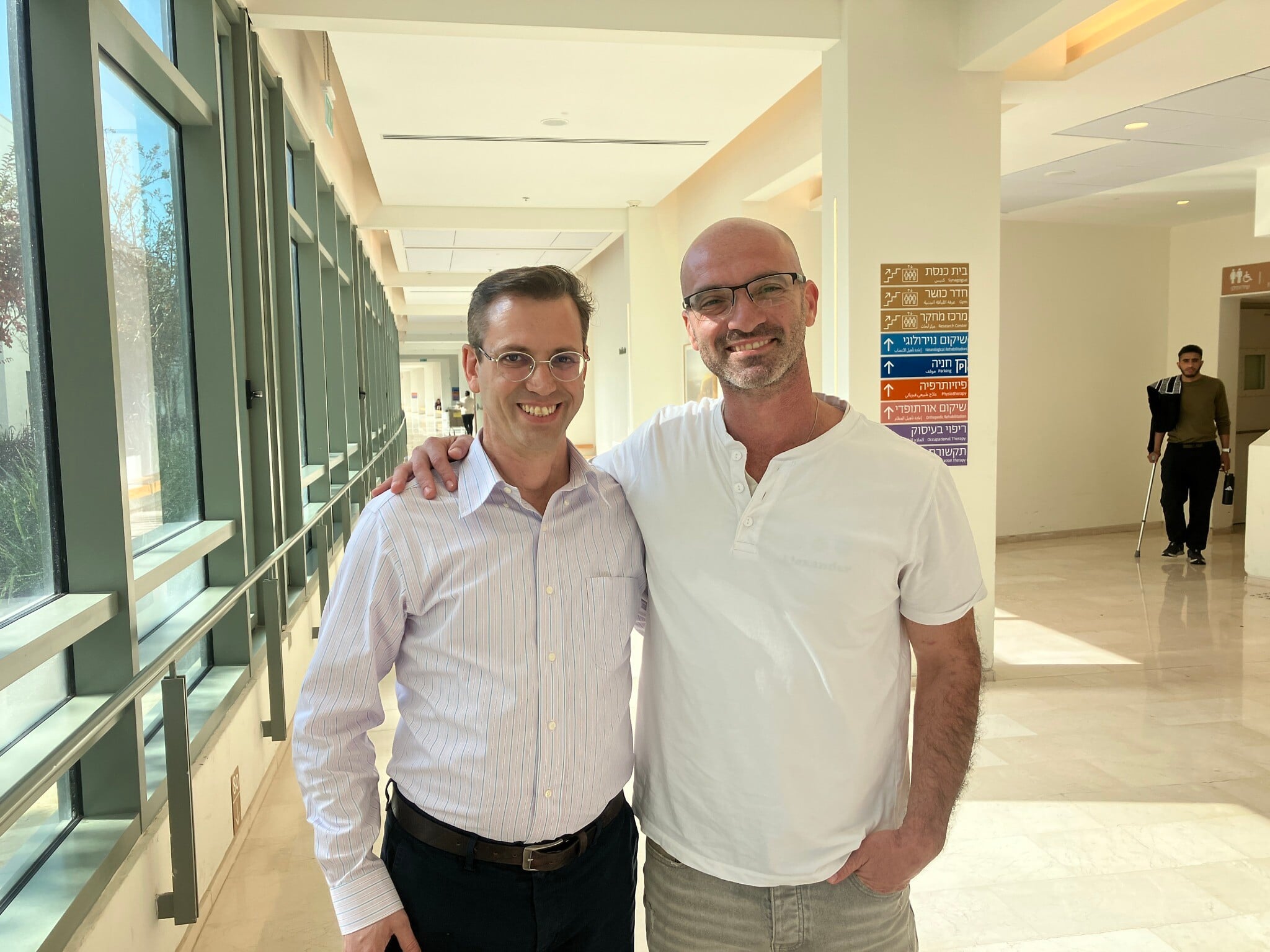
Utay Ostrei, left, and Alexander Yurovitsky, two of the 12 students at the ADI Negev-Nahalat Eran School of Prosthetics and Orthotics, the first-ever school of its kind in Israel. (Diana Bletter/Times of Israel)
“I wanted to help the wounded,” he said. “They were young soldiers, beautiful souls, but I couldn’t give them what they needed because I didn’t have enough knowledge.”
At Ostrei’s own expense, he attended an orthotics conference in the United States, and then visited a prosthetics facility in Maryland, where he met two Israeli soldiers being fitted for devices.
“It was crazy that they had to go all the way over there to receive prosthetics,” Ostrei said. “I know the necessity. I’m eager to learn more so that people here receive the best quality prosthetics and orthotics that they deserve.”