
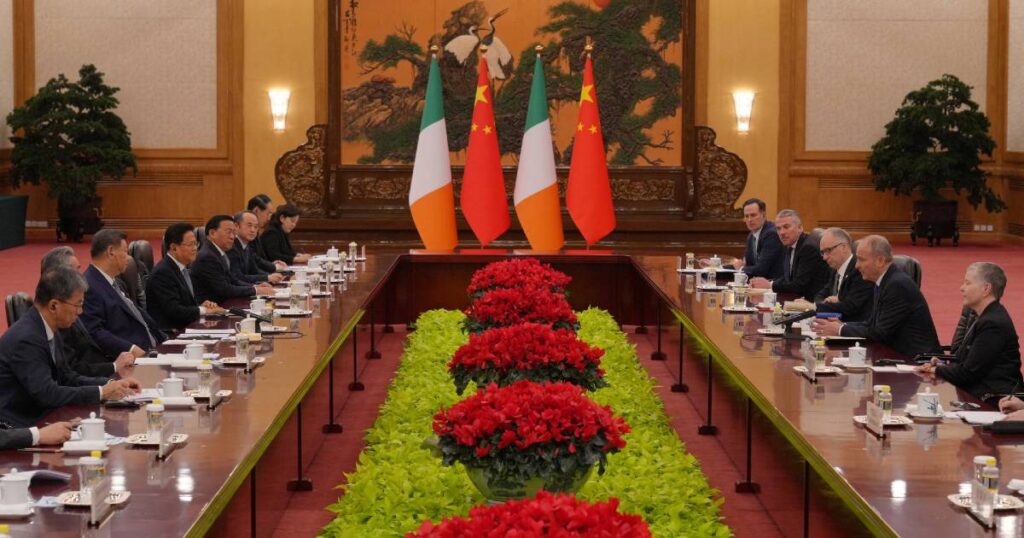
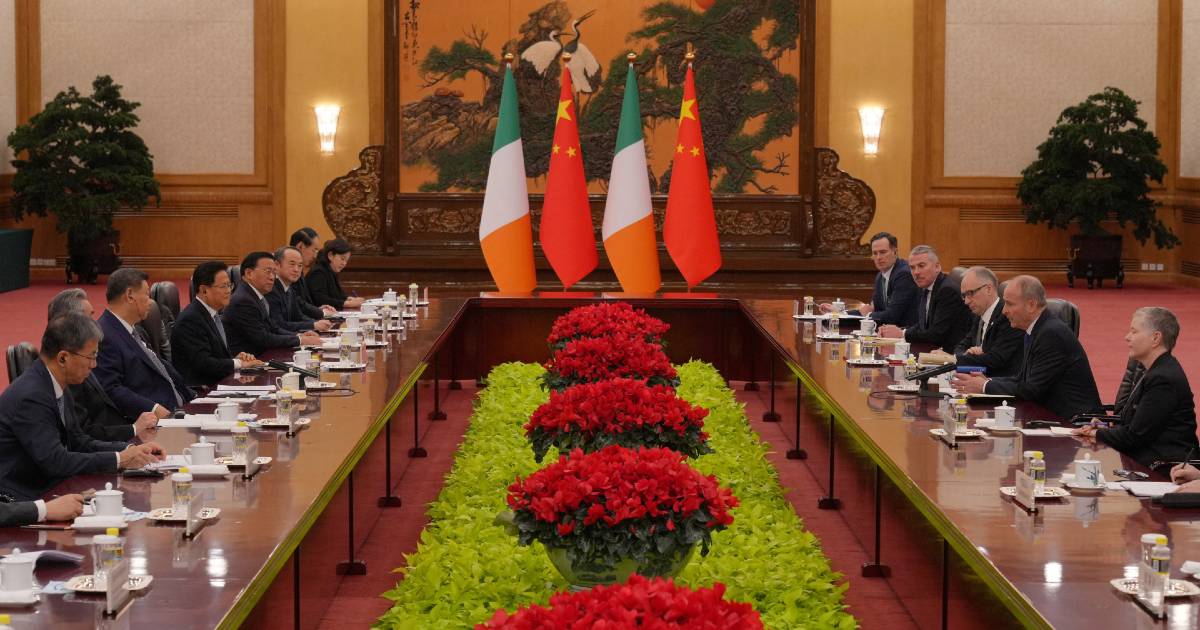
This week Irish Taoiseach (Prime Minister) Micheal Martin met the three top leaders of China, including President Xi Jinping, the world’s second most powerful man.
The meetings were much more comfortable than his last encounter with the most powerful, Donald Trump, on March 12 last year. Martin emphasised the benefits of their bilateral relations but Trump told him off for “taking” U.S. pharmaceutical companies and the trade deficit with Ireland.
In 2024, Ireland had a trade surplus of just over 50 billion euros with the U.S., with goods exports of 72.6 billion and imports of 22.5 billion. “Of course, Ireland is taking advantage of the U.S.,” Trump said. Martin was making the traditional visit to the White House to mark St Patrick’s Day.
Xi was more polite than Trump. “China is willing to strengthen strategic communication with Ireland and expand pragmatic co-operation,” he said. He mentioned artificial intelligence, digital economy, medicine and healthcare as areas of co-operation.
Martin also picked AI, as well as science and technology, biomedicine, renewable energy and education. China is Ireland’s largest trading partner in Aisa and its fifth largest globally. Its main exports are medical equipment, pharmaceuticals, computer services and agricultural products.
Martin also met Prime Minister Li Qiang and Zhao Leji, chairman of the National People’s Congress, the Parliament. It was the first visit to China by an Irish Taoiseach for 14 years.
There was a good reason for this red-carpet treatment. Beijing needs a friend in an increasingly hostile European Union. Ireland will hold the Presidency of the EU Council for six months from July this year.
In 2025, China had a trade surplus with the EU of 305.8 billion euros, up from 297 billion in 2023, as exporters rerouted goods that would otherwise have been sold to the U.S. but for Trump’s tariffs.
In December, in an article in the Financial Times, French President Emmanuel Macron wrote that the trade imbalances were becoming unbearable. “China must address its internal imbalances or Europe will have no choice but to adopt more protectionist measures.”
He passed this message to President Xi in Beijing in December but received no positive response.
These tensions were vividly illustrated last November when lowcost online retailer Shein opened a physical store in one of Paris’ most iconic department stores, BHV Marais, opposite Paris City Hall. While many queued to enter, others gathered to protest. Riot police were called to keep order.
An online petition opposing the Shein store gathered more than 120,000 signatures. They opposed it for poor environmental, labour and human rights practices, and selling sex toys and weapons on its site.
Among EU countries, Ireland is among the most favourable to open trade.
Martin said in Beijing: “Ireland is against tariffs, which are ultimately damaging to the global economy. We need to address economic security concerns through co-operation.
“Ireland is a small island, but we have a big economy built on open trade, exporting nearly 90 per cent of what we manufacture. You can understand our attachment to an open free trade environment,” he said.
But the governments of France and Germany are alarmed by the flood of Chinese goods, especially electric vehicles and increasingly high-tech products. They want China to shift its economic strategy to promoting domestic consumption and reviving the dismal property market.
China is Ireland’s fifth largest trading partner, fifth largest goods export market and fourth largest services export market. From 2017 to 2022, the value of goods exported to China increased by 203 per cent to 13.2 billion euros and imports more than trebled to 14.4 billion euros. In 2024, bilateral trade was 23.42 billion euros, with Ireland having a surplus.
As of the end of 2023, Irish foreign direct investment (FDI) in China was US$3.15 billion, mostly in the production of food, drinks and construction materials. As of the same date, Chinese FDI in Ireland had reached US$2.04 billion, with 40 companies, including Huawei, ICBC International Leasing and CDB Leasing International.
Online retailers Shein and Temu both operate European operations out of Ireland. In 2023, Shein Ireland reported sales of 7.68 billion euros and nearly 100 million euros in post-tax profits. Temu reported sales of 693 million euros in the July 2022-December 2023 period and pre-tax profits of 40 million euros.
Martin’s visit to China was a success. But it has left him with much to do after his return to Dublin.
