
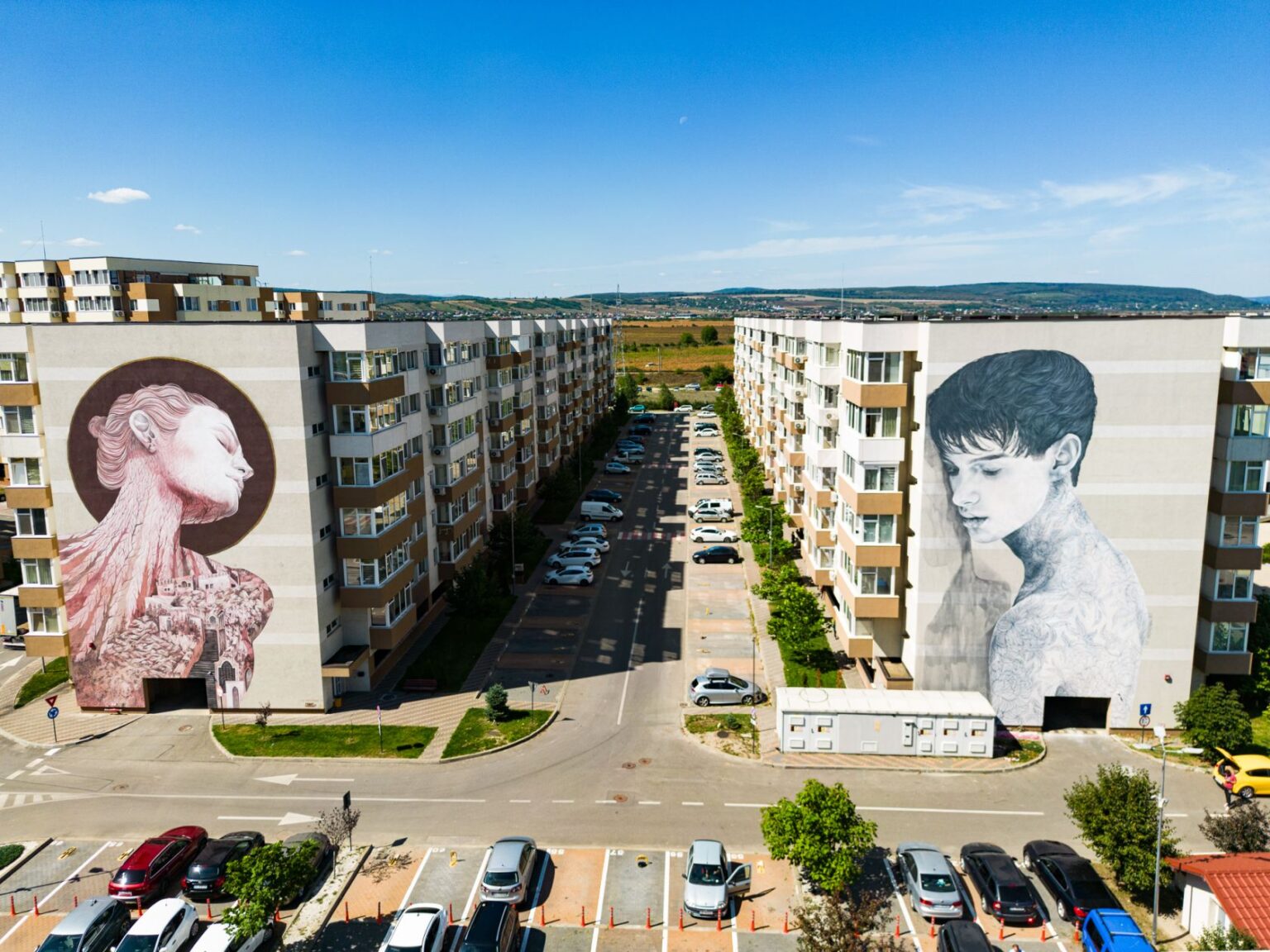
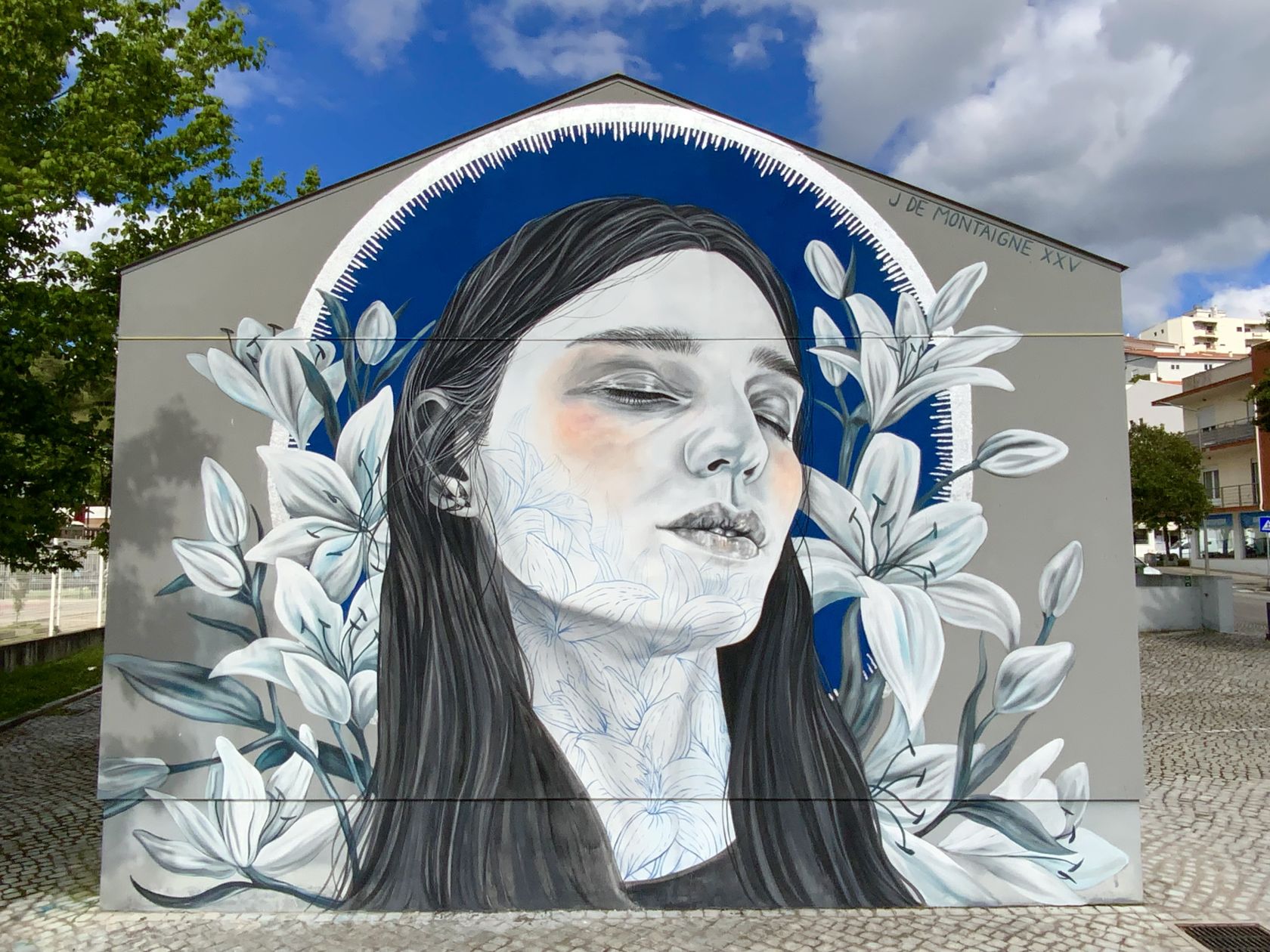
Created during the pandemic, the mural The Language of Flowers, located in Lisbon, became one of Jacqueline’s most resonant works. In 2023, it was ranked 35th in the top 100 murals worldwide. This made Jacqueline the first Portuguese woman to achieve this recognition.
Jacqueline has an Anglo-Portuguese heritage, which influenced the way she sees the world around herself. She spent summers in the Algarve and Cascais and winters on a farm in the Alentejo. From here came her love for blue from azulejos and the traditional southern houses, for flowers, and for nature. “In Lisbon, I focus on nature — you can never bring too much of it into an urban space. In the Algarve, my work leans more toward tradition. Our area is one of the last “un-touristy” places, and I try to honour that heritage.”
A Life in Motion
Today, she divides her time between Cascais and Príncipe Island, travelling worldwide for murals and exhibitions. She can take her work anywhere, which brings both freedom and restlessness. “I still spend about half the year in Portugal, but ‘home’ has become more of a feeling than a place. Home is where my sons and my partner are — for now, that’s divided between Príncipe and Cascais.”
Although Jacqueline began painting publicly only a few years ago, her murals now appear worldwide. When asked about this professional growth, she says everything happens when it’s supposed to. A lot led up to the moment she finally had the courage to transition into a full-time art career. As a single mother, she didn’t have the luxury of simply “having a go.” First, she needed to be sure she could live from art — so she tested the waters, doing a bit of everything until she could make the leap. Creating the art is only part of the job; talent is worthless without dedication and the ability to manage your practice like a business.
“I’m proud of the growth, but it’s been an immense amount of work — nights, weekends, holidays, even when I was sick.”
Early Influences and the Language of Flowers
Jacqueline’s artistic roots trace back to childhood. She adored Beatrix Potter, and her great-grandmother gifted her a monthly subscription to her books — Jacqueline still has the full set in my bedroom. That’s where her love of watercolour began.
“My maternal grandfather was a botanical painter, and as a child, I would watch him work in his study in Cascais. When I turned 36, my grandmother gave me his old reference books for my birthday. She loved her garden — especially Freesias — and when she became ill, I began painting them in her honour. Every flower I paint has a secret meaning, but they all connect me to her somehow.”
A Signature Style: Watercolour and Gold Leaf
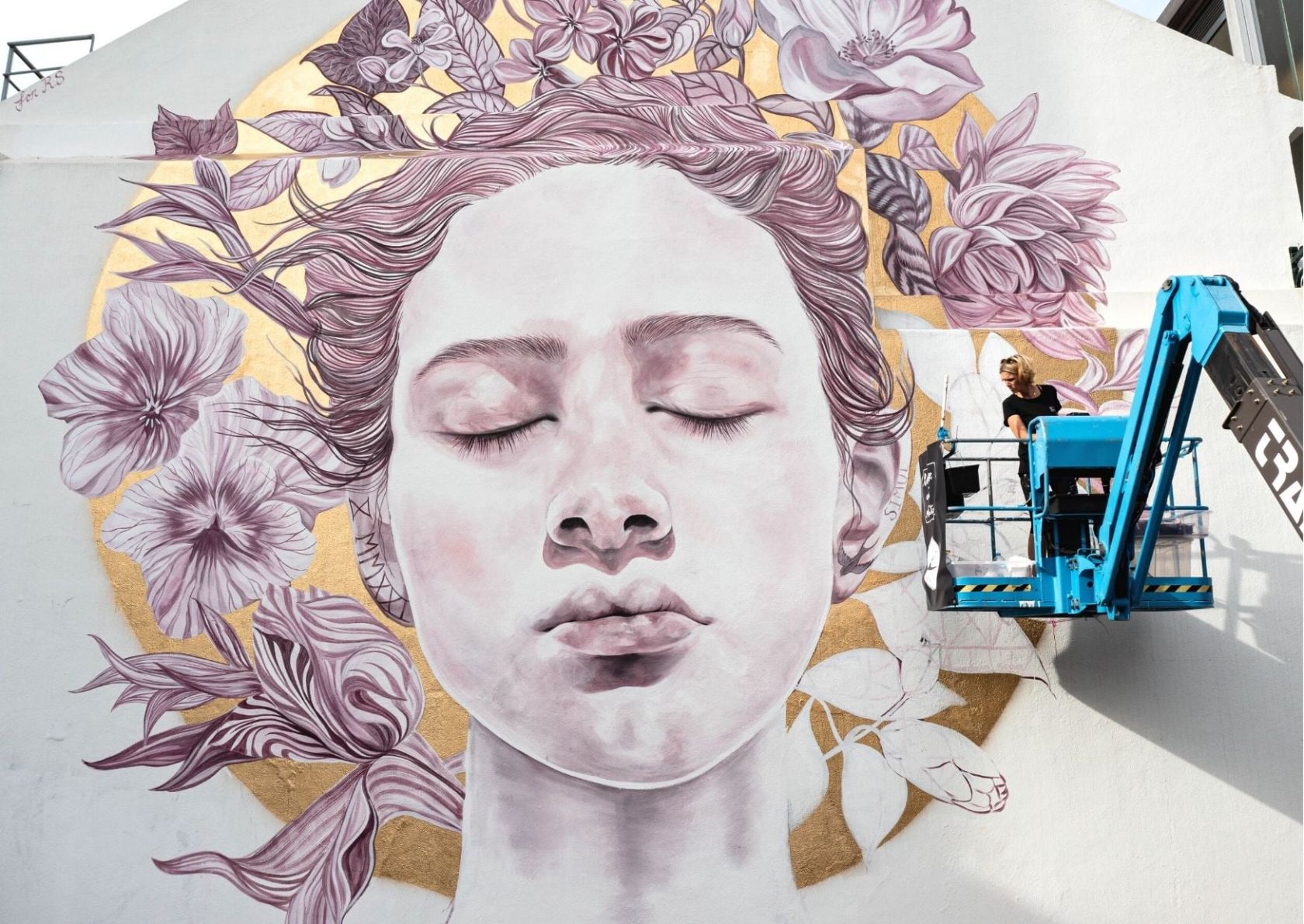
Jacqueline murals are recognisable for their signature blend of delicate watercolour effects with classical gold leaf techniques not usually seen outdoors.
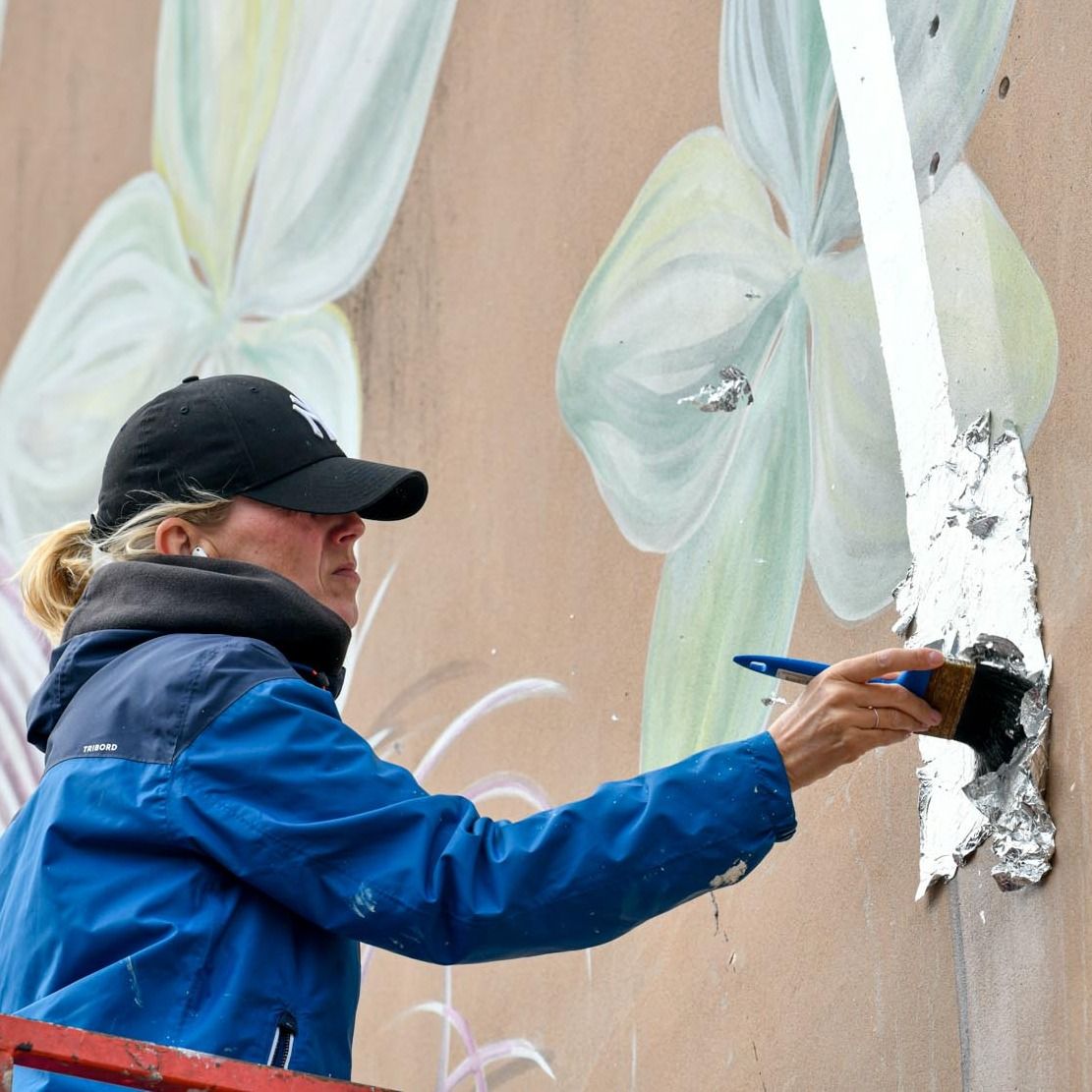
She discovered gold leaf at 18 in an art shop in Belém and had no idea how to use it. She experimented, and 27 years later, she still works with it — nothing compares to the illumination it brings, whether indoors or in a mural glowing under moonlight.
Using metal leaf outside comes with challenges. For Jacqueline, wind is the greatest enemy. A gentle breeze can actually help by holding the leaf in place — but a strong gust can send hundreds of sheets flying in seconds.
From concept to wall
Starting a new mural is a long process that begins with research and pencil sketches. Jacqueline makes endless lists, crosses things out, and narrows her ideas down to three or four key themes: figure, fauna, flora, and the local culture or heritage. She prints photos, lays them out like puzzle pieces, and rearranges them until the composition “clicks.” Then she presents the concept to the client or curator and starts painting.
Once on site, she draws a grid, sketches the mural, and paints — juggling sun, wind, rain, heat, and cold. She travels with her own brushes and pigments so she can work independently anywhere.
For Jacqueline, nature – especially flowers, birds, and animals – is central to her work. She has always been fascinated by nature
“I’m a modern-day naturalist, still seeing the world with a child’s curiosity. Whether in the rainforests of Africa or hiking near our home in the Algarve, I’m endlessly captivated by spiders, snakes, tiny flowers, fungi, or the Mona monkeys that play in the trees above our garden in Príncipe. In another life, I’d probably study Biology or Zoology properly.”
Art as a form of activism, meditation, and storytelling
Activism is in her blood as she grew up in a family deeply involved in charity work. Every project she takes on includes some social dimension. Art is also her meditation. Jacqueline battled depression growing up, and creating always helped her find balance and make sense of what she was going through. “And storytelling — that’s what art is, isn’t it? It’s how we tell the story of who we are, what we go through, what we believe, and the times we live in.”
The Language of Flowers
Jacqueline’s mural, The Language of Flowers, became a global favourite. She created the project during the pandemic. Each flower represents a different kind of love — maternal, platonic, passionate, eternal. During lockdown, she missed those simple acts of affection — a hug from mother or grandmother. “My grandmother was very ill at the time, so the mural became an ode to her and to love itself.”
Human Connections on the Street
Standing in front of her murals, Jacqueline hopes people will get a sense of calmness and bring that to others too. “Painting is how I make sense of emotion — it’s my constant search for peace.”
While painting murals, Jacqueline had several memorable encounters. People are curious, fascinated and eventually grateful. She spends days on their doorstep, so relationships form. People chat, bring food, and check if she and her team have everything they need. Every experience has been moving and heartwarming.
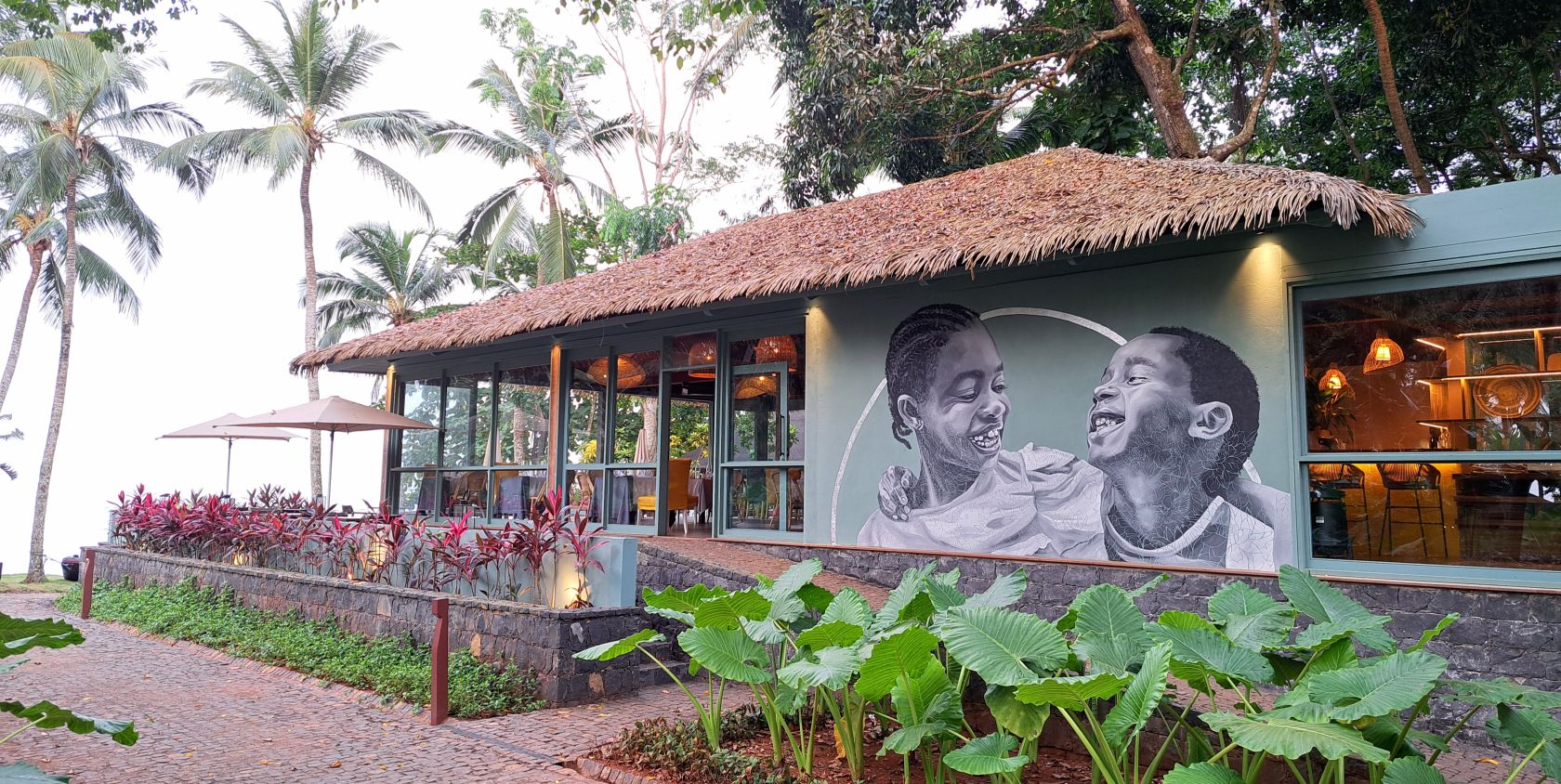
One encounter stands out above all. In Guinea-Bissau, a barefoot man brought her bottled water and a packet of peanuts one morning. “There, bottled water is a luxury — and a bag of peanuts can equal a day’s wages. He said, “Thank you for the mural,” and we sat on the pavement sharing the peanuts. I’ll never forget that.”
Dream Walls and Future Visions
If Jacqueline could paint a mural anywhere, she would choose Brazil. “Their festivals have murals painted across skyscrapers, which I’d love to try. I also admire Street Art for Mankind — they curate large-scale murals addressing social and environmental issues worldwide. Their current projects in Washington are especially powerful.”
When asked if she could capture the spirit of Portugal in one mural, what would it look like, Jacqueline answers simply, “Olive branches for endurance. Swallows for sanctuary. And somewhere, a touch of Alentejo blue.”
To discover more of Jacqueline de Montaigne’s work, visit her website https://www.jacquelinedemontaigne.com/ or follow her on Instagram @jdemontaigne.