
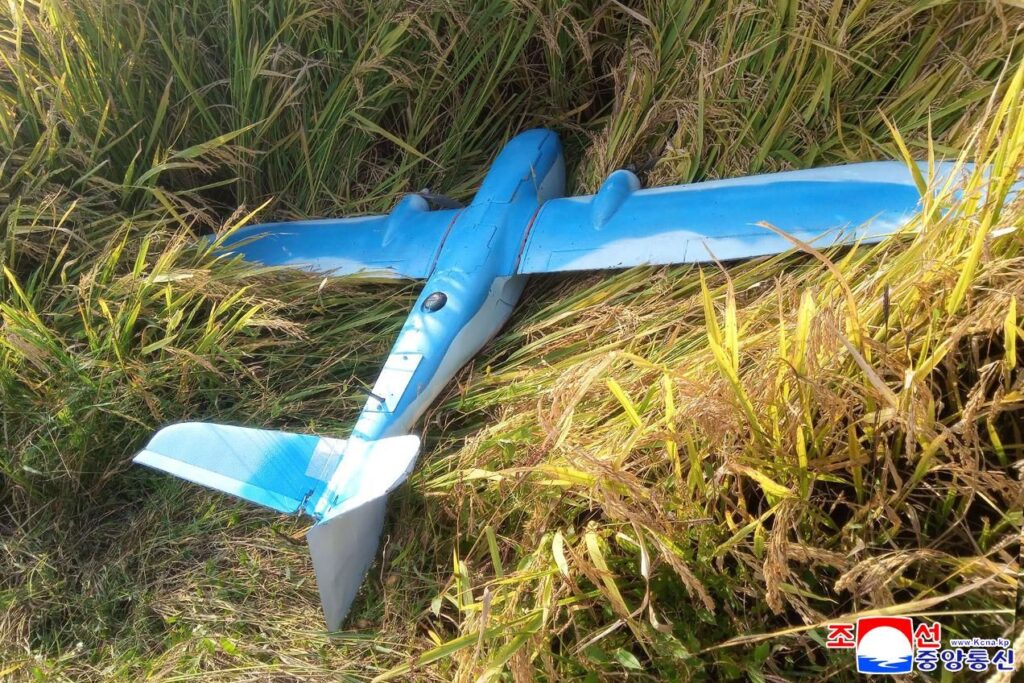
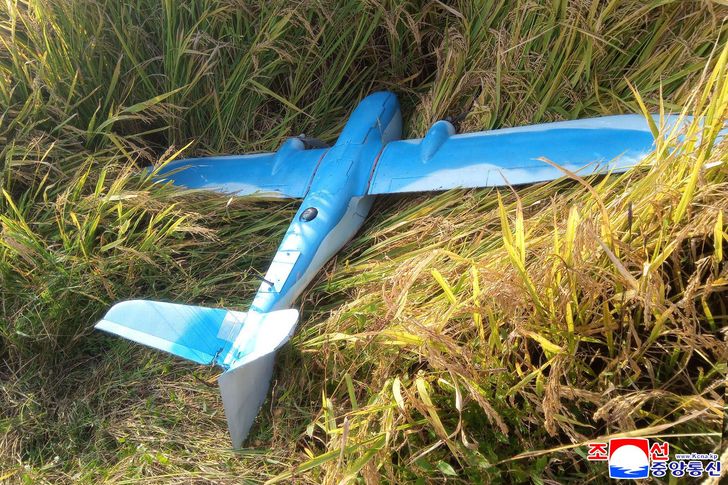
This captured image from the North’s Korean Central News Agency shows a drone that was discovered in the North Korean city of Gaeseong. Yonhap
“Rules for thee, not for me.”
North Korea has long criticized South Korea with this kind of hypocritical double standard — condemning actions by the South that mirror tactics the North itself has repeatedly employed. This time, Pyongyang’s anger is directed at drones.
North Korea on Saturday blasted South Korea for allegedly sending drones into its airspace on two occasions, earlier this month and in September last year, claiming that the flights constituted a violation of its sovereignty. The North said the actions were unacceptable and warned that South Korea would “pay the price” for its alleged provocations.
The vehemence of the response has raised eyebrows. During the previous Yoon Suk Yeol administration, North Korea sent trash balloons into the South 32 times, totaling between 6,000 and 9,000. Yet now the regime is issuing threats over two drones, widely believed to have been operated by civilians.
According to the North’s state-run Korean Central News Agency, its military detected an object in the sky near Ganghwa County on Jan. 4 and brought it down using unspecified electronic means. The recovered drone allegedly contained surveillance equipment and two videos showing footage of North Korean territory. Pyongyang released more than two dozen photos of the drone, including components made in China and a memory card bearing the Samsung logo.
North Korea also claimed another drone was spotted near the border town of Paju in September last year and was subsequently shot down. That drone reportedly contained a video with nearly six hours of footage of North Korean territory.
Calling South Korean officials “warmongers,” the North warned that they would pay for their “mad deeds.”
South Korea denied the allegations. The Ministry of National Defense said it did not operate drones on the dates cited by the North and that the drones in question were not military assets, leaving open the possibility that they were flown by civilians.
Kim Yo-jong, sister of North Korean leader Kim Jong-un and deputy director of the Workers’ Party’s publicity and information department, demanded further clarification from Seoul.
“In its official response, South Korea’s Ministry of National Defense made it clear that it has no intention of provoking the North. I personally think such a tactic is wise — it may help prolong their lives,” she said Sunday. Still, she insisted that South Korean drones had trespassed into the North’s territory and that a proper explanation must follow.
President Lee Jae Myung took the matter seriously. “If it is true that these drones were sent by South Korean civilians, it constitutes a serious crime that could endanger peace and security on the Korean Peninsula,” he said. Lee ordered the military and police to jointly investigate the case and disclose the results promptly.
The increasingly dangerous global security environment — highlighted by North Korea’s reported deployment of troops to Ukraine in support of Russia — has made governments wary of the potential fallout from seemingly minor incidents. The presidential office’s cautious response reflects this broader security context.
Still, North Korea’s explosive reaction remains puzzling. From Pyongyang’s perspective, drones crossing its border can indeed be viewed as a security threat. Yet given that North Korea itself repeatedly violated South Korean territory with balloon launches during the previous administration, its outrage over two alleged drone incursions is difficult to comprehend.
North Korea embodies what South Koreans call “naeronambul” — a phrase roughly meaning, “it’s romance when I do it, but adultery when others do it.”
The double standard is not new. When South Korea negotiated with the United States last year over plans to build nuclear-powered attack submarines, the North — despite possessing dozens of nuclear weapons and having conducted six nuclear tests — criticized Seoul, claiming the project would lead to nuclear armament and threaten peace in Northeast Asia.
There may be more than hypocrisy behind Pyongyang’s fury over the drones. Its overreaction could reflect deeper insecurity, possibly intensified by recent global developments such as the U.S. capture of Venezuelan leader Nicolas Maduro. Fear, anger and anxiety may be fueling North Korea’s volatile response to what would otherwise be a relatively insignificant incident.
South Korea should take this psychological and strategic context seriously and develop a more concrete North Korea policy — one that can better manage an insecure and unpredictable neighbor and reduce the risk of dangerous miscalculations.