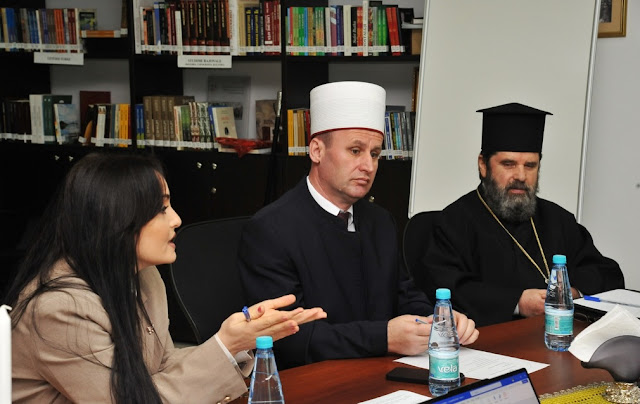
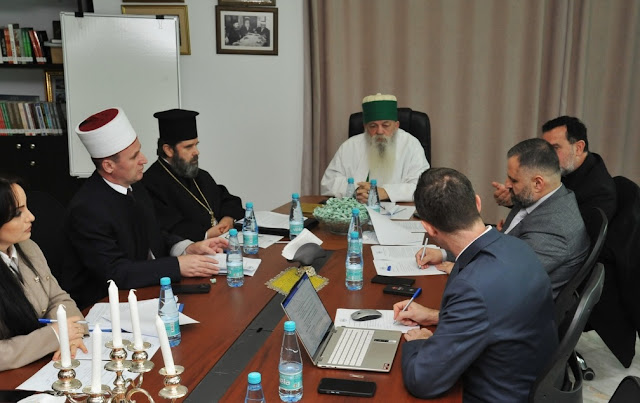
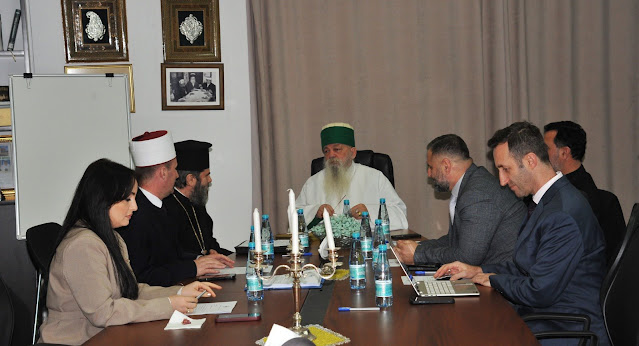
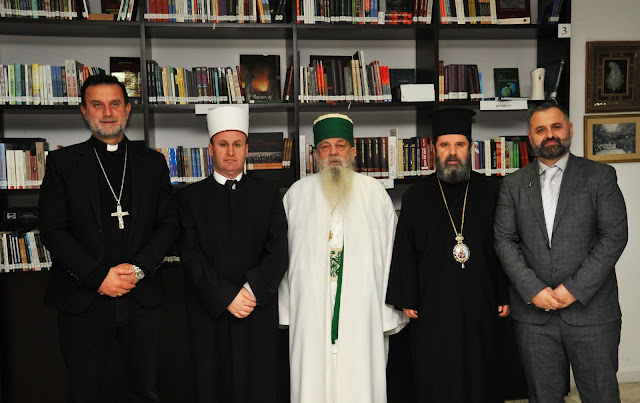
The Interfaith Council of Albania held its first meeting of 2026 recently, reaffirming its commitment to strengthening interfaith dialogue so that peaceful coexistence remains an unshakable achievement of Albanian society.
The Council brings together the leaders of Albania’s major religious communities: the head of the Muslim Community of Albania, Bujar Spahiu; the Orthodox Archbishop of Albania, John; the President of the Catholic Bishops’ Conference of Albania, Bishop Gjergj Meta; the leader of the Bektashi Community of Albania, Edmond Brahimaj; and the pastor of the Evangelical Brotherhood of Albania, Erion Syllari.
For 2026, the presidency of the Interfaith Council has been assumed by Edmond Brahimaj, head of the Bektashi Community, in accordance with the Council’s annual rotation of leadership. During the meeting, the Council also approved its strategic action plan for the period 2026–2028.
Discussions focused on coordinated efforts by the religious communities to address shared social, educational, and cultural challenges, with the aim of promoting harmony and progress for all citizens. Emphasis was placed on cooperation that respects each tradition’s doctrinal principles while fostering mutual understanding and social responsibility.
It is noted that the last time the presidency of the Interfaith Council of Albania was held by its visionary founder and co-creator, the late Archbishop Anastasios, was in 2024.
The Interfaith Council of Albania stands as clear evidence that religions can collaborate on social issues without compromising their theological identities, grounded in a shared commitment to love for one’s neighbor. Through this cooperation and a common understanding that fanaticism leads not to light but to darkness, Albania has avoided social unrest and secured conditions of peaceful coexistence within a multi-religious environment.
This model of interfaith collaboration is widely regarded as exemplary and has been recognized and praised not only within Albania but also internationally for its positive and lasting impact.
Fr. Ilias Makos