
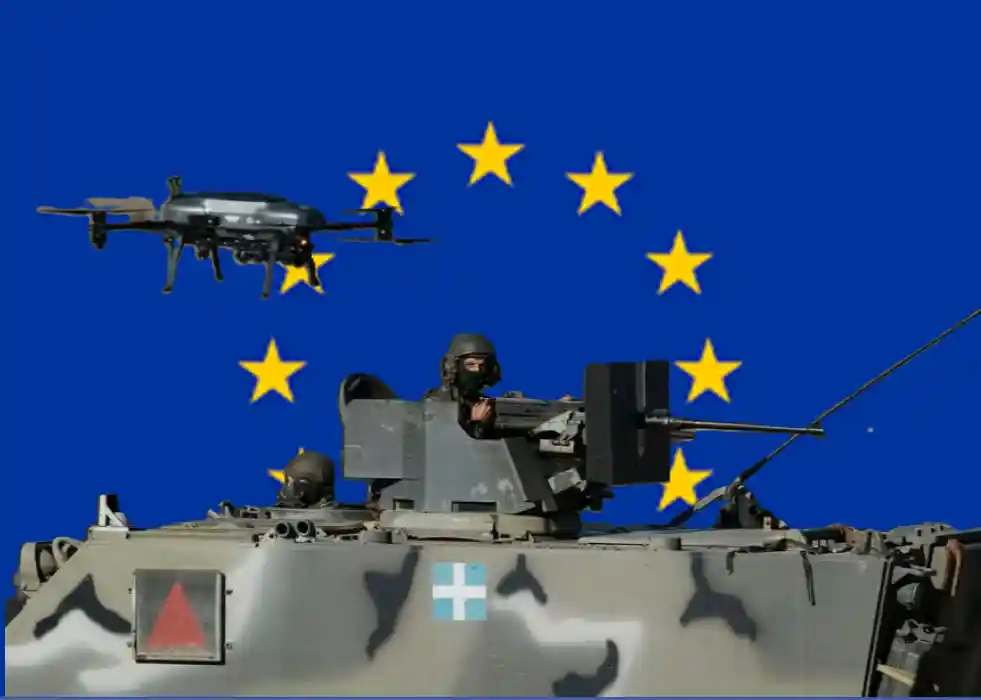
Athens has revised its application under the European Union’s SAFE defence financing instrument, narrowing an earlier broad submission into a shortlist of six projects with a total budget of €815 million.
The revised package, submitted to the European Commission for approval, marks a shift from a wide procurement scope to a more selective set of priorities, with emphasis on strategic surveillance, secure communications, and counter-drone capability-building.
Notably, the partner pattern itself draws attention. The EU consists of 27 member states. Excluding Greece and Greek Cyprus leaves 25 potential partners, yet the revised shortlist repeatedly gravitates toward the same limited set of third actors — a structure that suggests a focused cooperation template aimed at meeting SAFE’s multi-country requirements.
Space-enabled surveillance and strategic connectivity
A key portion of the revised SAFE bid focuses on space-enabled capability development intended to strengthen intelligence, surveillance and reconnaissance (ISR) and enhance secure command-and-control resilience. The list is also telling Greek, Greek Cypriot coordination.
Among the proposed initiatives, both of which involve Greek Cyprus, Athens is pursuing:
• a communications satellite project in cooperation with Greek Cyprus and Norway, and
• a planned acquisition of SAR-capable micro-satellites in cooperation with Poland, improving all-weather ISR coverage across land and maritime domains.
These selections point to an effort to strengthen enabling layers that support networked defence rather than investing in conventional platforms.
Counter-drone cooperation expands via a Balkan link
Another major element is a counter-UAS initiative developed with Greek Cyprus and Bulgaria, involving the Kentaurus and Yperion anti-drone systems.
This component signals a priority on low-cost, high-frequency threats which have become increasingly central to modern conflict environments, and positions the programme as a regional cooperation effort aligned with wider European defence concerns.
National procurements remain on the list
In addition to multi-country programmes, the revised shortlist includes three national procurement lines:
• cryptographic devices,
• wireless communications systems, and
• unmanned systems development.
While these items appear less cooperative in structure, they remain consistent with the overarching focus of the bid: strengthening the communications, sensing, and resilience layers of defence planning.
The repeated inclusion of Greek Cyprus as a co-initiator is particularly notable given that it is difficult to speak of an advanced defence-industrial base in the south of the island. The partnership therefore appears less about industrial complementarity and more about institutional positioning — using SAFE’s cooperative project framework to elevate Eastern Mediterranean priorities into EU-level financing structures.
Beyond the EU: Eastern Mediterranean positioning
The shortlist also indicates that SAFE cooperation is not limited to intra-EU formats alone. Norway’s inclusion — despite not being an EU member — highlights that Athens may be seeking partnerships that extend beyond the 25-member pool available inside the Union. In practical terms, this suggests SAFE is being used not only as a financing channel, but also as a mechanism to help position strategic enablers — particularly space-enabled surveillance, secure connectivity and counter-UAS layers — toward the Eastern Mediterranean security environment through structured multi-partner cooperation.
The regional logic becomes clearer when viewed alongside Athens’ wider alignment choices. As a NATO member state, Greece has recently deepened a new cooperation track with Israel and Greek Cyprus in the Eastern Mediterranean, despite Türkiye also being a member of the same Alliance. This pattern signals that the capability priorities embedded into SAFE are shaped not only by Europe-wide deterrence narratives, but by a concrete regional threat perception and competition dynamic.
A capability-priority dilemma
At the same time, the revised shortlist raises a capability-priority question. In high-intensity warfare, among the fastest consumed items are ammunition, rockets and missiles — stocks that must be replenished at scale and sustained over time.
Yet Greece’s SAFE priorities focus instead on satellite-enabled ISR, secure communications, counter-drone layers and unmanned systems development — areas where EU and NATO frameworks already provide access to shared interoperability and baseline capability.
This creates a debate over whether SAFE funding is being used primarily to increase immediate warfighting endurance through stockpiles, or to finance longer-term architecture, resilience and networked defence. Stockpiles may be pursued through national budgets or other procurement instruments, leaving SAFE to finance enabling layers with longer strategic timelines.
In effect, the shortlist prioritises architecture over consumables.
Author: Özgür Ekşi