
NEWS ANALYSIS: As the New Year gets off to a demanding and troubling start all over the world, Norway’s Prime Minister Jonas Gahr Støre has sought to reassure both European allies and his fellow Norwegians, along with himself. He intends to rely on his new “Plan for Norway” to get him through his second term in office, on a year-by-year basis.
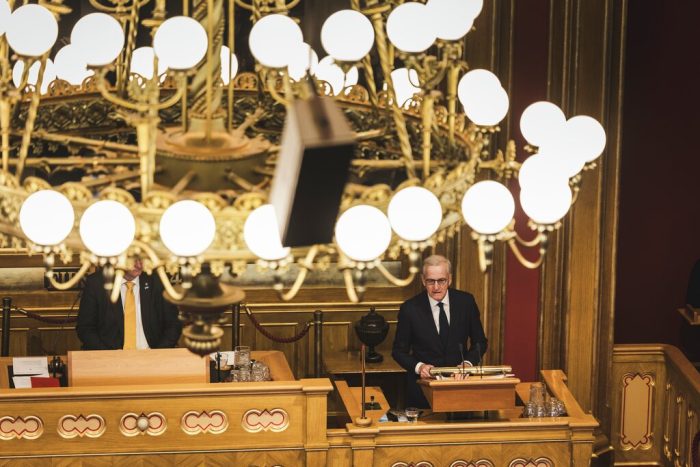 Prime Minister Jonas Gahr Støre addressing Parliament on Thursday about his new “Plan for Norway.” PHOTO: Peter Mydske / Stortinget
Støre, who won re-election last autumn, spent the first week of the New Year meeting more than 30 other government leaders in Paris, agreeing on more military support for Ukraine, speaking to business and labour organizations back home, and then addressing Parliament on his new “Plan for Norway.” The plan was first unveiled just before the holidays as an alternative to a traditional government platform. It’s meant to apply until the next national election in 2029, assuming Støre’s minority Labour Party government survives until then, with annual adjustments.
The plan has five main points that include an ongoing military build-up in Norway, defense of Norway’s interests “in a dangerous and more unpredictable” world, boosting “total preparedness” for potential crises, securing the country’s economic interests and strengthening the police in the fight against crime and criminal networks.
“We will strive for secure leadership in troubled times,” Støre told Parliament, “and this is our plan for doing that, strengthening Norwegian competitiveness and renewing, strengthening and improving the public sector.”
Støre noted how the Labour Party he leads “won renewed confidence” from voters last September, when it emerged as largest of the nine parties now represented in Parliament. Labour only won 28.2 percent of the vote, though, and then decided to rule alone without forming another multi-party coalition. That means Støre and his ministers must seek majority support on an issue-by-issue basis.
It won’t be easy, and all the uncertainty and trouble created by a US president who now threatens the NATO alliance has demanded the most attention. As a seasoned and multi-lingual diplomat, though, Støre is an expert at foreign relations both good and bad. That’s won him respect and consensus in Parliament so far, whether it be on support for Ukraine or dealing with an unpredictable US administration.
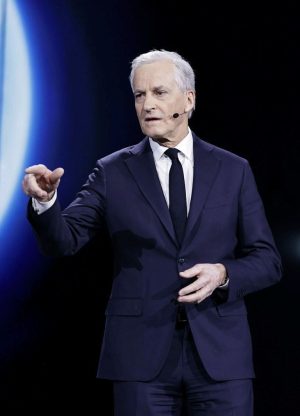 Støre speaking at the annual conference on Wednesday hosted by NHO, Norway’s national employers’ organization. PHOTO: NTB Kommunikasjon/Alf Simensen
Others called this week for Støre to spend less time on Greenland and more time on such things as taxation issues, social welfare and an alleged decline of innovation within Norwegian business. Støre could point to how his finance minister, the former NATO chief Jens Stoltenberg, is deeply involved in looming tax reform (a new tax commission has already been appointed) and how his “Plan for Norway” includes everything from construction of 130,000 new homes and getting 150,000 more people into the workforce to improving competitiveness, schools, health care and elder care.
“We shall be a government for all of Norway,” Støre claimed in Parliament, promising that his plan will address the concerns of those in the cities, smaller towns and rural areas, “those who open a shop early and work late at a hospital, for the students who dream about the future and the grandparents who built it.”
Støre has also called his new plan “the start of a new way of organizing the government’s work.” It will concentrate on “bigger projects” instead of “smaller measures,” with the plan less detailed and shorter than a traditional government platform.
“Norway and the world are changing faster than ever before,” Støre claimed at a press conference last month when he first presented the plan. Running the country needs to be “more dynamic” and “more flexible,” while also creating a sense of security for the future and making sure that Norway “will remain strong in a troubled world.”
His plan involves “security for the economy, security for workers and employers, security for children and youth, security for health and for the country itself.” It also calls for removal of “unnecessary bureaucracy.”
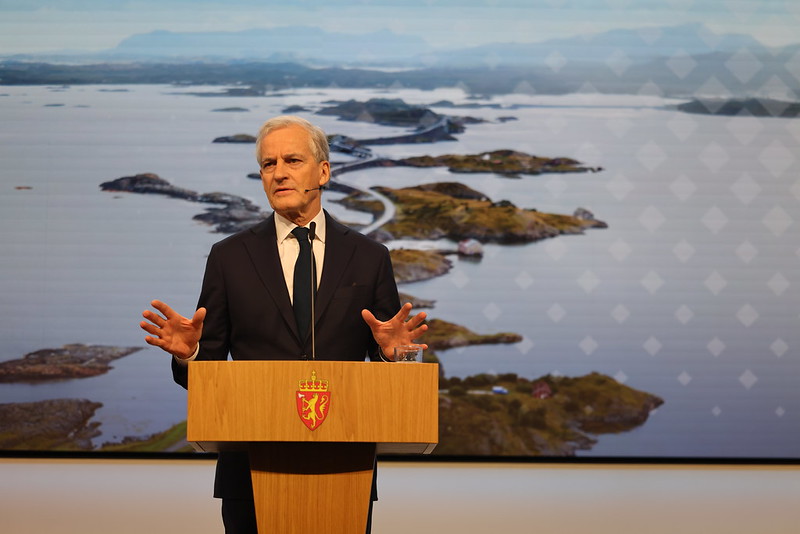 Støre releasing his “Plan for Norway” in December, with a photo of an island-hopping road along the country’s west coast that has attracted tourists from all over the world along with a James Bond film crew. PHOTO: Martin Lerberg Fossum / Statsministerens kontor
Some opposition politicians from the Conservative- and Progress parties scoffed at portions of the plan, calling them “fine words without political solutions.” Støre defended it and had already seemed to meet them more than halfway on some controversial issues including immigration. Even though Norway needs more workers, Støre’s justice ministry has launched plans to deport immigrants who have committed crimes, tighten rules around family reunification for those who’ve been granted political asylum in Norway and quicker deportation of those who haven’t qualified for asylum. After taking in more than 100,000 refugees from Russia’s war on Ukraine, Støre’s government only plans to take in 100 refugees certified by the UN per year.
Some of the parties most likely to cooperate with Støre’s Labour Party also have reservations about his new “Plan for Norway” and have plans of their own. Reds leader Marie Sneve Martinussen, for example, launched her own plan of sorts this week to reduce social differences in Norway. She wants, among other things, to tighten tax loopholes among businesses and the wealthy, increase the lowest levels of welfare benefits and boost funding for local governments that are charged with day care centers and operating nursing homes. Another new commission is already working on ways of improving local governments’ funding and delivery of services.
Still others think Støre himself, and his ministers, need to work more closely with the other left-leaning parties like the Reds, the Socialist Left and the Greens. “Labour needs to learn from Erna Solberg (leader of the Conservative Party),” claimed Greens leader Arild Hermstad last week, noting how Solberg kept two non-socialist government coalitions together for two terms in office, from 2013 to 2021, when Støre’s Labour and the Center Party won their first term.
The new “Plan for Norway” may simply be an attempt by Støre to adopt the so-called “W.I.N.” strategy of dealing with “What’s Important Now,” and having the flexibility to do so. In addition to the potential for being continually broadsided by an impulsive US president who has shown little respect for a rules-based world, Støre will need to finally start restructuing Norway’s economy as the oil era winds down, while also dealing with an aging population. Setting priorities will be more important than ever. Støre thinks his new plan will help him do so.
NewsinEnglish.no/Nina Berglund