
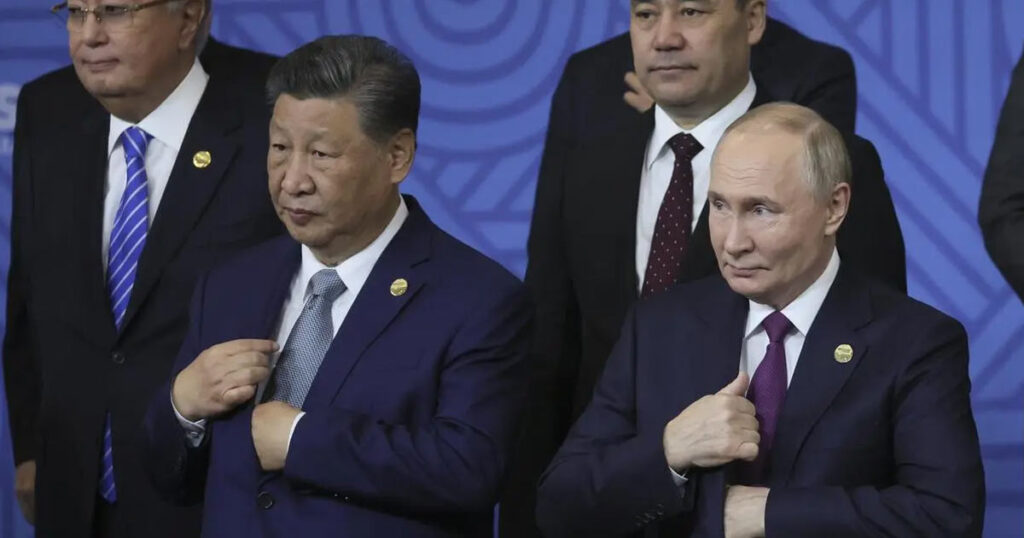
In September, reports surfaced about unconfirmed military supply agreements between Moscow and Beijing. According to these reports, Moscow has agreed to supply Beijing with amphibious assault vehicles, light amphibious anti-tank guns, and several airborne armoured personnel carriers. Along with weapons systems, the reports pointed to increasing bilateral military drills and Russian forces training Chinese airborne troops, with the former providing technology and training to the Chinese forces. These developments have been extrapolated by several military experts as Moscow augmenting the capabilities of the Chinese forces and tacitly consenting to Chinese ambitions of gaining control over Taiwan.
The growing convergence between Russia and China, particularly in the realm of the military technical partnership, is indicative of a positional synergy in their mutual perception of a security architecture in East Asia.
Interestingly, while Russia’s position on Taiwan de jure recognises China’s sovereignty over the Island, the likelihood of Moscow overtly supporting a potential Chinese invasion of Taiwan remains slim. However, the growing convergence between Russia and China, particularly in the realm of the military technical partnership, is indicative of a positional synergy in their mutual perception of a security architecture in East Asia.
Geostrategic context
Russia-China relations have grown progressively since the end of the Cold War, ostensibly accelerating with Russia’s growing contestation with the West. However, two key developments have been indicative of the consolidation of the Russia-China relations. First, was a shift in Russia’s position towards the Chinese Belt and Road Initiative. Moscow was initially sceptical of joining BRI, since the project aimed to enhance China’s foothold in Central Asia and the Caucasus through a network of infrastructure development projects. Russia considered it against its interests. But in 2015, the Russia-backed Eurasian Economic Union was linked with the BRI, reflecting a growing convergence in the positions of Russia and China in Eurasia.
Second, in the same period, the Russia-China military technical partnership was elevated with Beijing’s acquisition of 24 Russian Sukhoi Su-35 fighter jets and the S-400 anti-missile defence system. With Moscow announcing its “turn to the East” in 2012, the primacy of China in its broader Asia Pacific strategy became amplified.
Russia considered it against its interests. But in 2015, the Russia-backed Eurasian Economic Union was linked with the BRI, reflecting a growing convergence in the positions of Russia and China in Eurasia.
When the conception of Indo-Pacific gained traction, with the revitalisation of Quadrilateral Security Dialogue (QUAD), Russia criticised the nomenclature of the existing Asia-Pacific region, citing that the Indo-Pacific region was a construct aimed at curtailing the peaceful rise of China. It further alleged that the US alliance system in the Indo-Pacific had expanded, marked by an increasing strategic build-up in the region, such as the deployment of Terminal High Altitude Area Defense (THAAD) systems, the deliberations to deploy the land-based Aegis Ashore missiles, and the release of American strategic documents, such as its national security strategy, that emphasised containing China in the Pacific. These were the driving reasons for the converging positions on the understanding of an Asian security architecture. In response, Moscow helped China build a missile attack warning system. To gain a degree of parity in its nuclear arsenal, China began building hundreds of missile silos and bases for intercontinental ballistic missiles.
The Ukraine factor
Weeks before Russia began its invasion of Ukraine in February, Russian and Chinese leaders met. Both leaders declared that Russia and China were in a no-limits partnership, giving the perception of interest convergence in Eurasia and Asia-Pacific. Since then, however, both sides have refrained from using the term, with experts pointing out that the term could impact China’s equities with the West. Nevertheless, when the war broke out, Beijing did not condemn Moscow and did not join the sanctions regime against Russia. China became Moscow’s largest trading partner. The strategic partnership continued to grow, and both countries participated in joint military drills in strategic regions such as the Arcto-Pacific.
Against the backdrop of Ukraine and the churn in the Indo-Pacific, marked by the securitisation of the region, Russia’s position has remained consistent, with Moscow’s calculations in the Pacific changing with a stronger Russia-China partnership, and a freshly concluded alliance with North Korea solidifying the Russia-China-North Korea strategic triangle. Additionally, the sovereignty of Taiwan gained significant attention, particularly in Western capitals. While experts argue that Moscow and Beijing are interested in status quo, the latter believes in gaining concessions from the West in return for gaining stronger concessions and for agency granted to Chinese interests in the Indo-Pacific. Thus, Moscow’s presence within this matrix augments China’s position.
In return for China sustaining its economic engagement with Russia even under the threat of sanctions, the perception of a no-limits partnership, particularly in the West lingers on. Russia’s positions in the Pacific are becoming increasingly overt, giving agency to Chinese interests in the region. With the supply of components and training necessary for airborne and amphibious operations, experts indicate the possibility of these efforts being directed towards a potential invasion of Taiwan.
The strategic partnership continued to grow, and both countries participated in joint military drills in strategic regions such as the Arcto-Pacific.
However, an overt conflict with Taiwan is a complicated scenario for Moscow. An invasion would jeopardise Russia’s interests in the Asia-Pacific region, with scope for further deterioration of its relations with Japan and Korea and hamper its partnership with ASEAN countries. Thus, it is unclear whether Russia would leverage its interests or overtly support a Chinese annexation of Taiwan. Interestingly, several Russian experts believe Russia is more receptive to a grand bargain between China and the US on Taiwan in return for China gaining additional concessions and enhance its influence in the Indo-Pacific.
How does India see these developments
While the recent developments in India-Russia relations are prima facie indicative of Russia remaining cognisant of India’s security interests, as reflected in the Russian interest to export critical military weapons systems and platforms such as the S-400, S-500, and expressing interest to extend joint production of the Su-57 fighter jets, nevertheless a potential Russia-China condominium in the Indo-Pacific region stands against India’s interests given Beijing’s hegemonic ambitions in the Indian Ocean and the South China Sea, which amplifies the balance of threat perceptions in the region. India has to thus maintain a delicate balance between regional considerations and its Russia relationship.
This commentary originally appeared in The Hindu.
The views expressed above belong to the author(s). ORF research and analyses now available on Telegram! Click here to access our curated content — blogs, longforms and interviews.