A “Horizon of Peace” in the South Caucasus: An Interview with Elchin Amirbayov, Representative of the President of the Republic of Azerbaijan on Special Assignments.
By: Jekaterina Savicka and Alexander MacDonald
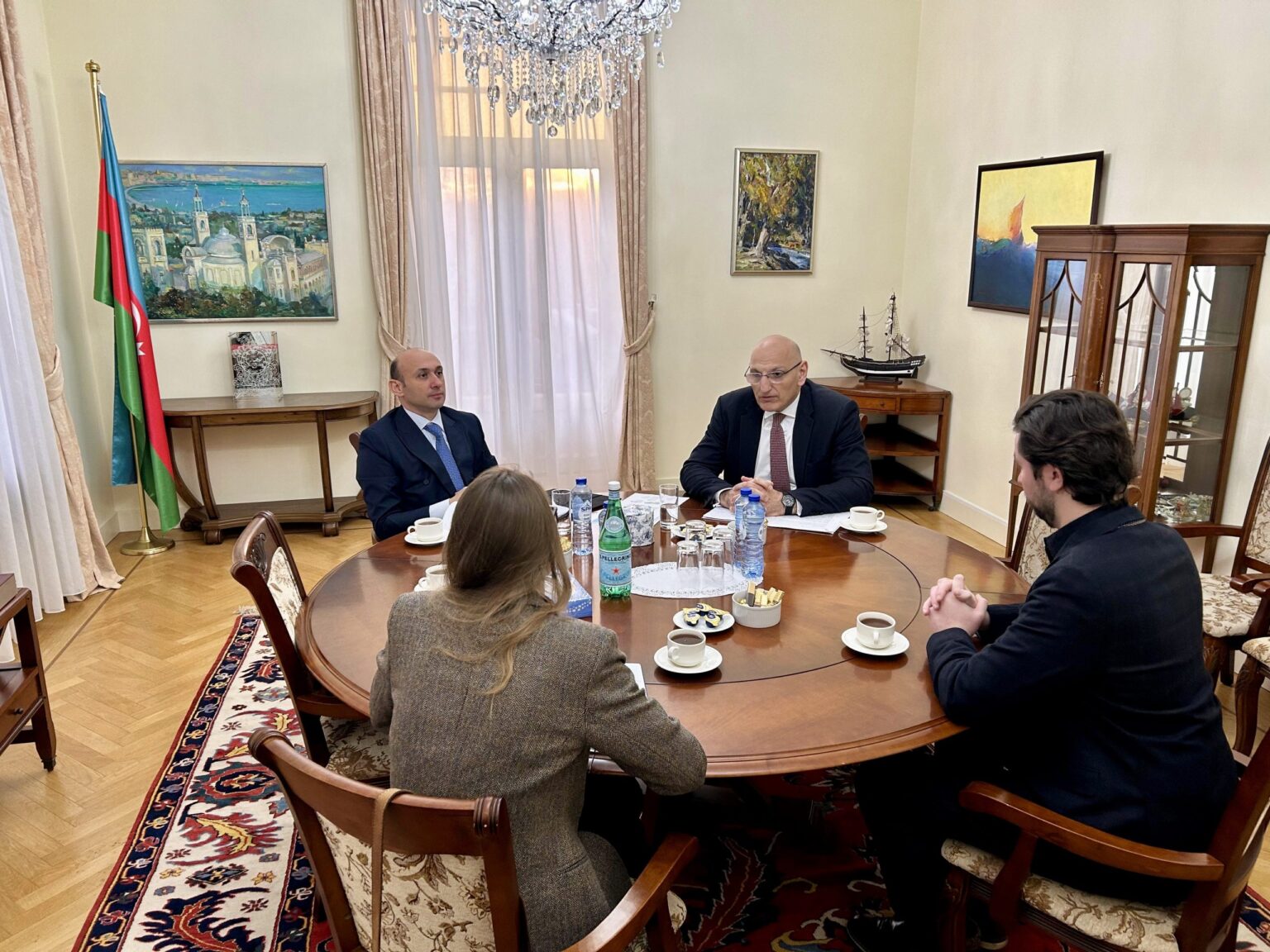
On 16 December 2025, the JASON Editorial Committee sat down with the Representative of the President of the Republic of Azerbaijan on Special Assignments, H.E. Mr. Elchin Amirbayov, at the Embassy of the Republic of Azerbaijan in The Hague, to discuss topical issues of security concerning Azerbaijan and the South Caucasus region.
“After more than 30 years of conflict, we finally have, in front of us, not the deadline for peace, but the horizon of peace,” says Elchin Amirbayov.
At the 2025 Washington Summit, Azerbaijan President Aliyev and Armenia Prime Minister Pashinyan sat down with US President Trump to seal their commitment to durable peace, turning a previous long rivalry into a rare opening for resolution. For the first time in 3 decades, it now seems possible that a new chapter of pragmatism, not paralysis, may shape the future of the South Caucasus region.
The peace agreement’s text was agreed upon by Armenia and Azerbaijan’s foreign ministers in March 2025, and was initialed in August in Washington at the White House. An important part of the agreed deal is a commitment on opening “Zanzegur corridor,” a 43 km stretch of territory in Armenia that would connect Azerbaijan’s Nakhchivan Autonomous Republic with the rest of Azerbaijan. The deal envisages a safe transport route for the corridor, now named the Trump Road for International Peace and Prosperity (TRIPP) as well as unimpeded passage through it for passengers and goods from one part of Azerbaijan to the other.
Europe’s Energy Security: Why Azerbaijan Matters
Azerbaijan has provided its natural gas to European countries as an alternative to Russian gas since 2021 thus significantly contributing to Europe’s energy security. Through the Southern Gas Corridor, Azerbaijan exports natural gas to 14 nations, including to 10 European countries, of which 8 are EU member states. The main supply source is Azerbaijan’s Shah Deniz gas field in the Caspian Sea. The Zangezur corridor, of which the TRIPP route is a part, would create a new, alternative connectivity and trade land route from East Asia to Western Europe via Azerbaijan allowing for a smoother and safer transfer of goods and people between the continents.
Azerbaijan plans to diversify its export energy portfolio to Europe to cover also clean and renewable energy in addition to fossil fuels. A clear illustration of this is the Caspian-Black Sea-Europe Green Energy Corridor initiative to transport green electricity from Azerbaijan through Georgia to Europe (Romania, Bulgaria, and Hungary) via a subsea power cable across the Black Sea. As a country which has been known mostly for its oil and gas, Azerbaijan itself is in the process of transition towards green energy, putting to use is enormous potential for solar, wind, and green hydrogen energy. “That is one of the areas that we think Dutch-Azerbaijani bilateral economic interaction can be extended to,” says Mr. Amirbayov, “because the Netherlands is one of the frontrunners in this field having top-notch technologies and know-how, and we are the country who is now expanding its partnerships in this field.”
“As the country which last year successfully hosted COP29,” says Mr. Amirbayov, “this [environmental] consciousness among people is growing strongly in the country. Another area is green hydrogen, where our national oil company Socar is currently actively exploring existing opportunities and is in the process of evaluating and planning projects of practical cooperation with some potential international partners.”
Connecting the Turkic World
Sustainable and irreversible peace in the South Caucasus would represent a major strategic gain not only for the region but for the Turkic world as a whole. In this context, TRIPP would play a transformative role by connecting Türkiye to the Caspian Sea and further to Central Asia, complementing the Middle Corridor, while at the same time enhancing East-West trade and transport links.
Forbes called it Central Asia’s geopolitical liberation, since opening up the route through the Caucasus would mean the region would no longer be as dependent on big players. “If you look at the map,” Mr. Amirbayov says, “Central Asia is a region which attracts strong interest by many large players, because of the abundance of natural resources, critical strategic geoeconomic location, but when you look from the Western perspective, Azerbaijan is the natural gateway to Central Asia from Europe.”
Mr. Amirbayov emphasised that Azerbaijan’s existing links with the Turkic world would only strengthen as a result. “Four out of five Central Asian nations, as Azerbaijan and Türkiye, belong to this group of Turkic-speaking countries,” notes Mr. Amirbayov. “We are also united through OTS, which is the Organisation of Turkic States.” In addition, since October, Azerbaijan has been accepted as a full-fledged member of the “C5” format of Central Asian states, turning it into C6 – Central Asia plus Azerbaijan. This development “will certainly help these nations untap jointly the enormous potential to promote global connectivity, energy and other types of international cooperation,” says Mr. Amirbayov. “And I think this new reality will redefine the Caspian Sea not as a dividing line, but as a unifying element in the region.”
Baku’s Balancing Act: Russia and Iran
Iran and Russia have criticized the proposed TRIPP project as an encroachment by the US. Speaking in general on Azerbaijan’s foreign policy, however, Mr. Amirbayov stressed the relevance of a balanced, pragmatic and multi-vector foreign policy for his country. “Azerbaijan has always stood in favour of interest-driven, forward-looking, and constructive relations with everyone, and I think that is the best strategy. Owing to its geography and other considerations, Azerbaijan has learned to navigate its foreign policy with a finely calibrated sense of balance, which has enabled it, inter alia, to safeguard its strategic autonomy while remaining firmly anchored in the protection of its vital national interests.” While responding to comment on TRIPP project, he replied that ”Azerbaijan is firmly convinced that its implementation may benefit all actors involved, without exception, as it is meant to contribute to consolidate peace, achieve stability and economic development in the region. Therefore, we invite all parties to regard it as a true win-win project”.
On relations with Russia, in the context of the tragic shooting down of the passenger plane of Azerbaijani Airlines, in which 38 people lost their lives in December 2024, Elchin Amirbayov mentioned that “obviously this tragic incident and its consequences could not help but leave a negative impact on our relations. The leaders’ conversation in October in Dushanbe, along with the clarifications made then by the Russian President, provided a certain positive impulse towards resolving the issue. But we still expect the Russian side to take the necessary practical steps that would allow the problem to be completely resolved and would lead to full normalization of our bilateral relations.”
The Way Forward
According to Mr. Amirbayov, “even when it will be signed, the peace agreement is not the end of the chapter; it is the beginning of a long relationship.” The Washington Summit was “historic” in terms of its breakthrough boost, says Mr. Amirbayov, “but it only opened the door. Now it is our responsibility, along with Armenia, to do the rest of the job to make sure that peace is irreversible. We need to be able to sign and to ratify the already initialled peace agreement, because when peace is codified, it becomes harder to undo.”
And there are still difficulties to be addressed. For example, the deal does not address the constitutional problem. Namely, the position of Azerbaijan is that Armenia’s constitution contains claims to Azerbaijani territory that must be removed from the constitution’s text before a peace can be finalized. “We must first bring the constitutional frameworks of both countries in compliance with the letter and spirit of the peace agreement, which is currently not the case with Armenia’s constitution.” Mr. Amirbayov says that he expects this issue to be successfully addressed next year (2026). The government of Armenia has gone back and forth on the question, but with the elections coming up in Armenia in June, the issue might not be given immediate priority. A referendum to adopt a new constitution has been proposed but the time has not yet been confirmed.
Trust-Building between Armenia and Azerbaijan
Mr. Amirbayov named several important headways that have been made to build confidence between the two countries in the meanwhile. First, Azerbaijan lifted unilaterally the embargo on the transit of goods through Azerbaijani territory for Armenia. The second was to send a shipment of Azerbaijani fuel to Armenia. The third has been engaging societies in peace-building through Track 2 diplomacy (informal diplomacy and trust-building through civil society cooperation, e.g. reciprocal visits of academics, think tanks, and journalists from both sides). “Diplomacy between societies is as important today as diplomacy between governments,” says Mr. Amirbayov. “It must catch up with Track 1, though it is usually the other way around.” Last but not least, the official rhetoric from both sides has substantially improved.
“Building trust has no alternative, […] engaging different layers of our society, so that they can see that the people on the other side of the border are no longer enemies, but they are neighbours and potentially good partners. We need to slowly but steadily develop economic interaction that will lead to win-win benefits: prosperity, as they say, is the most effective peacekeeper with trade corridors, energy cooperation leading to a certain degree of economic interdependencies, which, in my view, is the best insurance policy for durable peace.”
A Role for Third Parties?
Peace between Azerbaijan and Armenia, according to Mr. Amirbayov, is about national ownership with international partnership. “By international partnership, I mean financial and technical assistance, demand-driven development programmes, etc. For example, the EU could positively contribute by providing financial support to the overhaul of the railway passing through Nakhchivan, as part of the Zangezur corridor.”
“We sincerely hope that the whole international community will do its best in order to encourage our two countries to get to the end of the road, because the process itself has to continue in a strictly bilateral format like it has been the case up to now.” says Mr. Amirbayov. “I think all these years that we spent with mediation with all sorts of hidden agendas have taught us a lesson that no one better than us understands the essence of the problem and how to address it. But that does not mean that we should not look into and try to profit from all those international best practices that exist out there in the world. That is why we do study lessons learned by others, are in constant conversations with different partners, to hear them, to see what they have gone through, especially those who were themselves affected by similar experience in the past.”
Challenges Ahead
When asked whether he foresees any challenges in the reintegration of territories, Mr. Amirbayov emphasised the severe contamination of liberated territories by landmines and explosive remnants being the main factor slowing down a large-scale effort by the Government of Azerbaijan to reconstruct and rehabilitate the liberated territories. “After five years of work by our National Mine Action Agency ANAMA, we were able to clean up only 20% of the contaminated territory, which means that 80% still has to be done.”
“To day, we have spent $464 million from our budget to finance this work, and the total amount of foreign assistance was about $24 million, so 95% comes from our own budget. We do understand and assume our own responsibility, but we very much appreciate the solidarity by 13 donor countries and 11 donor organisations that have helped us up to now to address the challenge. We hope that the Netherlands also can join this club of donor countries, given the role it plays traditionally in humanitarian action across the world.”
Why is demining so important?
- Human security reasons. “It is about saving innocent lives in the future. Since the end of the war, 414 Azerbaijanis have fallen as mine victims. This is in addition to the 3,400 Azerbaijanis which were mine victims before the end of the war. Today victims are mostly civilians, deminers, engineers, and constructors.”
- Humanitarian reasons. “800,000 Azerbaijani IDPs (internally displaced persons) uprooted by the former conflict await the possibility of return. So far, we were only able to return 23,000 IDPs and the pace is not as high as we would wish because of the mine contamination.”
- Reconciliation. The war has just recently ended. For many, especially those who were directly affected, the wounds are still fresh, and so reconciliation will take time. “The more the mine threat goes on, the more difficult it will be to those who are directly affected by this conflict in the past to reconcile with the idea of peace and of forgetting all those wounds and difficulties.”
Conclusions
The new year will bring more clarity on what headway can be made towards peace. “I think this window of opportunity is a historic one, and we do not have the right to waste it,” says Mr. Amirbayov. “I tend to believe that this is a shared understanding of both countries.”
“We need to cherish peace, we need to build on it, and we need to, through peace, create the best possible conditions not only for our countries, but also for our peoples. That is why I mentioned that it is crucial that people on both sides of the border really feel benefits of peace in their daily lives, and then they can understand the value of peace. Because as peace grows, I think there will be less and less temptation from any side to put that status quo into question.”
The JASON Institute would like to extend a special thank you to our colleagues at The Hague Research Institute for Eastern Europe, the South Caucasus, and Central Asia, for their support in organizing this interview, and to the Embassy of the Republic of Azerbaijan in The Hague for hosting.