
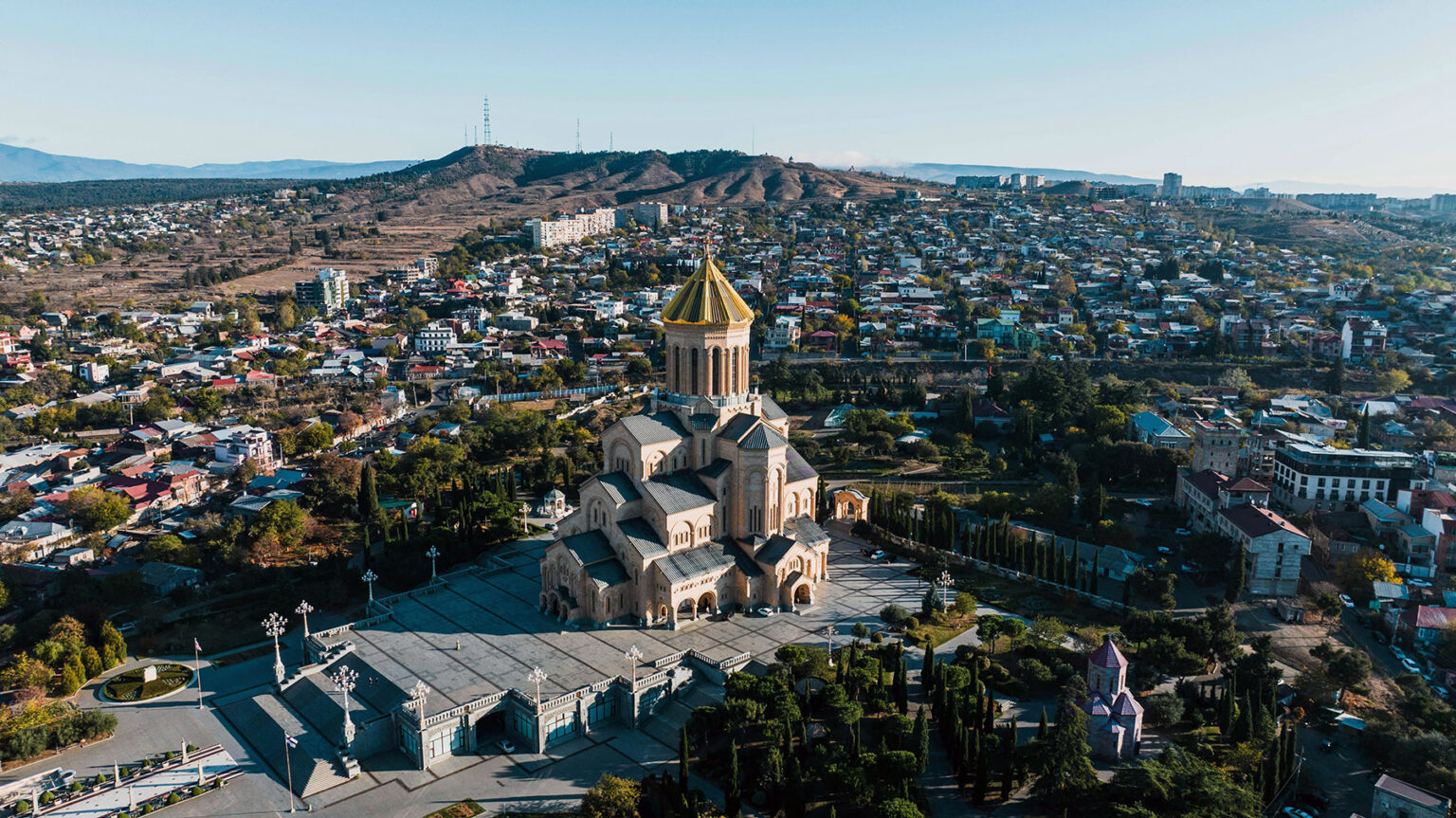
Roughly 5,500 air miles from Saranac Lake lies the country of Georgia, at the crossroads of Europe and Asia. It’s a long-inhabited land of towering Caucasus Mountains, Black Sea beaches, medieval architecture and a 33-character alphabet. Despite the distance, Adirondack agriculture recently played a central role in bridging the gap between the two cultures.
Developed by the Congressional Office for International Leadership (COIL), Open World programs match small groups of emerging leaders from countries on four continents with U.S. counterparts in areas such as local government, agriculture, technology and economic development.
All of the local planning and outreach for the Open World visit was coordinated by the Rotary Club of Saranac Lake. John Banta, the planning lead for the visit, was inspired by his own transformational time as a student abroad years ago.
“It became the foundation for major elements of my career,” he said, prompting him to bring that same cross-cultural connection to Saranac Lake. The end result was a week that was centered on the importance of local agriculture and also on creating cultural and personal connections over food.
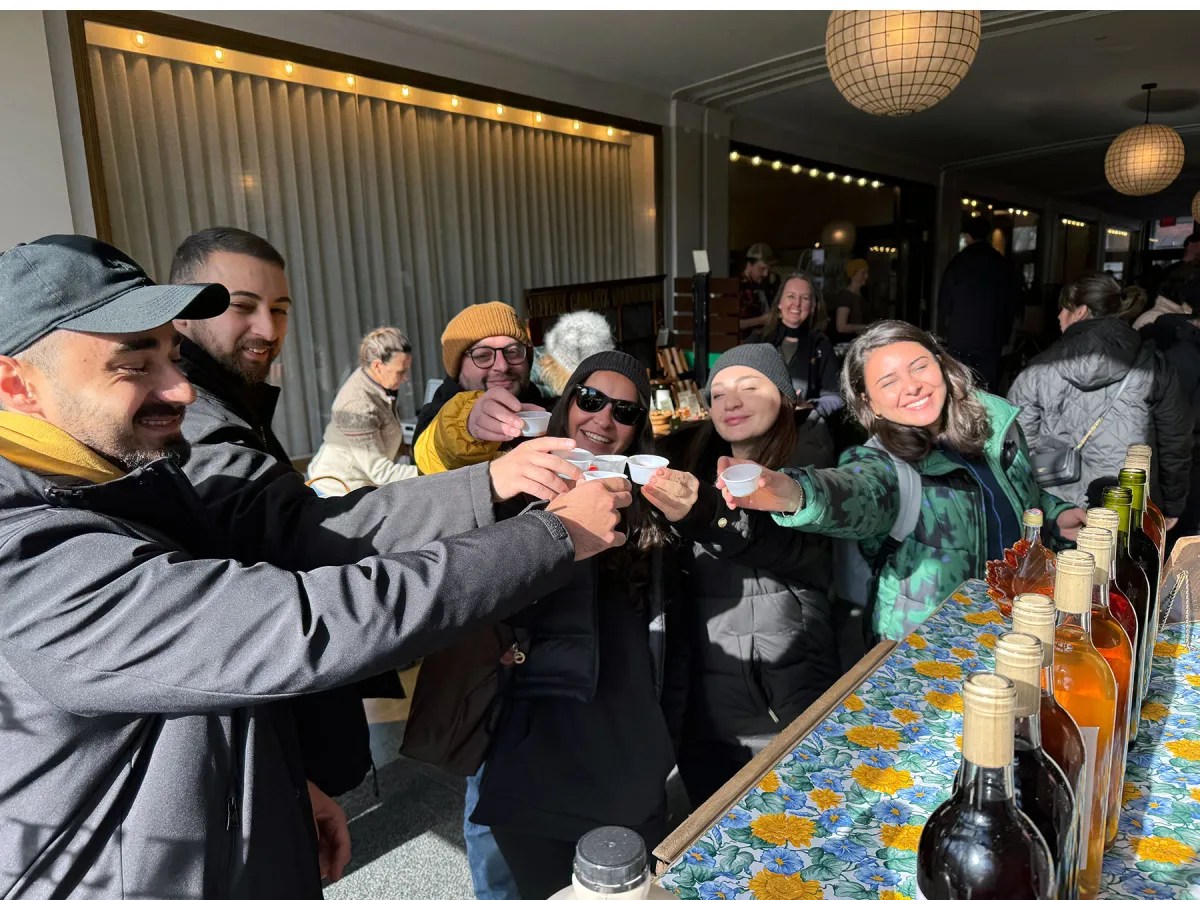 Members of the Georgian Farmers’ Association sample maple syrup for the first time at the Saranac Lake Farmers Market at Hotel Saranac. From left to right: Simon Tsikarishvili, Giorgi Khuroshvili, Koba Zhorzhikashvili, Mariam Mebaduri, Tamta Mamulaidze, Dali Barjadze. Photo courtesy of Saranac Lake Rotary
Common ground
In the agricultural countryside of Georgia, which benefits from the warm, moist air of the Black Sea, the majority of farms are small-scale (roughly 2.5 acres, on average), family-owned and run using traditional methods.
The six delegates who were nominated for the exchange—Dali Barjadze, Giorgi Khuroshvili, Tamta Mamulaidze, Mariam Mebaduri, Simon Tsikarishvili, and Koba Zhorzhikashvili—work for the Georgian Farmers’ Association (GFA), a nongovernmental organization (NGO) with 5,000 members thst carries out initiatives to help Georgia’s farms become stronger and better connected to markets as well as incorporate new technology.
“Though farming isn’t the first thing you think of for Saranac Lake, it is at the center of many innovations and thriving farms,” says Banta. “In the end, it is a fascinating story of how our area has worked to improve nutritional quality and food security using local resources, and the shared challenges in both countries.”
Delegates also connected with food producers, pantries and conservation districts—including ANCA, the Adirondack Food System Network, and the Franklin County Soil and Water Conservation District—to share strategies on managing natural resources and improving food accessibility.
They were introduced to specific strategies and skills that have helped local farms grow, be more visible, and provide greater food accessibility to all Adirondackers. Food pantries opened their doors, sharing the all-too-important reminder that there are those in need all across the globe, and how they work to feed members of communities including Westport and Saranac Lake.
At Sugar House Creamery in Upper Jay, the delegates were impressed not just by the farmland and famous cheese, but by the addition of income-generating lodging and a farm store that incorporates a range of products from numerous local producers—the kind of community-wide support that is reflected at farm stands and markets throughout the region.
“The insights we gained—especially from meeting farmers, small business owners, and community leaders—are directly relevant to our work in Georgia,” said Tsikarishvili. He added that what meant the most to him “was the genuine sense of community we experienced.”
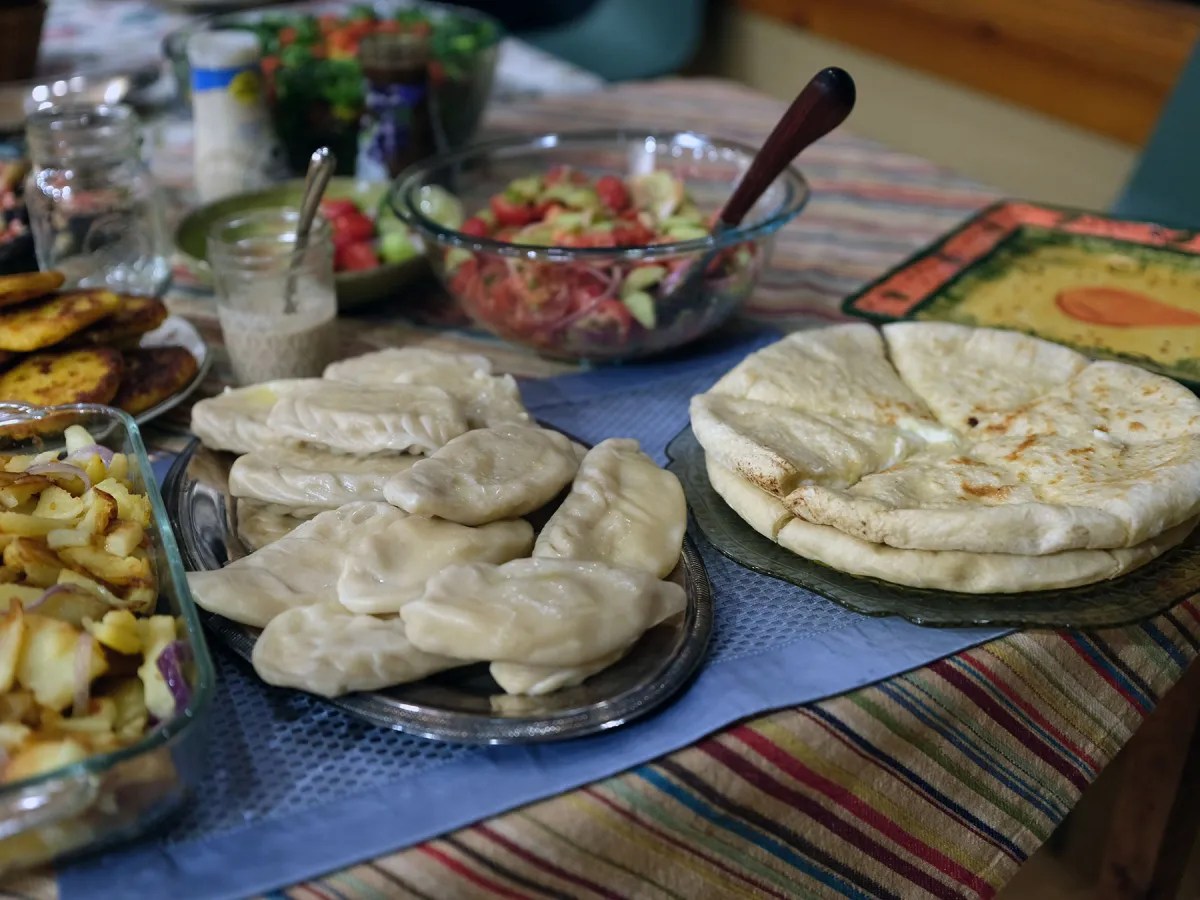 Georgian food at a Thanksgiving meal. Left, khinkali (a type of dumpling); right, khachapuri. Photo by Aurora Pfaff
Gathering around the table
That food would play a role in the program was, perhaps, inevitable, and yet it manifested itself not just in farm visits, but sitting together over shared meals, prepared by local host families, the Georgian guests, and local restaurants, breweries, and community kitchens. Food isn’t simply to be consumed, it’s an experience.
Before leaving Tbilisi, the six delegates gathered supplies so as to share Georgian food with the Americans. Laughter burst out one evening when one of the delegates related the story that, while traveling across the globe, the traditional Georgian spices Mebaduri carried in her luggage were given extra scrutiny at the airport.
Those spices were introduced to the local hosts at an early Thanksgiving dinner hosted by the Weinrick family at their home overlooking Lake Flower. While Brian Weinrick, a scientist at Trudeau Institute, and his wife, Kim, cooked two turkeys, Barjadze and Mebaduri led the creation of traditional Georgian dishes, a way to introduce their home to the Adirondacks. Dishes highlighted ingredients significant to Georgian cuisine, including walnuts, cheese, and potatoes. The dishes were cooked and presented, with friendship and enjoyed, gratefully, by the diners.
More meals were shared in small groups, over kitchen tables with Rotary hosts who provided home-cooked food, friendship and a sense of being welcomed; at local restaurants, and in the hall of St. Luke’s Church, where the delegates joined the weekly free Community Lunch Box.
Looking back, Saranac Lake resident and longtime Rotarian Mary Brown, who accompanied the group every day along with a rotation of other Rotary Club volunteers, says, “Their warmth and enthusiasm was inspiring. They worked hard to absorb every bit of the experiences we planned for them.”
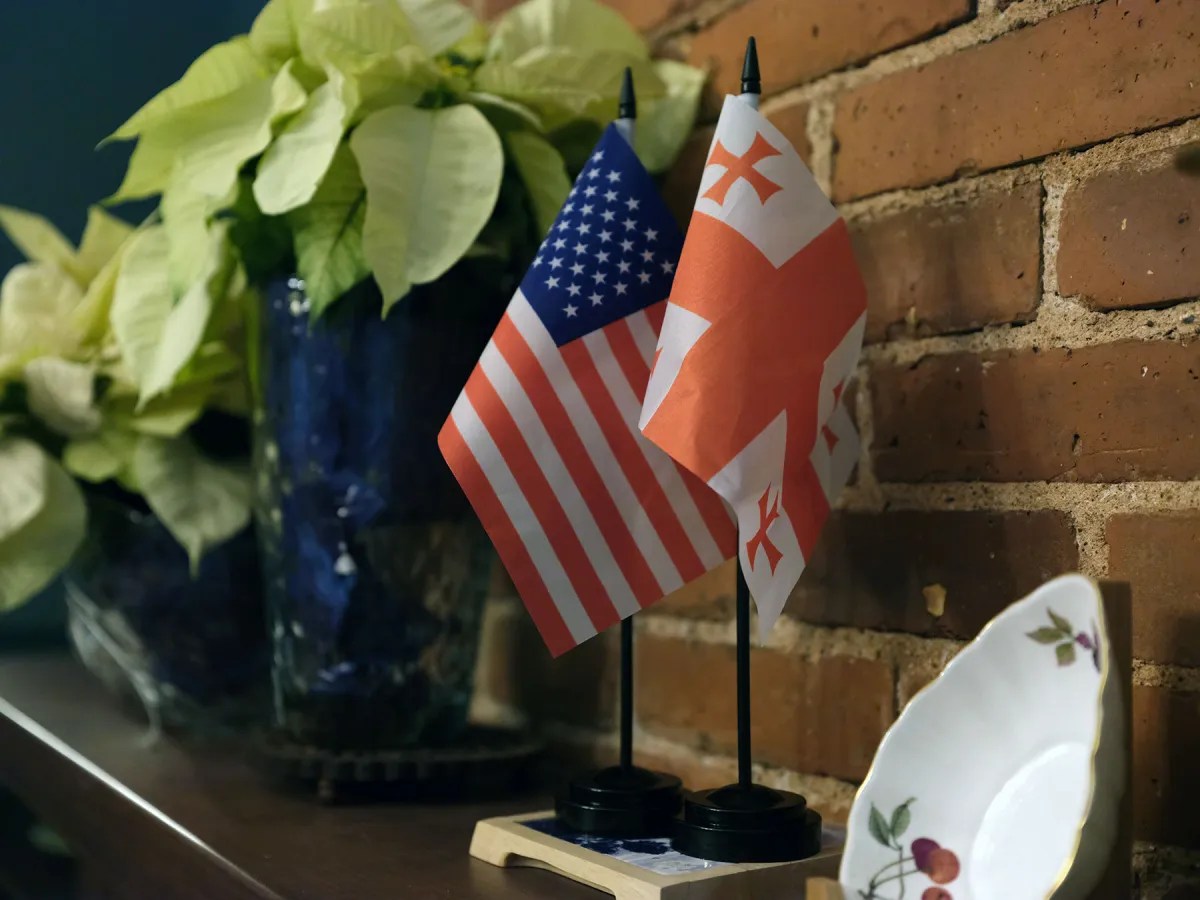 Georgia and U.S. flags decorate the mantle at a Rotary Club host family home. Photo by Aurora Pfaff
Political realities
The delegates brought a perspective many in the Adirondacks are free from: the proximity of conflict. With 20% of Georgia illegally occupied by Russia, the visitors’ determination to improve their nation’s food security is a matter of national resilience. Seeing the steadfast interest the delegates took in all they experienced, Brown said, “One is reminded of the perilous status of the Russian borderland countries and can only respect their determination to do their best for their people.”
At the Adirondack Common Ground Alliance Annual Forum in Schroon Lake, discussions on land use such as the sale of Whitney Park, the role of government in said land use, and how to communicate with those we disagree with struck a chord not just with the GFA delegation, but with the volunteer Rotarians who accompanied them, as well, who recognized that despite local and national political upheaval, many in the Adirondacks live relatively safe, peaceful lives.
“We can’t have peace in this world without sincere efforts to better know and understand our neighbors near and far,” said Banta. “It’s a main mission of Rotary. It was super cool to play some small part in that.”
By the end of the week, tears were shed, promises to visit Georgia were made and friendships had been built. A few weeks after returning to Georgia, her family, and her work, Mamulaidze looked back and shared that “Saranac Lake reminded me that home is not a location but a connection. Shared values, open hearts, and unexpected moments can turn any place into home. I gained life experiences that are sometimes more valuable than any knowledge.”