
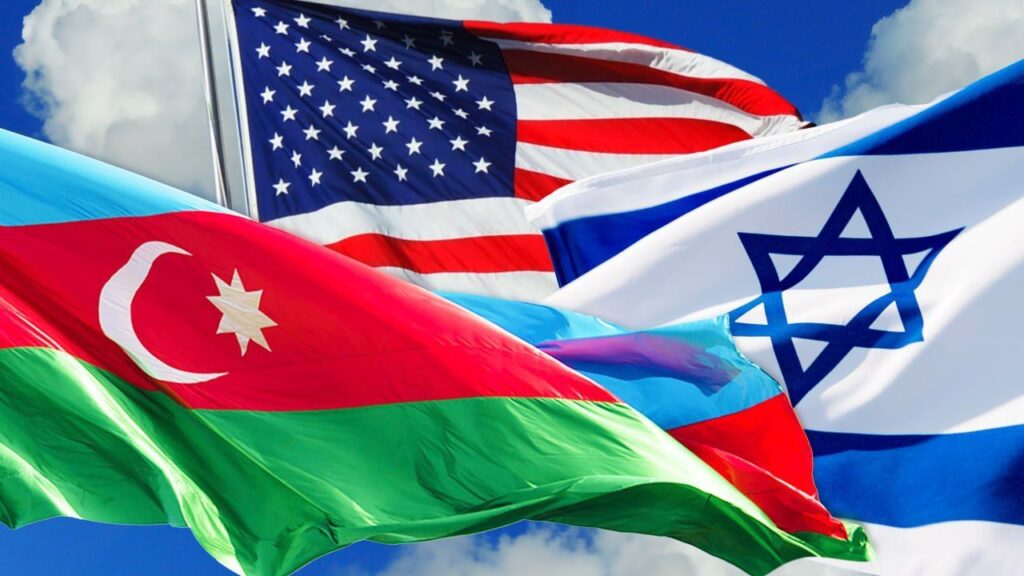

Since 2020, the Abraham Accords, initiated under US mediation as
a series of agreements between Israel and the United Arab Emirates,
Bahrain, Morocco, and Sudan, have begun to extend well beyond their
original regional scope. The initial intention was to restore
relations between Israel and the Gulf states, as well as several
Arab countries, after decades of hostility, and to promote cultural
and economic cooperation. However, in the context of the
Palestinian issue, this process has in recent times, generated
serious discontent in Iran and a number of Muslim-majority states
across the region.
It is therefore no coincidence that, following the Trump
administration’s return to leadership in the United States, the
White House has put forward Azerbaijan’s potential accession to the
agreement as a proposal. Although Azerbaijan belongs neither to the
Middle East nor to the Arab world, the nature of Israel–Azerbaijan
relations, coupled with Tel Aviv’s strategic approach to the South
Caucasus, creates conditions under which Baku’s inclusion in this
framework has become a realistic possibility.
Supporters argue that joining the Abraham Accords would merely
formalise what already exists. Azerbaijan and Israel maintain one
of the closest strategic partnerships in the broader Middle
East–Caspian region, encompassing defence and intelligence
cooperation, energy trade, technology and innovation ties.
From this perspective, accession would not represent a radical
policy shift, but rather the institutionalisation of a
long-standing, pragmatic partnership under a recognised
multilateral framework supported by the United States.
Another positive argument is that accession would serve as a strong
geopolitical signal, such as reaffirming Azerbaijan’s role as a
constructive, stability-oriented actor, strengthening ties with the
US political and security establishment, and increasing
Azerbaijan’s diplomatic visibility beyond the post-Soviet and South
Caucasus space. Put simply, in an era of intensifying great-power
competition, proponents see the Accords as a platform through which
Azerbaijan could diversify its strategic partnerships without
formal alliance commitments.
From the perspective of the Abraham Accords, their economic
rationale also appears to have proven its value. If one examines
the internal logic of the agreement, Azerbaijan’s formal
participation would create opportunities to gain access, alongside
Israel, to investment networks linked to the Gulf and the United
States, as well as to cooperation with the countries concerned in
such fields as agriculture, water management, cybersecurity,
artificial intelligence, and defence technologies. It would also
open pathways to emerging trade routes and logistics corridors
connecting the Eastern Mediterranean, the Gulf, and Europe. In this
sense, the Abraham Accords go beyond a narrow peace agenda,
functioning instead as a geo-economic ecosystem that forges
connective links between regions.
At the same time, under current conditions, certain risks also
come into play. The existing closeness in Azerbaijan–Israel
relations has, in many cases, both irritated and unnecessarily
unsettled neighbouring Iran. In some instances, economic interests
are perceived in Tehran less as commercial opportunities and more
as geostrategic risks, which in turn contributes to an atmosphere
of tension in the South Caucasus. Moreover, Azerbaijan places a
premium on maintaining balanced relations with countries that are
members of the Organisation of Islamic Cooperation, as well as the
Non-Aligned Movement. Because joining the Accords could be
interpreted, fairly or not, as Azerbaijan taking sides in Middle
Eastern fault lines, especially at a time of heightened
Israel–Palestine and Iran–Israel tensions. From this view, Baku
gains little by voluntarily importing geopolitical baggage from
another region.
Despite all this, as a South Caucasus country Azerbaijan is
actively involved in a range of initiatives aimed at building
economic ties with both Israel and Arab states. In particular, in
the field of energy (both green and conventional) it has taken a
number of successful steps in cooperation with the United Arab
Emirates, Saudi Arabia, and even Syria, which is entering a new
phase. All of this indicates that, whether within the framework of
the agreements or outside them, Azerbaijan attaches particular
importance to the development of political, economic, and cultural
relations.
As regards the Abraham Accords, which are rapidly expanding in
scope, they harbour ambitions not only to encompass the South
Caucasus but also Central Asia. This suggests that the United
States and Israel intend in the near future to move beyond a
conflict-centred agenda and prioritise the preservation of economic
balance. The current environment, however, is rather different:
tensions surrounding Iran, the unresolved Palestinian crisis, and
instability in the Middle East continue to cast a shadow over
confidence in the future.