
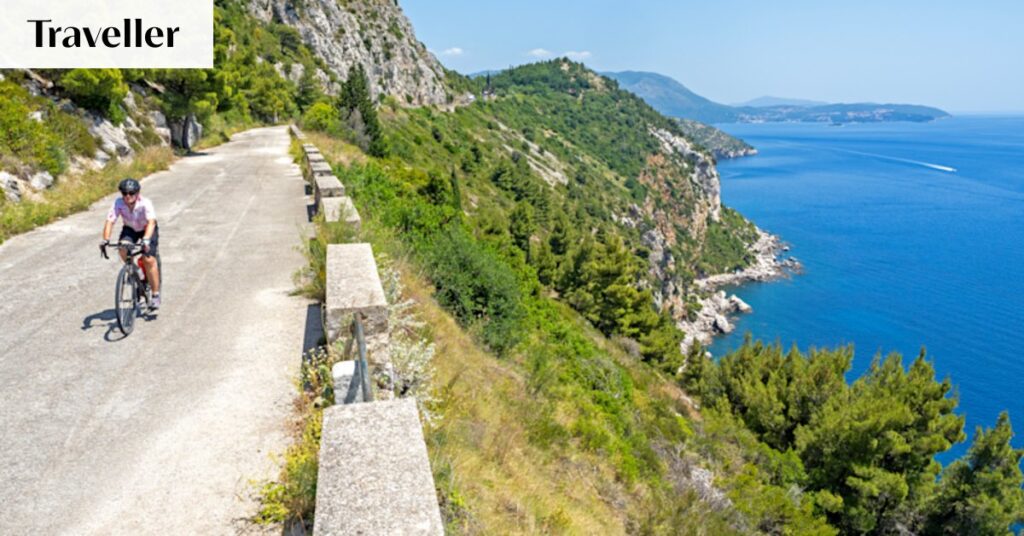

January 12, 2026 — 5:00am
On a rail trail in Bosnia and Herzegovina’s far west, the warning signs are chilling. As we cycle towards the old railway town of Ravno, blood-red signs hang from trees above one of Europe’s largest karst plains, their skulls-and-crossbones cautioning of the presence of land mines. This is not a trail I’ll be leaving for random exploration.
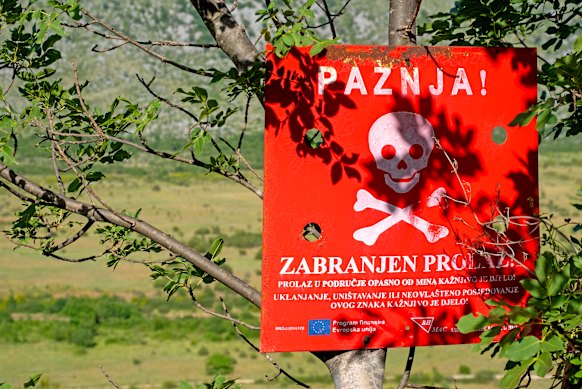
Cycling through the minefield.Andrew Bain
Stretching from Bosnia’s bridge city of Mostar to Dubrovnik on Croatia’s Adriatic coast, the 157-kilometre Ciro Trail is Bosnia’s first rail trail, following the course of an Austro-Hungarian railway that connected Dubrovnik to Austria for much of the 20th century.
It is in some ways an untypical rail trail, following roads more than dedicated paths. For a time, it weaves along roads beside the railway and, later, roads laid down atop the rail bed. Despite that, we see more bikes than cars on my two days on the trail.
The trail also comes with more reminders of Bosnia’s modern history than mere tales of trains. Bombed-out train stations and villages – legacies of the Balkan conflict of the early 1990s – linger like scars in the landscape, as do these landmine signs near Ravno.
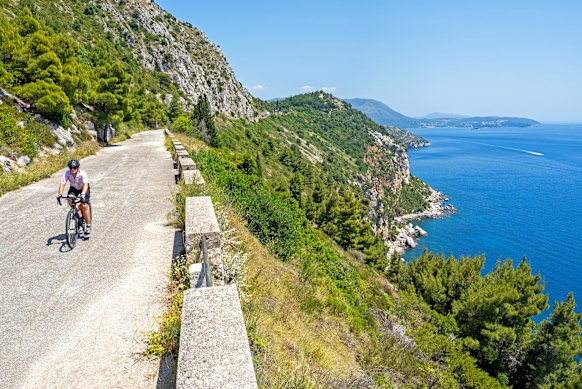
Riding by the coast – not your typical rail trail.Andrew Bain
But behind it all, there’s great beauty, from cave systems to curious waterfalls.
From Mostar’s Spanish Square, ringed by wartime ruins, the Ciro Trail sets out strangely on a highway, though within four kilometres I’m riding on quiet roads, passing through vineyards with limestone mountains rising tall around me.
Though the trail follows the course of the Neretva River – the waterway into which Mostar’s bridge jumpers famously leap – out of Mostar it’s a while before the river appears in view. When it does materialise, it does so spectacularly, pouring over black ledges of rock into a deep channel known as the Buna Canals, forming a chain of dozens of small waterfalls.
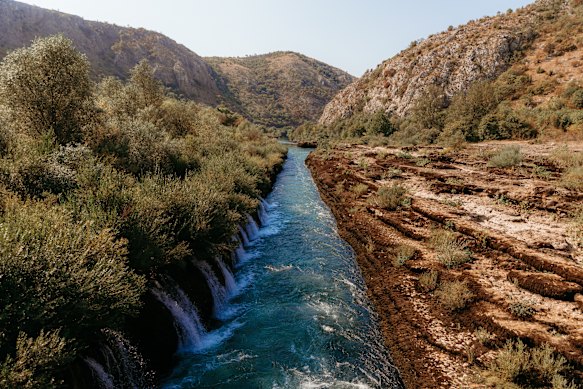
The Buna Canals on the Neretva River.iStock
For the first 40 kilometres, there’s barely a ripple in the trail’s gradient – a miracle of design in this mountainous landscape – even as it burrows into a narrowing gorge just beyond the canals. Beneath the gorge’s rocky bluffs, a turtle crosses the path ahead of us and every tree branch is seemingly hung with butterflies.
Out of Capljina, pretty much the last stop for cafes and supermarkets on the trail (despite there still being about 120 kilometres to ride), this rail trail finally takes to the rails. Across rickety iron bridges, including one designed by Gustave Eiffel, the Ciro deviates onto a gravel path. Unusually for rail trails, it makes a long squiggling climb into hills above the marshlands that surround large, bird-filled Svitavsko Lake.
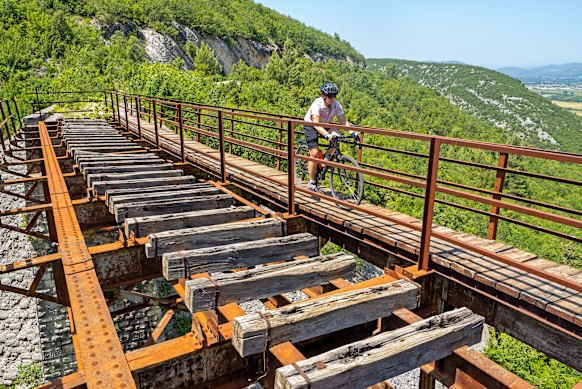
Crossing an old railway bridge on the Ciro Trail.Andrew Bain
On this bumpy track, 10 tunnels bore through the limestone hills. Fierce sunlight turns to darkness inside each tunnel, and bats, disturbed from their tunnel roosts, flit past my ears like tiny fighter jets.
As the trail descends towards the karst Popolo Plain, the ruins of stations and guard houses flicker past, and at one point we ride above an entire village destroyed by war, its walls and chimneys standing in the undergrowth like headstones.
One station, however, has risen from its despair, and it’s here that we’re headed. In Ravno, the old railway station has been converted into the boutique, four-room Hotel Stanica Ravno, complete with restaurant and wine bar. Most of its guests are cyclists, and what I like above all are the ice cubes the manager slips into our water bottles the next morning as we pedal out into another hot Bosnian day.
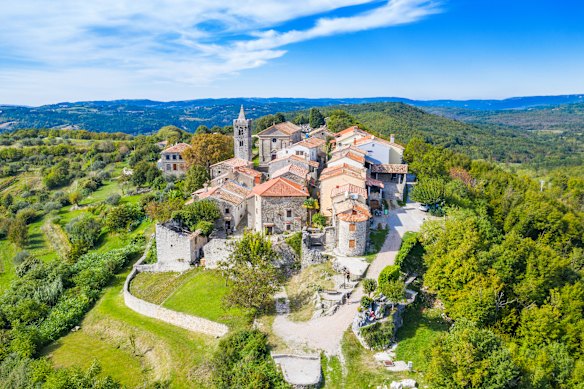
Historic town of Hum in central Istria.Getty Images/iStockphoto
In the village of Hum, the trail forks, continuing straight ahead to the old rail terminus in Trebinje or turning right for Dubrovnik. Like most, we take the latter turn, climbing through the mountains in the magically gentle way of rail trails and passing the ruins of train stations now seemingly commandeered by cattle.
The Adriatic Sea comes into view for the first time as our passports are stamped at the hilltop border, entering Croatia and swooping down to the coast. As we cross the highway, another empty road leads us towards our finish, the Dalmatian cliffs tumbling away below us and the orange smudge of Dubrovnik’s roofing calling us forward towards an Adriatic swim. It’s been a journey across a battle-scarred land, but somehow all the richer for it.
THE DETAILS
RIDE
Mountain bike and e-bike hire can be arranged through Herzegovina Bike in Mostar. Follow the “About Herzegovina” link at herzegovinabike.ba, which also has plenty of information about the Ciro Trail.
STAY
The boutique Hotel Stanica Ravno has rooms from €85 ($150) a night. See stanica-ravno.com
FLY
Qatar Airways flies to Mostar from Melbourne and Sydney, transiting through Doha, Munich and Zagreb. See qatarairways.com
The writer travelled at his own expense. See ciro-trail.com
Sign up for the Traveller Deals newsletter
Get exclusive travel deals delivered straight to your inbox. Sign up now.
 Andrew Bain is a Hobart-based writer and author who has been writing about travel and adventure for more than 25 years, and is most at home in the outdoors and remote places.
Traveller GuidesFrom our partners