
Breadcrumb Trail Links
Common Sense Health: That night, someone thought it was a good idea to set off flaming champagne sparklers in a crowded, enclosed space
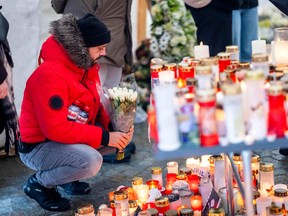 Attendees gather in mourning, placing messages, candles, and flowers at a memorial site in front of the bar “Le Constellation” during a national day of mourning in Crans-Montana, on January 9, 2026, in tribute to the victims of the fire that ravaged the bar on New Year’s Eve, killing 40 people and injuring 116 others, most of them teenagers. (Photo by MAXIME SCHMID / AFP via Getty Images)
Article content
By any measure, what happened in Switzerland a couple a few weeks ago is a human catastrophe. A room filled with young people full of promise was turned into a scene of lifelong grief. Families shattered. Futures erased. Survivors left with horrible scars.
Advertisement 2
Article content
Authorities will do what they must. Investigators will trace the ignition point. Building inspectors will scrutinize ceiling materials, fire exits, sprinkler systems, and renovations. Prosecutors will decide whether criminal negligence was involved. All of this matters. We should insist that regulations are enforced and that those who ignore them are held accountable.
Article content
Recommended Videos
Article content
But more troubling than regulatory failure, this was also a failure of common sense.
That night, someone thought it was a good idea to set off flaming champagne sparklers in a crowded, enclosed space. Not outdoors in the open air. But inside, with people packed shoulder-to-shoulder. That decision set in motion consequences that will echo for decades.
Advertisement 3
Article content
And the truly chilling truth is this: it will happen again.
After every nightclub fire, warehouse inferno, or stadium stampede, we say, “How could anyone have allowed this?” And yet, it happens again because novelty and spectacle overpower judgment. Because risk feels theoretical.
We like to think safety is something others provide. But real safety begins between our ears.
When was the last time you didn’t do something because your analytical internal voice said, “This isn’t smart”?
A snowstorm is rolling in. You’ve been waiting months for that weekend getaway. The hotel is booked. The car is packed. Do you pause? Or do you say, “We’ll be fine” as icy roads turn highways into high-speed skating rinks?
Your smoke detector hasn’t chirped in years. You can’t remember the last time you changed the battery. You assume it’s working.
Advertisement 4
Article content
There’s no carbon monoxide detector in the house. You’ve meant to buy one. But it keeps getting bumped to next weekend.
Your barbecue sits against the siding of your home. You know embers can blow. You know vinyl melts. But you’ve done it a hundred times without incident — so why move it now?
Your phone buzzes while driving. You glance down. Just for a second.
These are not rare behaviours. They are risks that get normalized. Most of the time, nothing happens. And that’s what makes them dangerous.
The tragedy in Switzerland was not caused by mystery physics. It was not an unforeseeable freak accident. Fire and sparks in confined spaces have been setting buildings alight since long before electricity was invented. Every firefighter knows it. Building codes reflect it. Insurance companies price it.
Advertisement 5
Article content
So what possessed someone to light flaming devices indoors? The answer is brutally simple: the same human instinct that tells us, “It’ll be fine.”
The heartbreaking reality is that many of the victims in Switzerland were young. They did not light the flame. They were simply there, trusting.
If there is anything to be salvaged from grief on this scale, it is a renewed commitment to thinking ahead and to pausing in the moment.
The families of victims are living with terrible grief. Our hearts are with them. But sympathy is not enough. If we truly honour the victims, we must change how casually we flirt with danger.
I’ve written about fireworks before, and I am not a fan. It is beautiful what they do in the night sky with ever more sophisticated displays. But without caution and common sense, there will be more horrible accidents.
In celebrating life’s joys, let’s choose to marvel at the things that will keep us alive, not make us dead.
This column offers opinions on health and wellness, not personal medical advice. Visit www.docgiff.com to learn more. For comments, diana@docgiff.com. Follow on Instagram @diana_gifford_jones
Article content
Share this article in your social network