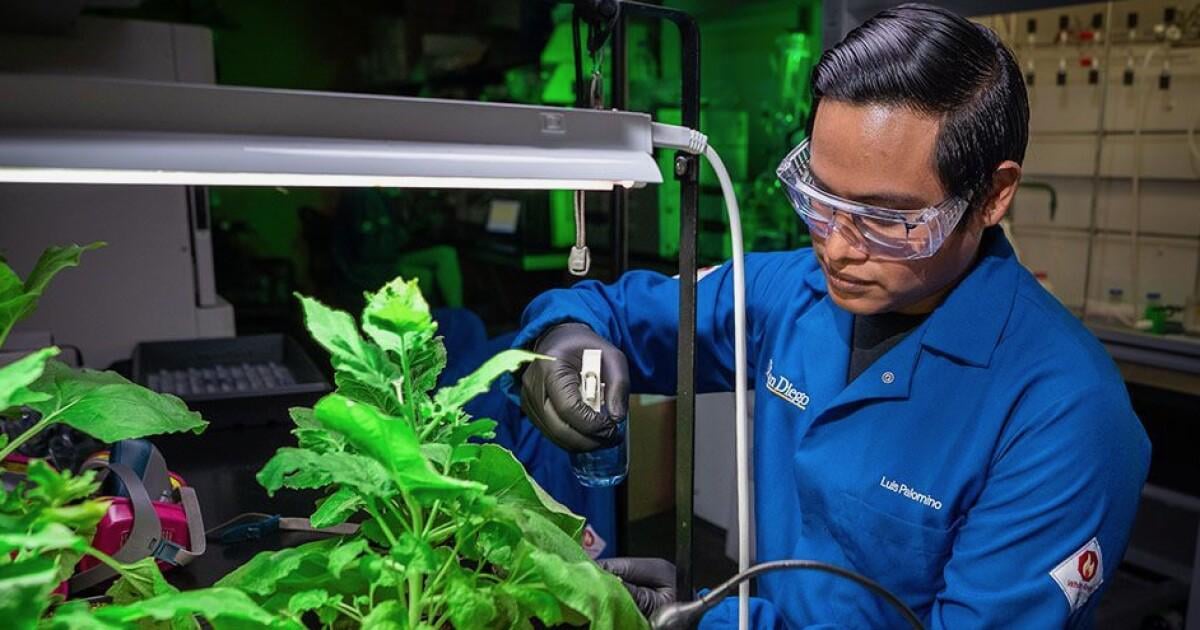
Spray-on armor for plants offers a new tool for global food security. Research reveals a polymer functioning as a spray-on armor that helps plants fight destructive bacteria while surviving drought.
https://newatlas.com/science/spray-on-armor-plants/

17 Comments
>Because of industrial climate chaos, catastrophic economic inequality, war and displacement, there is, as the United Nations puts it succinctly, a global food crisis in 68 countries, with 318 million people facing acute hunger. Simultaneous famines in two countries (Palestine and Sudan) – which the UN calls “a devastating first this century” – threaten millions of lives.
>While it’s clear that crises caused by economic and political decision makers are most easily solved by “un-deciding” them, until those decision-makers develop empathy, the rest of humanity will need to create and implement other solutions to starvation. And fortunately, researchers in the Jacobs School of Engineering at the University of California San Diego are doing just that.
>In their ACS Materials Letters [paper](https://pubs.acs.org/doi/full/10.1021/acsmaterialslett.5c00798) “Polynorbornene Spray Coating to Enhance Plant Health,” lead author Patrick Opdensteinen and colleagues reveal that their new tool for global food security is a polymer functioning as a spray-on armor that helps plants fight destructive bacteria while surviving drought.
The article is light on details. What does the polymer do when humans ingest it?
Now watch me whip, now watch me Polynorbornene.
Like… plastic? That doesn’t sound healthy if so.
Polynorbornene is made from hydrocarbons. Its also brittle, so it has to be mixed with polymers.
This could be up there with ideas like lead in gasoline, asbestos cigarette filters and ozone destroying spray cans
A spray on polymer? So another plastic to be ingested and contaminate the environment?
So these chemists decide to create a sealant for plants, to which they follow up with “we hope to increase the biodegradability” and “investigate toxicity”. Yknow, things that are fully secondary to stopping plant bacteria and sealing in water. Not to mention that processing the spray requires that they dissolve it in water to the desired concentration, and that their bacterial defense is not understood and the guess is that it causes the plant to undergo a stress response and release a ton of hydrogen peroxide. Absolutely irresponsible research.
I’ll be honest, for coming up with such an environmentally destructive idea like this, they should have been dismissed/fired.
> The major polymers identified in the food samples were polyethylene terephthalate, polystyrene, **polynorbornene**, nylon, polychloroprene, and copolymer polyacrylamide
Neat…
https://pubmed.ncbi.nlm.nih.gov/35753373/#:~:text=Abstract,;%20Exposure;%20Food;%20Microplastics.
Wouldn’t it better to work on what is causing the drought in the first place?
A bunch of companies are working on tech like this – I know of a few that are focusing on citrus greening. Some of them are using less creepy polymers like peptides, modified sugars, etc. Unfortunately there’s basically zero money in this field driving innovation
Anything And everything but cutting fossils fuels, including spraying petroleum based chemicals on our food.
And is super safe for humans and the environment right? … … right?
Covering plants in plastic doesn’t seem like something I would support.
Is it milk? Milk really helps like this.
Sounds like something that plants might crave.
What could possibly go wrong?
Sounds tight asf.
Armor up them plants. Chainmail too