
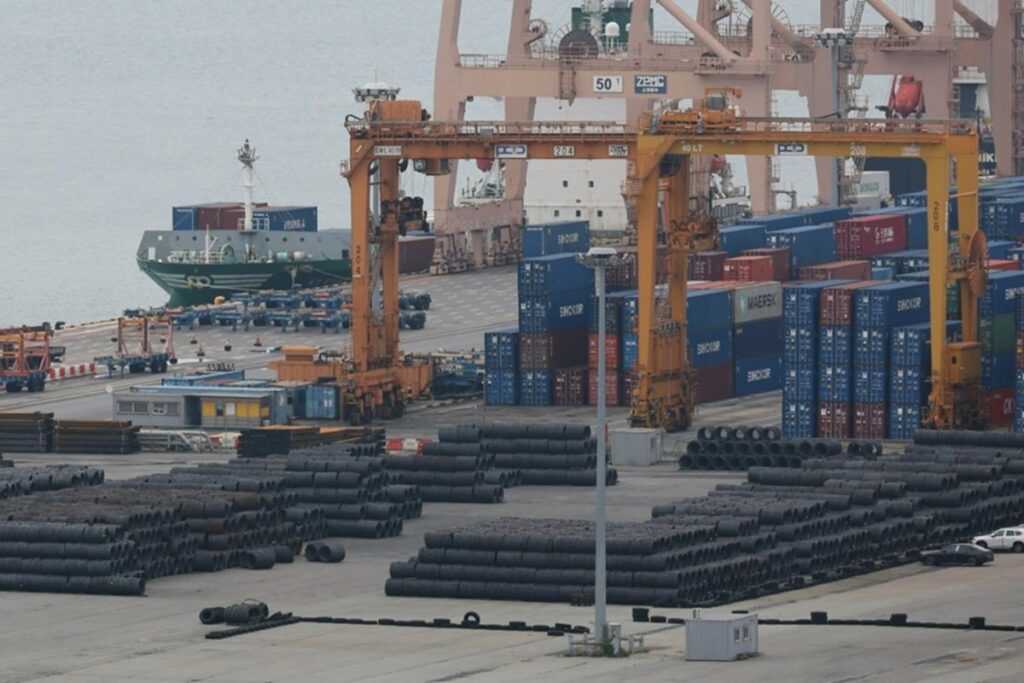
Steel products are piled at Pyeongtaek Port, south of Seoul, South Korea 12 October 2025. File Photo by YONHAP / EPA
Jan. 11 (Asia Today) — South Korea’s government has set a 2.0% economic growth target for this year, citing strong exports led by semiconductors and a gradual recovery in private consumption and construction, while warning that chip-cycle momentum and a prolonged weak won remain key risks.
The Ministry of Economy and Finance said its “2026 Economic Growth Strategy,” announced Friday, projects real gross domestic product to rise 2.0% from a year earlier. The forecast is up 0.2 percentage points from the 1.8% projection the government presented last August.
The ministry’s outlook is higher than forecasts from several major institutions cited in the report, including the International Monetary Fund at 1.8%, the Asian Development Bank at 1.7%, the Korea Development Institute at 1.8% and the Bank of Korea at 1.8%. The Organisation for Economic Co-operation and Development projected 2.1%.
First Vice Minister of Economy and Finance Lee Hyung-il said the government’s projection reflects its commitment to pursue policy tasks aimed at achieving 2% growth, adding that the focus this year will be on making a major leap after efforts to support recovery last year.
The ministry said exports have continued to rise as the semiconductor industry improves, while private consumption has expanded on stronger real purchasing power and recovering sentiment. Construction investment, which had been negative, is expected to return to positive growth this year, it said.
The government also plans to raise total spending by 8.1% from last year to support private-sector growth and to execute a record 70 trillion won ($54 billion) in public institution investment to help spur activity.
Officials also pointed to downside risks. The report said achieving 2% growth would be difficult if the semiconductor upswing cools. Bank of Korea Gov. Lee Chang-yong said in a New Year’s address on Jan. 2 that excluding the information technology sector, growth this year would be about 1.4%.
The ministry also cited the possibility of a prolonged weak won as a source of pressure, saying while a weaker currency can support exports, it can also raise costs, weigh on prices and domestic demand and strain companies reliant on imported materials. Small and medium-sized firms and the self-employed could face greater difficulty passing on cost increases, the report said, potentially dragging on investment, hiring and growth.
— Reported by Asia Today; translated by UPI
© Asia Today. Unauthorized reproduction or redistribution prohibited.