
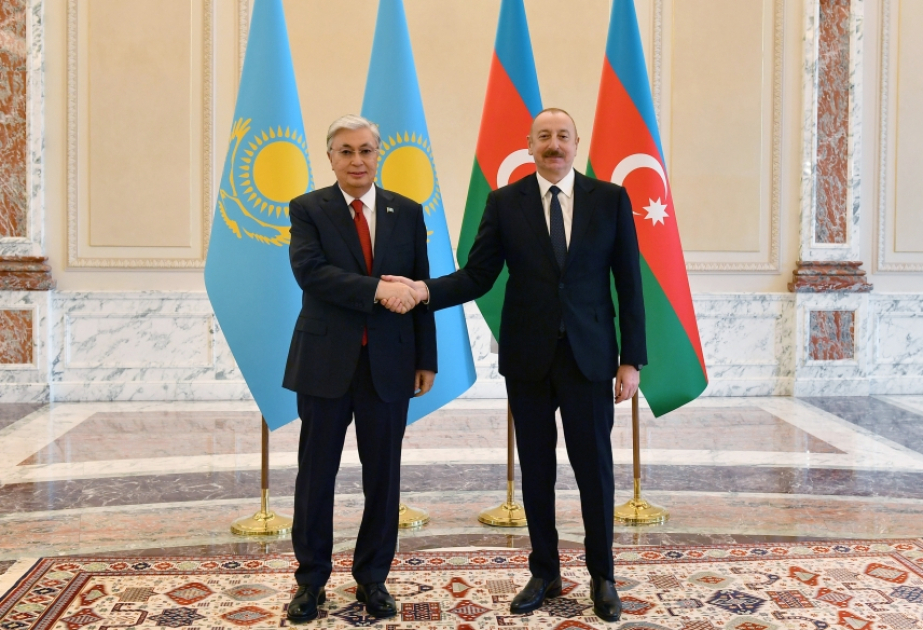
BAKU, Azerbaijan, January 12. On January 5,
2026, President of Azerbaijan Ilham Aliyev and President of
Kazakhstan Kassym-Jomart Tokayev gave extensive interviews to their
national media, summarizing the results of the past year and
outlining key milestones for the further development of their
states. The leaders of the two nations are similar in their
assessments of the current moment, their vision of regional
processes, and the formation of long-term strategies.
Speaking on the transformation of regional interaction,
President Ilham Aliyev emphasized that the vast space from the
South Caucasus to Central Asia is undergoing a major transformation
toward a new model of development.
“Today, the Central Asia-Azerbaijan unity and the transformation
of the C5 into C6 carry great importance not only for our region
but for the world. Because connectivity, transport, and logistics
are of major significance for many leading international actors,
and in this regard, the only reliable country geographically
capable of linking Central Asia with the West is Azerbaijan,” the
head of state added.
The President of Azerbaijan also emphasized that 2025 was marked
as a turning point in terms of concluding the long-standing
conflict between Azerbaijan and Armenia in the political plane.
According to him, the country has entered a qualitatively new
reality, which he characterized as a period of peace and creation.
The Head of State specifically noted that even in the first months
of living under peaceful conditions, practical results have become
visible — a positive public mood and the expansion of economic
opportunities. These factors, in his assessment, create a
sustainable basis for further development and allow Azerbaijan to
focus on solving long-term tasks.
A similar logic of reasoning was heard in the interview with the
President of Kazakhstan. Kassym-Jomart Tokayev spoke of 2025 as a
period of significant socio-economic achievements, noting record
economic growth figures, an increase in GDP, and a rise in per
capita income. At the same time, he emphasized that the results
achieved should not become a cause for complacency, pointing to
persistent risks, including those related to inflation and the need
to strengthen the resilience of the economic model.
The key motif of the Kazakh President’s speech was the
irreversibility of domestic transformations. He explicitly stated
that the main result of the year was the strengthening of public
understanding regarding the necessity of large-scale reforms aimed
at modernizing the state and the economy. The launch of a new tax
code, the beginning of the implementation of the national project
to modernize the energy and utilities sector, as well as the
continuation of institutional reforms were presented as elements of
a unified strategy for which the country has no alternative.
In this context, the approaches of the two leaders
demonstrate an obvious similarity. In both Baku and Astana, reforms
are viewed not as situational political decisions, but as an
objective necessity dictated by changes in the regional
and global environment. We are talking about a transition from an
adaptive development model to a more stable and structured
strategy.
A significant place in both interviews was occupied by
the theme of transport and logistical connectivity of the
region. Ilham Aliyev identified Azerbaijan as a key
geographical link capable of reliably connecting Central Asia with
the West under the current geopolitical configuration. He noted the
growth of transit shipments through the country’s territory,
including the passage of more than 100,000 containers, emphasizing
that this figure is only the beginning of more large-scale
processes.
Special attention was paid to the development of the
Middle Corridor and the prospects for its strengthening
through the Zangezur Corridor, which is considered not only as a
tool for internal connectivity but also as an international
transport route. According to the President of Azerbaijan, cargo
from China and Central Asian countries will increasingly use this
route, which will increase its significance in the system of
Eurasian transportation.
Kassym-Jomart Tokayev, in turn, emphasized the strategic
importance of Kazakhstan’s transit and logistical potential, noting
that connectivity is a key element of the country’s economic
development. The commissioning of the new “Dostyk–Moyynty” railway
line was presented as a step capable of manifoldly increasing the
throughput capacity of the route between China and Europe. The
President also noted the importance of a comprehensive approach,
including the modernization of ports, airports, railway hubs, and
the development of a digital ecosystem.
In both cases, transport is not considered in isolation,
but as a point of intersection for the interests of
various economic sectors, investments, and technologies, reflecting
a similar understanding of the role of connectivity in modern
development.
Energy issues became another area of convergence in the
two leaders’ approaches. Ilham Aliyev in his interview
explicitly stated the need for a realistic view of the role of
fossil fuels in the global economy, emphasizing that ignoring this
reality does not correspond to the interests of sustainable
development. Simultaneously, he outlined specific plans for the
large-scale development of renewable energy sources and the
modernization of the country’s energy infrastructure.
Kassym-Jomart Tokayev spoke of similar challenges, focusing on
the need to upgrade Kazakhstan’s energy and utility systems. He
emphasized that without reliable energy generation, it is
impossible to move to a new technological model of the economy
based on the development of data centers, high-performance
computing systems, and automated production facilities. In this
context, the construction of nuclear power plants was designated as
a rational and long-overdue step for the country — the world leader
in uranium mining.
In energy, both leaders demonstrate a pragmatic and sovereign
approach, in which the choice of tools — from hydrocarbons to
renewable sources and nuclear energy — is determined not by
ideological considerations, but by the practical tasks of
development and ensuring long-term sustainability.
Azerbaijan and Kazakhstan are entering a new stage of
development with a close understanding of their tasks and
opportunities. For Baku and Astana, the key guidelines are
stability, predictability, and long-term planning. The completion
of complex historical periods, the implementation of structural
reforms, the development of transport corridors, and the
strengthening of the energy base are considered not as disparate
steps, but as elements of a single strategy. In this sense, the
approaches of Ilham Aliyev and Kassym-Jomart Tokayev reflect a
similar desire to turn achieved stability into sustainable
development and to strengthen the role of their countries in the
region.