
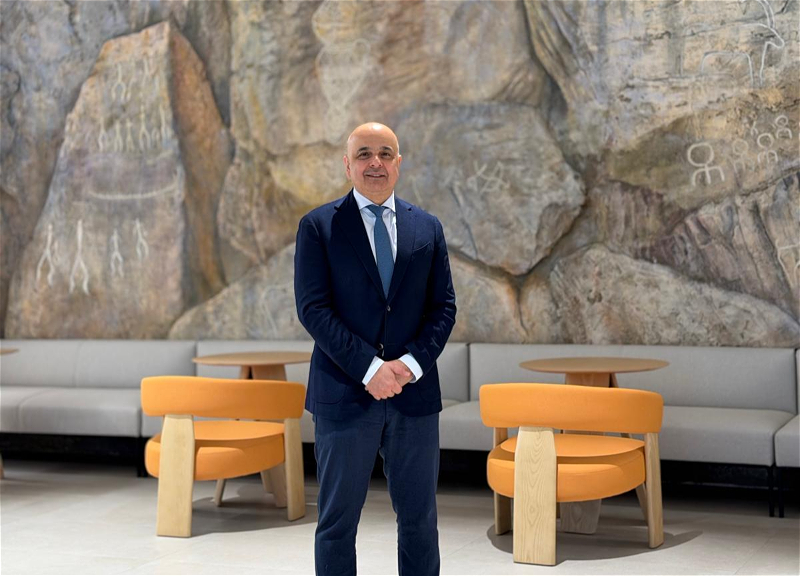
Among those awarded by President of Azerbaijan Ilham Aliyev for their contribution to strengthening friendship between peoples and supporting the development of the Azerbaijani diaspora is the world-renowned scientist, neurologist, and Professor at the University of Copenhagen, Messoud Ashina.
The awarding of the Shohrat Order is seen not only as recognition of his personal scientific achievements, but also as a reflection of Azerbaijan’s international scientific and humanitarian standing.
Combining a medical education received in Baku with the European scientific school, Messoud Ashina today heads leading international research centers on migraine and headache, represents Azerbaijan successfully in the global scientific community, and contributes actively to diaspora initiatives.
In an interview with 1news.az, Messoud Ashina shares his views on his scientific path, international achievements, diaspora activities, and the place of Azerbaijani science within the global system.
What kind of path and values do you associate with receiving the Shohrat Order?
I see this award as recognition not only of specific scientific results, but also of a professional path built over many years and of adherence to certain values. Alongside my academic work, an integral part of this journey has been my activity within the diaspora and participation in projects under the YAŞAT Foundation. The core values for me have always been consistency, a sense of responsibility, professionalism, and the desire to deliver real, tangible benefits in the fields in which I work.
How did the medical education you received in Azerbaijan and the Danish scientific school complement each other in your biography?
The medical education I received in Baku gave me strong clinical thinking, a practical approach to patients, and a deep sense of responsibility. This became a very solid foundation for all subsequent stages. In Europe, I encountered scientific methodology, evidence-based approaches, research planning, and systematic analysis of results. The European scientific environment requires the ability to ask questions, to doubt, and to constantly re-examine conclusions. Over time, these two approaches complemented each other, shaping a balanced perspective in both clinical practice and research.
How did your path toward international recognition in migraine research take shape?
It was never a sudden leap. The key factors were long-term focus on specific scientific questions, consistent research, and bringing results into international scientific discussion. Working in an environment of international cooperation, engaging in dialogue with different scientific schools, and being open to criticism became integral to the process. Over time, this approach built trust within the scientific community, and recognition emerged as a natural outcome.
What has kept you in science for so many years?
The main motivation is not only scientific curiosity, but also the real problems I encounter daily in clinical practice. Migraine is a condition that significantly reduces the quality of life for millions of people and for a long time was not taken seriously enough. Seeing the burden caused by pain, reduced productivity, and social limitations in patients’ everyday lives makes it impossible not to feel a heightened sense of responsibility. The understanding that even small advances in this field can genuinely improve people’s lives is what sustains long-term motivation.
In what context is Azerbaijan mentioned today on international scientific platforms?
Mostly through individual scientists, specific research areas, and personal initiatives. To some extent this is positive, as it points to existing potential. At the same time, it also indicates that institutional and systemic representation has not yet been fully formed. Existing links are largely project-based and require support through a long-term strategic approach.
How can ties between Azerbaijani scientists living abroad and their homeland be strengthened?
This requires more practical, results-oriented mechanisms. Short-term targeted research projects, joint research programs, and structured knowledge exchange can be more effective. The key point is that cooperation should not be formal, but based on mutual benefit. Models that take into account the real needs of both sides tend to deliver more sustainable results.
How would you describe the current stage of migraine research?
This stage is characterized by a deeper understanding of the biological mechanisms of migraine. Insights gained at the level of neurobiology and molecular processes are creating opportunities for more precise and personalized treatment. This is not a sudden or dramatic breakthrough, but a new phase developing step by step. Strengthening the scientific foundation provides a solid basis for further progress.
What challenges do young Azerbaijani professionals face when seeking to build a scientific career abroad?
One of the main challenges is finding the right scientific environment and establishing a long-term perspective. A scientific career does not deliver quick results, which can be psychologically difficult, especially at an early stage. Additional barriers include language and cultural differences, as well as intense competition. Patience, consistency, and realistic expectations are crucial along this path.
What is lacking for faster integration of Azerbaijani science into the international scientific community?
Above all, a systemic approach and continuity. International integration cannot be achieved through one-off initiatives; it develops over years on the basis of a well-thought-out strategy. Parallel investment is needed in scientific infrastructure, human capital, and mechanisms for international cooperation. Gradual development appears more realistic than an emphasis on short-term results.
What gives you hope today regarding Azerbaijan?
The country’s economic development in recent years, growing attention to the climate agenda, and a focus on sustainability in the region inspire cautious but genuine optimism. These processes suggest that long-term thinking is beginning to take shape. If this approach is pursued consistently, there are grounds to expect positive outcomes both in science and at the institutional level.