
Tista’ taqra bil-
Malti.
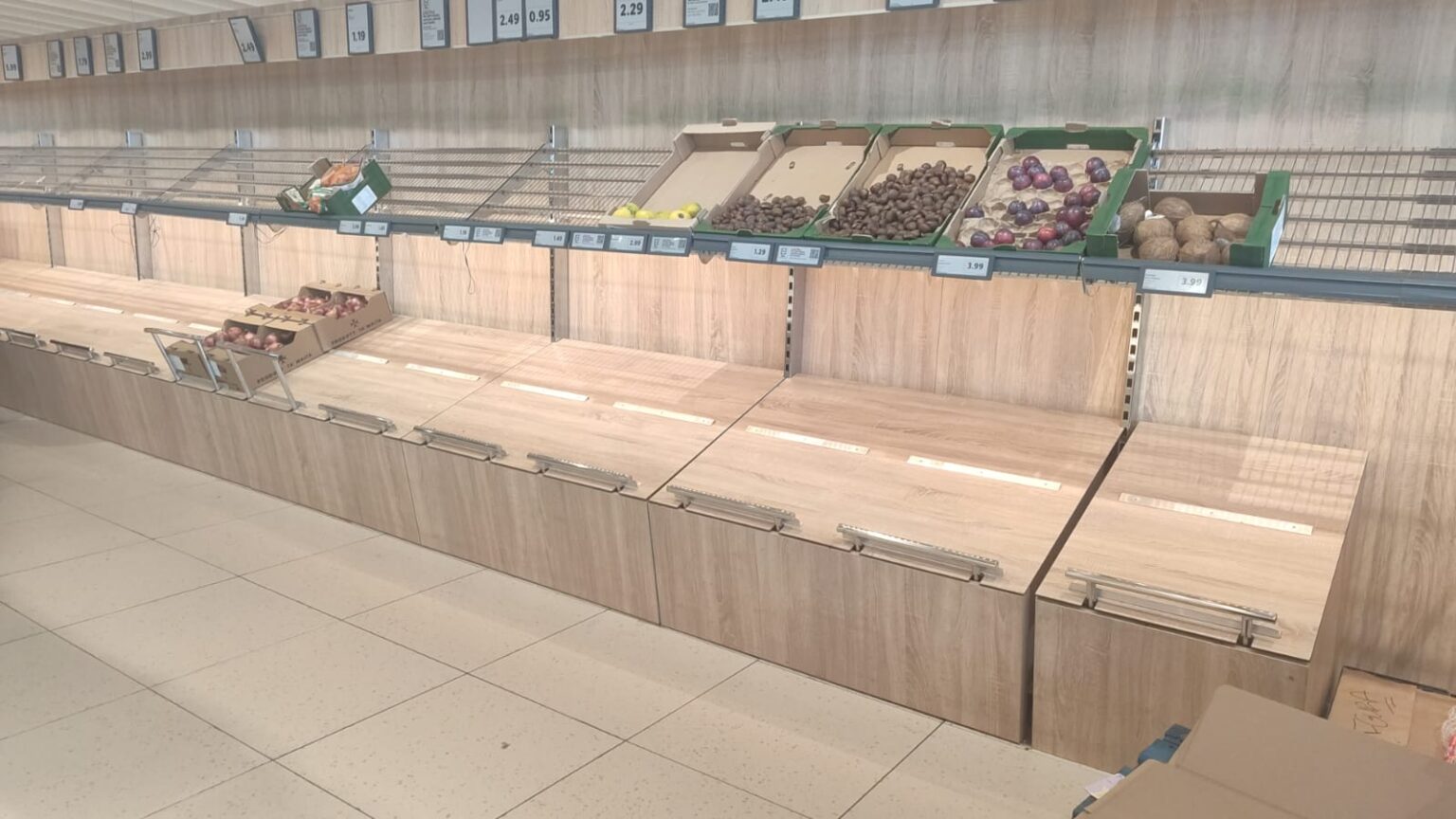
Shoppers across Malta have been confronted with bare supermarket shelves in recent days, as severe weather conditions prevented container ships from reaching the island, leaving stores critically short of fresh produce, frozen goods and dairy products.
Images show empty aisles at major retailers including Lidl and Eurospin, with vegetables, frozen foods and certain pasta and dairy items completely out of stock since Monday morning.
Both chains import the bulk of their products from Sicily, and the recent storms have forced the postponement of ferry services between Malta and the Italian island.
The Għaqda Bdiewa Attiva (Active Farmers Association) responded to the crisis by underlining that the shortages demonstrate the serious consequences of Malta’s excessive dependence on imported food.
“It’s worth realising the repercussions when a country depends excessively on imported produce,” the association stated on social media. “A bit of bad weather for a day or two and these are the effects.”
The catamaran service between Malta and Sicily was suspended for several days last week due to dangerous sea conditions, with passengers given alternative dates as the voyages were deemed too perilous to operate.
While major supermarkets struggled, The Food Coop, which specialises in local produce, reported no similar problems. The cooperative explained that Maltese food doesn’t need to cross the sea to reach Maltese consumers, coming instead directly from farmers and fishermen.
The group appealed for greater support of local producers, stating their shelves remained stocked with “fresh, genuine, zero-mile produce” while others faced shortages.
Weighing in on the matter, Maltese MEP Peter Agius published correspondence with the European Commission revealing that €3.8 million in EU agricultural funds intended for farmers were instead redirected to forestry initiatives by the Maltese government.
“We’ve been hearing from farmers and fishermen that European funds are going to government agencies instead of being used to produce good, local food,” Agius told Newsbook Malta.
“Today I have proof from the European Commission that €3.8 million supposedly dedicated to farmers in fact went to spending on agencies and so-called ‘forestry’ measures.”
The correspondence from Commissioner Christophe Hansen’s cabinet confirms that in the final Maltese Rural Development Programme, adopted on 4 November 2025, the entire €3.8 million was reallocated to “investments in forest area development and the improvement of the viability of forests.”
Agius expressed concern that funds earmarked for initiatives such as young farmer programmes and farm machinery purchases were diverted away from food production. “This unfortunately shows that having good, local food is not a priority for the government. This worries me greatly and should worry all Maltese families because food security in Malta is at its lowest point ever, with various fields closing and farmers leaving the profession,” he stated.
The MEP also criticised what he described as widespread delays in fund distribution, noting that whilst the government recently boasted of paying out €86 million through the Arpa agency, hundreds of farmers have been waiting over a year for approved projects to move forward. Contracts for machinery purchases have never materialised, leaving farmers unable to proceed despite receiving awards.
“It’s a great irony that instead of seeing how to encourage young farmers to take up this vitally important profession, the government is instead dedicating itself to the viability of forests in Malta,” Agius remarked, acknowledging that whilst investment in trees and green spaces is important, it should never supersede the emergency of food security.
However, Malta’s predicament is far from unique. Similar supply disruptions have been reported across Europe in January 2026, with areas in Germany and France experiencing persistent egg shortages due to a combination of avian flu outbreaks and weather conditions that prevented trucks from reaching farms for collections.
The pattern reflects broader structural weaknesses in European food supply chains that have been building for months. Port congestion has reached critical levels as vessels from both Red Sea and Cape of Good Hope routes arrive simultaneously, creating bottlenecks.
Moreover, container imbalances, with shipping containers concentrated in European ports rather than distributed globally, have compounded the problem.
Chronic lorry driver shortages across the continent mean that even when goods arrive at ports, insufficient personnel are available to transport them to retailers. The situation has been worsened by packaging scarcities, particularly of aluminium cans and CO2, linked to spiralling energy costs throughout 2025.

