
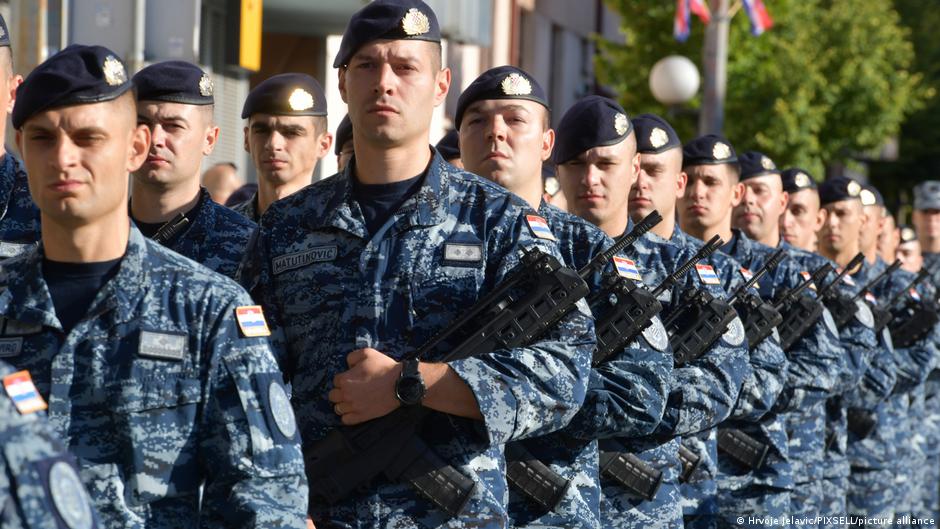
The new year is bringing an old challenge in a fresh guise for the young men of Croatia.
In the first days of 2026, around 1,200 of them have been receiving letters informing them that they are being called up for two months of military service.
They are the first generation to face conscription since it was scrapped in 2008, the year before Croatia joined NATO.
At that time, the idea was to professionalize the armed forces and move away from mandatory national service.
Now, with only Hungary separating Croatia from Ukraine, the prospect of armed conflict feels a little too close for comfort.
Croatia’s Defense Minister Ivan Anusic said the resumption of conscription after 17 years is a response to ‘a rise in various types of threats’Image: Nicolas Tucat/AFP
A stray drone — probably Ukrainian but never officially identified — crashed in Croatia’s capital, Zagreb, in 2022. It did not do much in the way of damage but it certainly concentrated minds.
Broad support for the relaunch of conscription
Croatia’s government became uncomfortably aware that it could rely on fewer than 15,000 active military personnel. Ahead of parliamentary elections in 2024, it proposed reinstating national service for male school-leavers.
Defense minister Ivan Anusic said it would help young men change “bad habits” and prepare them for “any major threat.”
Polls indicated broad support for the idea, with seven out of ten Croatians in favor. Voters duly re-elected the HDZ party, which has now put the policy into practice.
The required legislation breezed through parliament last October, with 84 MPs voting in favor and just 11 against.
Little in the way of protest
The Defense Ministry has wasted little time in contacting the first batch of recruits, without much — if anything — in the way of protests.
“I don’t see any challenges to conscription,” says Gordan Akrap, the vice rector of Croatia’s Franjo Tudjman Defense and Security University.
“There are going to be more people who want to be part of this than are able to join because it’s a limited number at this moment,” he adds.
“Some populist groups from the far left say we should invest in kindergartens and so on. But the fact is that someone needs to protect the kindergartens and our European way of life and democracy — and that can be done in the final stages by the army.”
A broader trend across the region
Croatia’s reintroduction of mandatory military service is part of a broader trend across the countries that used to be part of Yugoslavia.
Several of them have been considering the return of some sort of draft, in a throwback to the days of Josip Broz Tito’s socialist regime.
During Josip Broz Tito’s socialist regime in Yugoslavia, young men had to serve a year in the army. Pictured here: Soldiers of the Yugoslav People’s Army occupy a Slovenian border station during the ten-day Slovenian War of Independence in June 1991Image: Gert Eggenberger/APA/picturedesk.com/picture alliance
Back then, young men had to serve a year in the People’s Army, creating a significant fighting force. Just before the country’s disintegration began in the 1990s, two-thirds of the ground forces were conscripts — with a further million trained reservists available.
After the Yugoslav wars
The independent countries which emerged from the Yugoslav Wars of the 1990s gradually did away with national service.
Slovenia was the first to scrap the draft in 2003; the last Serbian conscripts finished their service in 2010.
With the prospect — or, for Slovenia and Croatia, the achievement — of EU membership, there seemed little need for the kind of military force that involves subjecting a country’s youth to months of drills.
But even before Russia’s invasion of Ukraine, the mood was starting to shift.
Slovenia considering conscription again
In 2020, the parties forming a new right-wing nationalist government in Slovenia made the reintroduction of military service part of their coalition agreement. Its prime minister, Janez Jansa, had made his name as defense minister during Slovenia’s 10-day war of independence in 1991.
Although the parties of the previous Slovenian government led by former Prime Minister Janez Jansa (pictured here) made the reintroduction of military service part of their coalition agreement, consription has not been reintroduced to dateImage: Jose Jordan/AFP/Getty Images
He claimed the country’s armed forces — with just 7,000 personnel — could no longer defend the country from attack and complained that young people did not know how to handle weapons.
The current center-left government under Robert Golob has not taken up the idea, but parliamentary elections are set for March, and Mr. Jansa’s SDS party is leading the opinion polls.
Will Serbia follow suit?
In Serbia, the government has been talking up the possibility of conscription for several years.
A number of deadlines have passed without anyone being drafted, but that may change this year, with Defense Minister Bratislav Gasic claiming that legislation would soon be submitted to parliament.
Serbian Defense Minister Bratislav Gasic has claimed that legislation on the reintroduction of conscription will soon be submitted to parliament Image: Milos Savic/BETAPHOTO/SIPA/picture alliance
With countries in the region increasing their military spending as well as working on adding to their personnel, the timeworn question arises of whether the rest of Europe should be concerned about the Balkans.
Toby Vogel of the Democratization Policy Council think tank believes the potential for actual conflict remains low.
“The military angle to all of this is primarily one of preparedness, rather than concrete planning, and certainly not offensive planning,” he told DW. “Serbia is not about to attack Croatia, and Croatia is not about to invade Serbia.”
“In a situation where the general environment is one of volatility and unpredictability, I think governments are probably prudent in taking some sort of precautionary measures and putting the elements in place for a more strategic approach to international affairs,” he said. “But it is a throwback to older times.”
Edited by: Aingeal Flanagan