
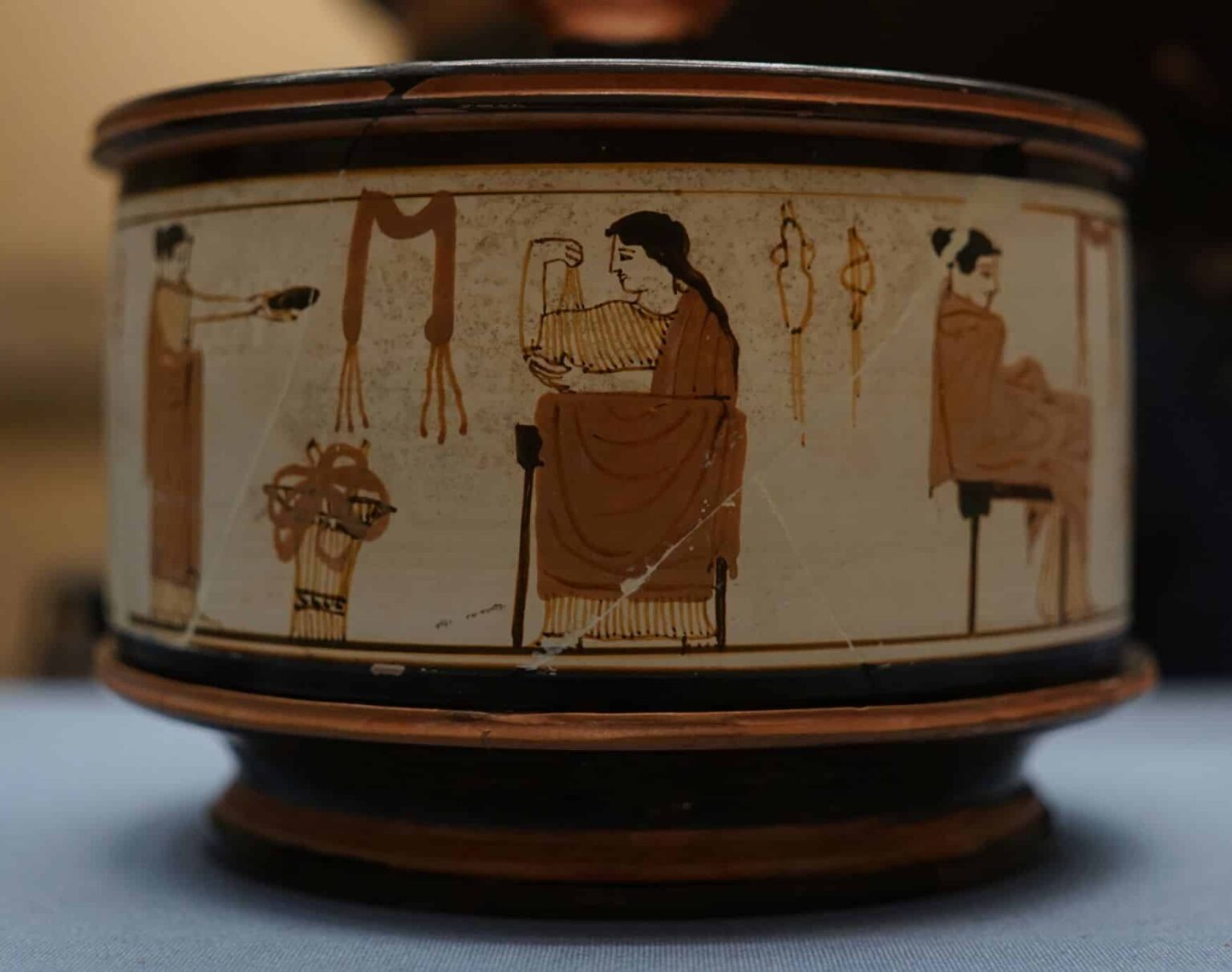
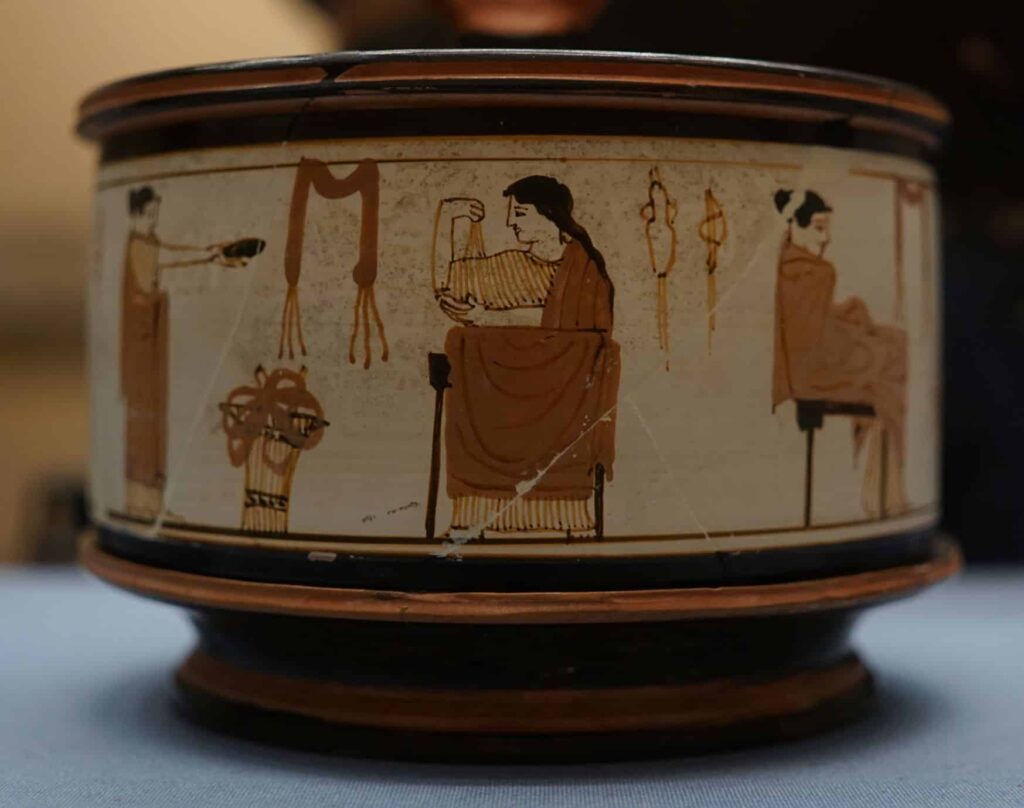
Women in Ancient Greece and Rome worked in agriculture and not only in domestic chores. Photo of Attic cosmetics box depicting women producing wool. Credit: Caenciliusinhorto CC BY-SA 4.0
Most research on women in Ancient Greece and Rome concentrates on urban domestic life, with no references to women involved in agriculture or work outside the home.
However, recent studies indicate the important contribution of rural women in agriculture and out-of-home work.
Austrian historian and Stanford University Professor Walter Scheidel highlighted the challenging existence women faced in Ancient Greek and Roman societies, where they were burdened with arduous agricultural tasks and domestic responsibilities.
A study by Ester Boserup and Jack Goody notes the difference in women’s contributions to hoe-farming and plow-farming rural communities. In the former, hoe-farming communities, women had a greater role in agricultural work, dividing their time between fieldwork and household duties. In contrast, women were more sequestered in the home in the more advanced plow-farming communities, where the work was predominantly male-dominated.
Scheidel places considerable importance on understanding the degree to which women in Ancient Greece and Rome participated in fieldwork and outdoor activities, as this is crucial for evaluating their broader roles within the family and society.
Regardless of their actual contribution to the household economy, the visibility or invisibility of women resulting from the physical location of their daily work could likely have been a factor in shaping their position within their own families and their relationships with, and access to, the outer world.
We may even go as far as to suspect a link between the contribution of women to more readily acknowledged and respected economic activities such as rural work out of doors, as opposed to domestic work and child-rearing, and the amount of food and healthcare allocated to them.
Division of labor between men and women
Ancient Greek and Roman literature often assumed distinct roles for men and women. In the Homeric epics, for instance, tasks were divided by gender, with agriculture deemed the men’s responsibility, while women were primarily engaged in domestic activities, notably textile production.
In classical times, the idea of women abiding within the house was invariably assessed favorably and, more often than not, represented as an ideal. Rationalizing reasons for a corresponding division of labor is given above all by the authors of economic treatises that concern themselves with managing the households of well-to-do people.
According to the author of the pseudo-Aristotelian book Oikonomikos, “the gods have made one gender (the women) fit only for a ‘seated’ way of life but too weak for activities outdoors, while the other gender (the men) were less suited for domestic work but strong enough for labor that required motion.”
Ancient Greek philosopher Aristotle noted in his Politics, “There are different tasks in a household for men and women: the former acquire, the latter administrate.” This, in turn, would have resulted in a corresponding spatial division of their respective areas of work. Xenophon says, “The woman should be responsible for all work indoors, and the man would take charge of the outdoor activities.”
The Stoic philosopher Hierocles aimed to be more specific about the division of labor between men and women in Ancient Greece and Rome. He stated, “The man should take care of the fields, the market, and urban affairs, while the woman would process the wool, bake bread, and look after the house.”
Most people in antiquity lived at or near the subsistence level
In Ancient Greece and Rome, only men of certain social and economic standing were able to keep their wives and daughters as, to borrow a phrase from a study of women’s life in Victorian England, “ornaments in the drawing room, wholly withdrawn from physical toil and the world of men,” Scheidel notes.
In reality, two fundamental preconditions governed most peoples’ lives in classical antiquity. First, most of the population lived at or near a subsistence level. Second, a comparably large proportion of the labor force was employed in agriculture. Due to the relatively low level of agricultural productivity and the high degree of local or regional self-sufficiency in producing basic foodstuffs, it is likely that even in urbanized areas, no fewer than two-thirds of the population were engaged in farming activities.
For the ancient Mediterranean, comparative material from other pre-modern societies suggests that it might be more accurate to assume an even higher figure of eighty to ninety percent of all people were producing food or providing auxiliary services for the agrarian economy.
The evidence indicates that women in Ancient Greece and Rome were not generally prohibited from participating in agriculture. An examination of the urban sector highlights women’s involvement in diverse economic activities. Although extensive epigraphic records provide insights into the various occupations available to women in urban areas, particularly in Rome, there is a noticeable lack of similar documentation in rural regions, thereby obscuring information about women’s employment in these areas.
Overall, it can be assumed that most women in the Greco-Roman world either belonged to households that subsisted on agriculture, necessitating the labor of all its members at times or were compelled, as slaves or dependents, to fulfill whatever tasks they were assigned.
Women figured prominently in food production
Anthropologists have argued that women greatly contributed to food production from the outset of the transition from hunter-gatherer societies to sedentary agricultural systems. Evidence shows that women participated in agriculture in ancient Near Eastern civilizations. From Pharaonic Egypt, we have several drawings of women working in the fields, reaping corn ears. Women were also known to have tended animals among the Hittites, Persians, Arabs, Phrygians, and Indians.
A recent study of the peasant economy in ancient Greece conducted by Thomas Gallant has
shown that many small farms would have found it difficult to produce enough surplus to buy and maintain an additional paid laborer. In Roman Italy, too, most members of the lower census classes would have farmed their land without much help from outside.
It is realistic to assume that women also had to carry their share of the burden of working in the fields. Aristotle’s general observation that “the poor have to use their wives and children as servants since they cannot afford to keep slaves” would have applied to the rural population.
The importance of the Household Life Cycle should not be overlooked. This concept underscores the economic effects of shifts in the family’s age composition and size on the balance between household supply and demand. For instance, as parents age and cannot maintain agricultural duties, their children, regardless of gender, must assume greater responsibilities. Subsequently, those childrens’ children will also contribute to the farm workforce.
The frequent involvement of many ancient peasants in military activities, which caused intermittent losses of agricultural manpower on their holdings, must be considered. When the family men went to war, the women were responsible for tending to the fields.
Given all these reasons, while it is virtually impossible to reconstruct an exact picture of women’s contributions to ancient peasant agriculture, it seems most likely that they were, at least at certain times, called upon to perform all kinds of agricultural work.