
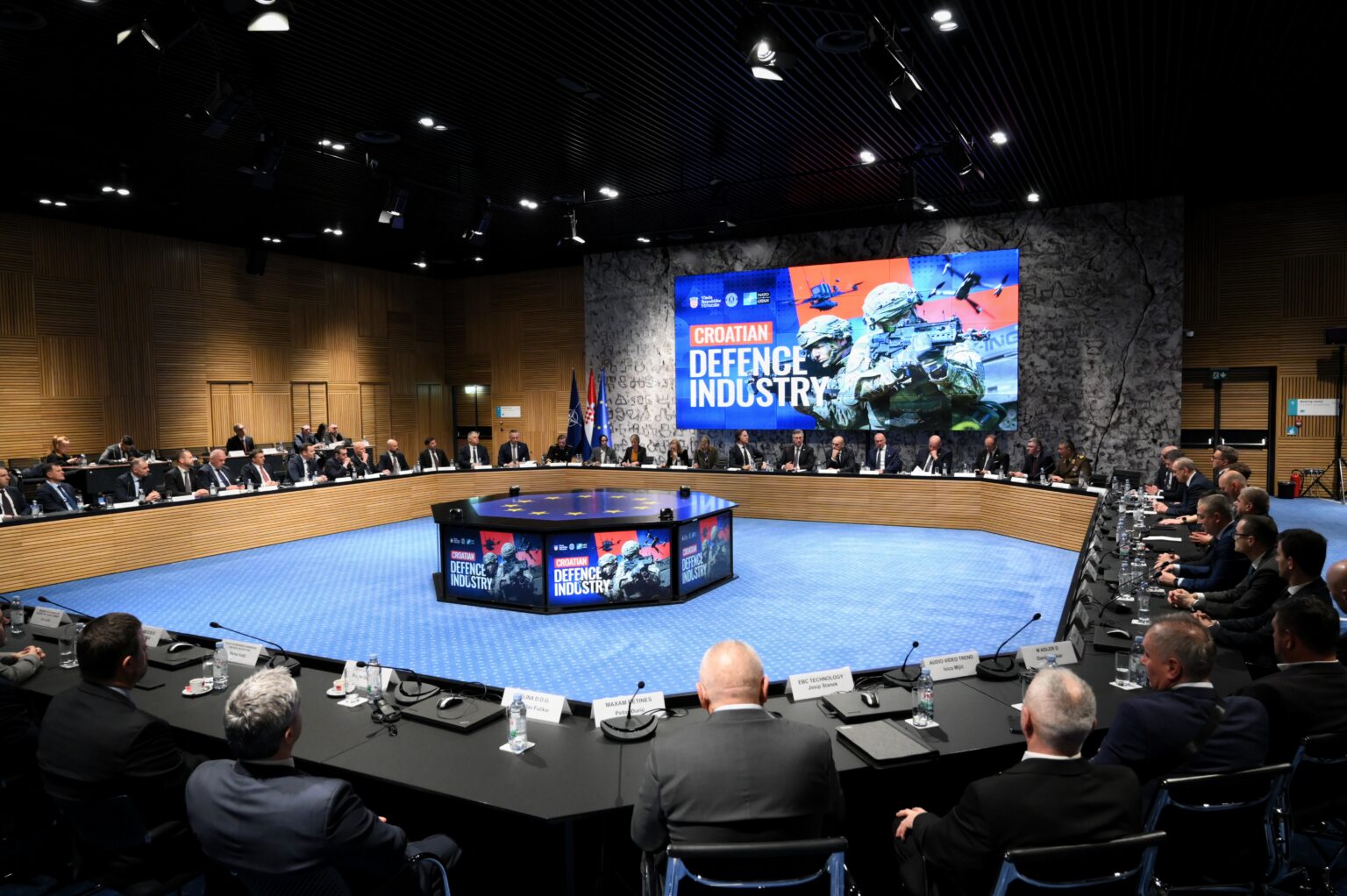
After the talks in Banski Dvori, Prime Minister Andrej Plenković and NATO Secretary General Mark Rutte met at the National and University Library with representatives of the Croatian defense industry. The meeting was attended by representatives of numerous companies, including the Alan Agency, HS Produkt, Sestan-Bucsha, DOK ING, Orqa, Đuro Đaković, Končar, Ericsson Nikola Tesla, Čateks, Odašiljača i veza, the Faculty of Electrical Engineering and Computing, the Faculty of Mechanical Engineering and Naval Architecture, and the Croatian Defense Industry Competitiveness Cluster, which deal with various areas, from microelectronics, through artificial intelligence, satellite technology, unmanned aerial vehicles, to the production of protective equipment, explosives, pistols, shipbuilding and many others. The aim of this meeting, said Prime Minister Plenković, is to present to the NATO Secretary General the activities of the Croatian defense industry, an important segment of the Croatian economy.
“We want to put the export orientation of companies that are part of the cluster in the foreground,” he stressed.
Stating that the global circumstances in terms of security are very uncertain, the Prime Minister said that it is therefore not surprising to see a wave of huge investments in defense.
In this context, he stated that in 2025, Croatia had reached an allocation of 2.08 percent of GDP for defense, or one billion and 930 million euros.
Of this, 34 percent was allocated for the modernization of the Croatian armed forces, he added.
Stronger, more capable and more interoperable armed forces
He recalled the commitment of the allies from the summit in The Hague this year to allocate 3.5 percent of GDP to defense, with 1.5 percent for defense-related activities by 2035.
“Our ambition is to make Croatia and its armed forces even stronger, more capable and more interoperable with our allies through joint efforts, strengthening the Croatian economy, and thus the possibility of greater fiscal space that we will allocate for defense,” said the Prime Minister.
In this process, he added, the 100 or so Croatian defense industry companies, many of which are present at today’s meeting, play an important role, as well as their connections with the scientific community that contribute to projects and programs.
The export strength of the Croatian defense industry
Speaking about the export strength of the Croatian defense industry, the Prime Minister stated that in recent years the average annual export was between 150 and 250 million euros, of products that fall under the military equipment export regime, and over 400 million euros when the part that is not under the same regime is added.
The Cluster employs 5,000 workers, and another 2,000 indirectly, which speaks of an exceptionally potent and export-oriented sector, emphasized Prime Minister Plenković.
At today’s meeting, he stated, companies that deal with various fields are present, from microelectronics, to artificial intelligence, satellite technology, unmanned aerial vehicles, to the production of protective equipment, explosives, pistols, shipbuilding and many others.
We want your activity to be recognized within the entire Alliance, but also in other export markets, he told the representatives of the defense industry.
Rutte: Croatia can be an example for other countries
NATO Secretary General Mark Rutte used this opportunity to say that defense allocations, in the context of its importance for our security, should not be discussed as spending, but as an investment in deterrence.
If we do not have a strong defense industry and cooperation between the scientific and economic sectors, we cannot expect to maintain our security, he added.
He emphasized that Russia spends 40 percent of its budget on the defense sector, warning that they really want to use what they produce.
He also recalled the importance of NATO’s agreement to achieve the allocation of 5 percent of GDP, 3.5 percent for defense and 1.5 percent for defense activities, by 2035.
You are therefore crucial to us, he said, emphasizing that the defense industry and its new capacities are being developed so that it can produce everything we need.
“I think that what Croatia is doing can be an example for other countries,” he said.
He added that the Ukrainian experience warns us that we must accelerate our actions and, in this context, he welcomed the cooperation of the scientific community and the economic sector in order to develop technology as quickly as possible and so that we can apply it in everyday life.
The industry of NATO member countries is propulsive and innovative, he emphasized, adding that we do not produce enough and calling on everyone present to increase production, saying that there will certainly be demand for these products