

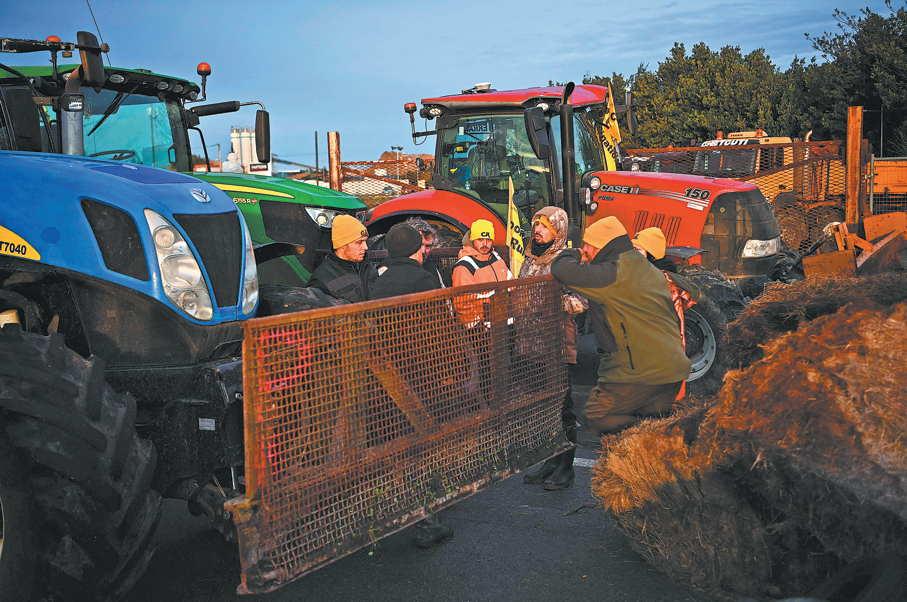
French farmers stand next to a barricade at the start of their blockade of an oil depot as part of national protests against the EU-Mercosur agreement, in La Pallice, France, on Monday. CHRISTOPHE ARCHAMBAULT/AFP
Thousands of Europe”s farmers have taken their opposition to the European Union’s proposed trade deal with the South American Mercosur trade bloc to the streets, blocking roads and ports to highlight their fear that it would hurt them financially and lower food standards.
The protests against the deal that EU member states agreed in principle on Friday were especially spirited in Belgium, France, Ireland, Italy and Poland.
Agence France-Presse quoted one protesting Irish farmer as saying:”We have good quality Irish beef and good standards here, and they don’t have the same standards in South American countries. There is not a lot of traceability on their beef.”
Mercosur, which has six full members — Argentina, Bolivia, Brazil, Paraguay, Uruguay and Venezuela — and several associated states, has what the EU describes as around 700 million active consumers.
The protests, which began on Saturday and which organizers say will continue until at least Wednesday, included one at an oil depot in Bassens, near Bordeaux, France, over the weekend that was broken up by riot police.
Farmers also tried to block access roads leading to the French port of Le Havre in the country’s northwest on the weekend. On Monday, around 30 tractors and 60 protesters staged a blockade at the French port of La Pallice.
Protesters also blocked major roads elsewhere in Europe, and tried to close border crossings.
Friday’s agreement between the 27-nation EU and Mercosur was the culmination of more than 25 years of talks and looks set to create one of the world’s largest free trade areas.
Negative effects feared
However, the fear that the deal could negatively affect Europe’s farmers has led to a lot of opposition, and EU member nations Austria, France, Hungary, Ireland and Poland all voted against it on Friday.
While the opposition was not enough to halt the deal that promises to open new tariff-free markets for EU companies producing chemicals, machinery and pharmaceuticals, it could still be derailed in a vote in the full European Parliament, which is expected later this year.
To help ensure the agreement gets the backing of lawmakers, the EU has added several sweeteners, including a 45 billion euro ($52.6 billion) budget adjustment that means EU member states will be able to divert more money toward their farmers.
With European Commission President Ursula von der Leyen and European Council President Antonio Costa set to sign off on the proposed agreement in Paraguay on Saturday, Brazil’s President Luiz Inacio Lula da Silva hailed it on X as a victory for multilateralism.
“In an international scenario of growing protectionism and unilateralism, the agreement is a signal in favor of international trade as a driver of economic growth, with benefits for both blocs,” he said.
earle@mail.chinadailyuk.com