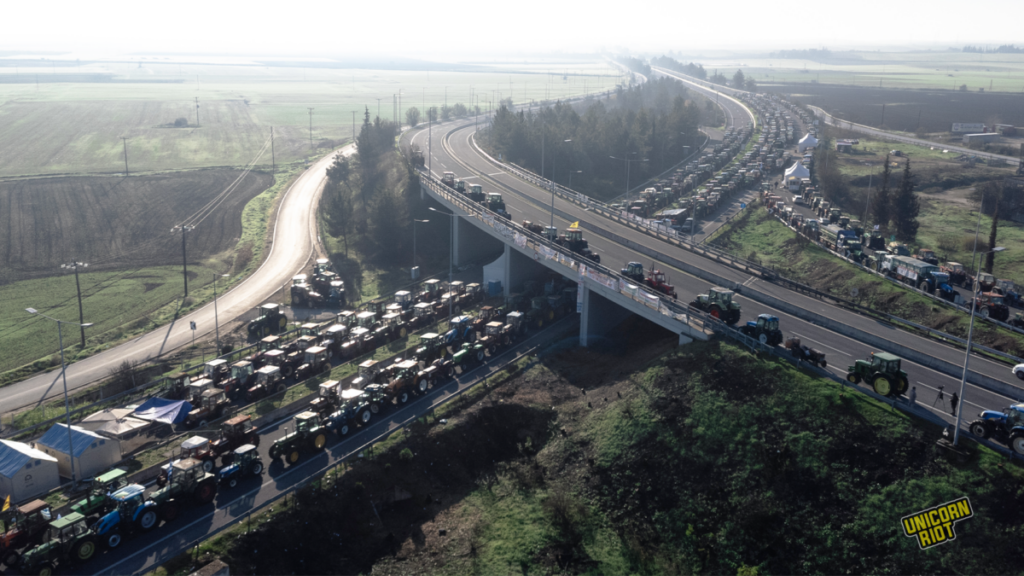
Larissa, Greece — Since Sunday, November 30, central roads across Greece have been paralyzed. The country keeps moving — but only via side streets — because tractors have blocked basic parts of highways. What began as localized demonstrations has escalated into one of the most extensive mobilizations in modern Greek history: customs offices have shut down, ports have been blocked, and airport access has been disrupted.
The image is striking. Long convoys of tractors stretch across national roads, their engines idling beneath banners demanding dignity, survival, and justice. In some places, farmers have parked their vehicles nose to nose, creating immovable barriers that slice the country into fragments. Greece is still moving, but only around them.
Across the country, farmers set up roadblocks in what they describe as a fight for survival. For many, this is no longer about negotiation or leverage. It is an existential struggle. “It cannot go on like this,” they warn, arguing that without immediate and structural change, small-scale farming in Greece will simply disappear.
At the blockades, people of all ages gather — men and women who have taken part in past mobilizations alongside those protesting for the first time. As evening falls, fires are lit from wooden pallets and scrap metal barrels. Coffee is poured, cigarettes shared. Conversations stretch late into the night.
They talk about earlier decades, about winters spent on highways in the older times, about roadblocks that once forced governments to negotiate. What is unfolding today is not unprecedented — neither in Greece nor elsewhere in Europe, where farmer-led protests have erupted repeatedly in recent years. But the scale of the current mobilization is different.
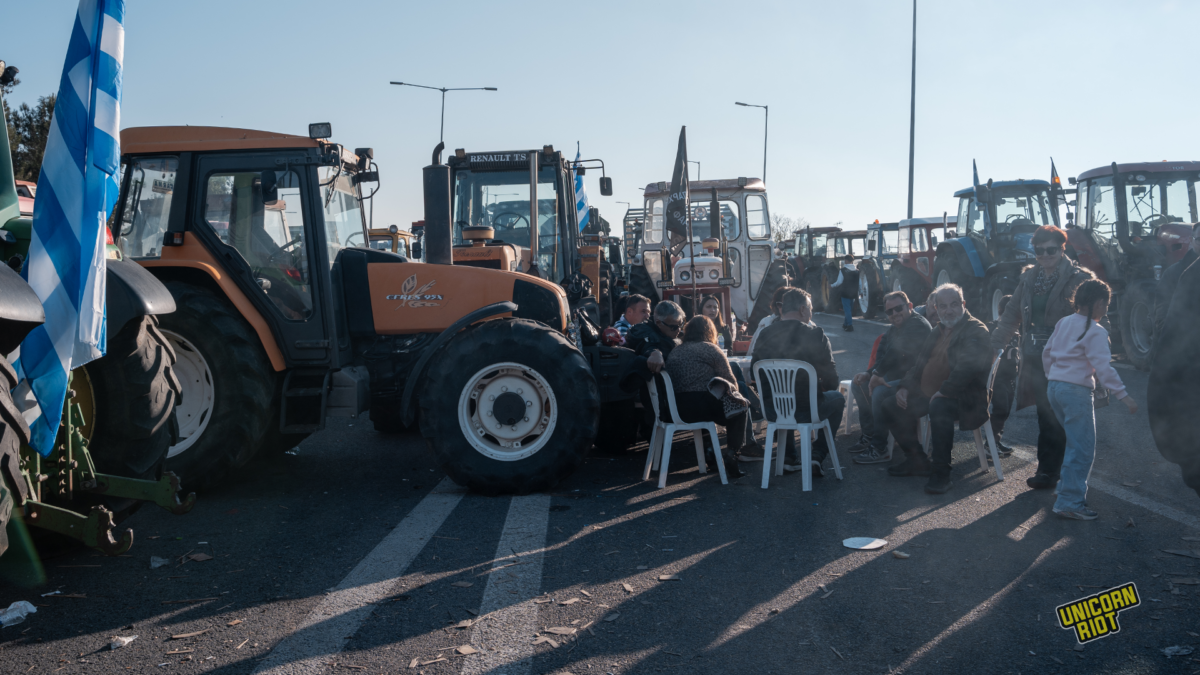 Agricultural workers sit among tractors, obstructing a highway, at the Nikaia blockade in Larissa.
Farmers point out that today’s roadblocks are larger than those of 1996, which lasted three to four weeks. The current blockades have been in place already for four weeks at the time of publication, with no indication that they will be dismantled.
For many, this time feels different. Not because they believe victory is assured but because there is little left to lose.
“I have been actively participating in the mobilizations since 2009.” says Giorgos Beis, a second-generation farmer. Growing up watching his father work the fields, he knew from the age of seven that he would become a farmer — because he loved it. Today, Beis says, he would hesitate to encourage his own children to follow the same path.
“When I turned 18 back then, the problems were fewer; now, as we speak, they are more. We have reached a point where, in simple mathematical terms, we cannot cultivate — we cannot make it work.”
The costs of fertilizer, seed, fuel, electricity, and equipment have skyrocketed. At the same time, the prices farmers receive for their products fall below production costs.
“We work hard for a piece of bread,” Beis says. “We’ve reached a dead end. We are the only profession that works without knowing whether we’ll even get back what we are owed.”
As many farmers explain, making a living from agriculture has become increasingly untenable. To survive, many are forced to take on multiple jobs — working their fields by day and operating machinery, driving trucks, or doing seasonal labor whenever possible. Farming is no longer a livelihood on its own but seems like a component of a punishing double shift.
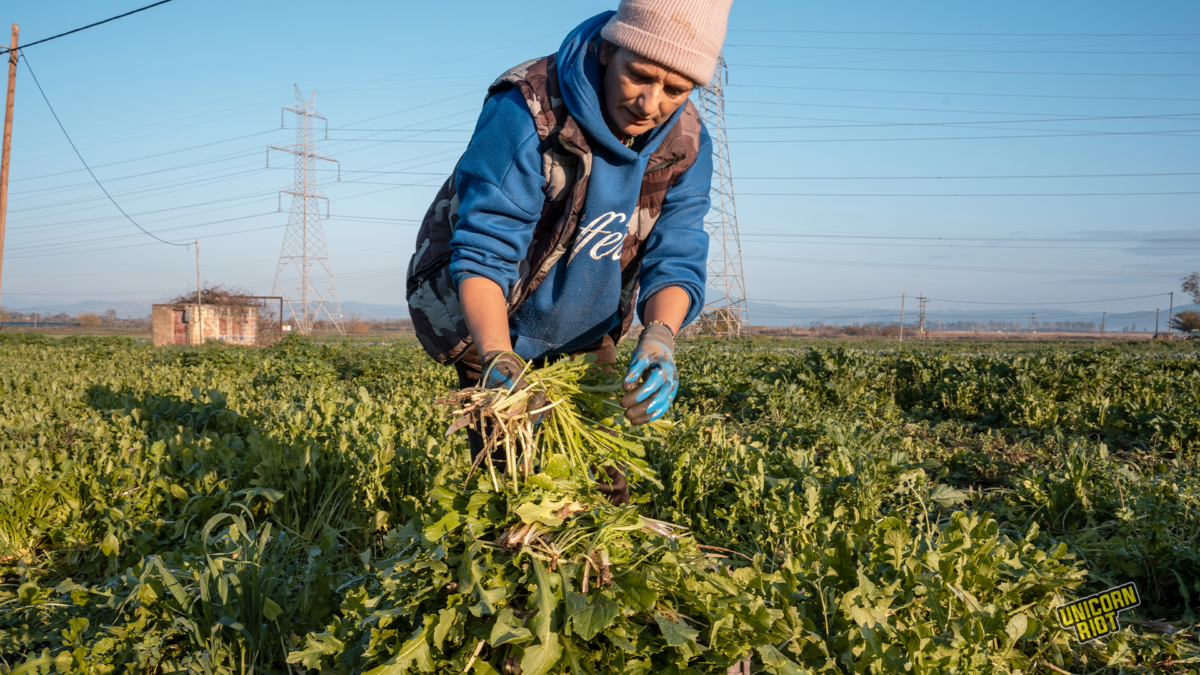 A farmer tends to their crops in Greece.
Without structural support, fair pricing, and meaningful policy intervention, agriculture risks becoming unsustainable — not only as an economic activity, but as a way of life. Τhe countryside faces abandonment.
“A lot has accumulated — it was already a lot, but now it’s overwhelming,” says Pavlos Lappas, a former farmer. “Someone wants to sow, to cultivate their land. They don’t have what’s necessary. They don’t have the money to buy fertilizer or seed. That’s where they’ve brought us.”
“If you go around the plain [of Thessaly], you’ll see fields left uncultivated,” he continues. “It’s not worth it. I have a plot of 33 stremmata [around 20 hectares]. I left it unsown. Should I plant wheat and then put one or two thousand euros out of my own pocket?”
A few years ago, as many farmers point out, having 200 stremmata of land was more than enough to support a family. Today, with this, you can’t even keep your head above water.
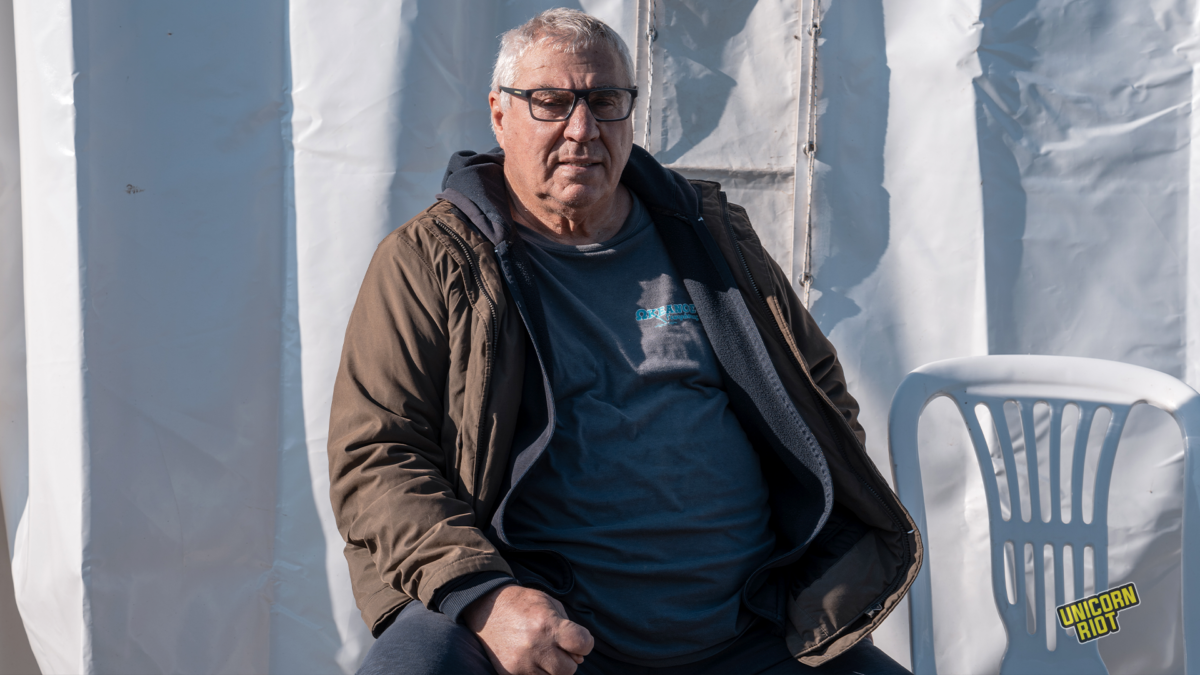 Former Greek farmer Pavlos Lappas
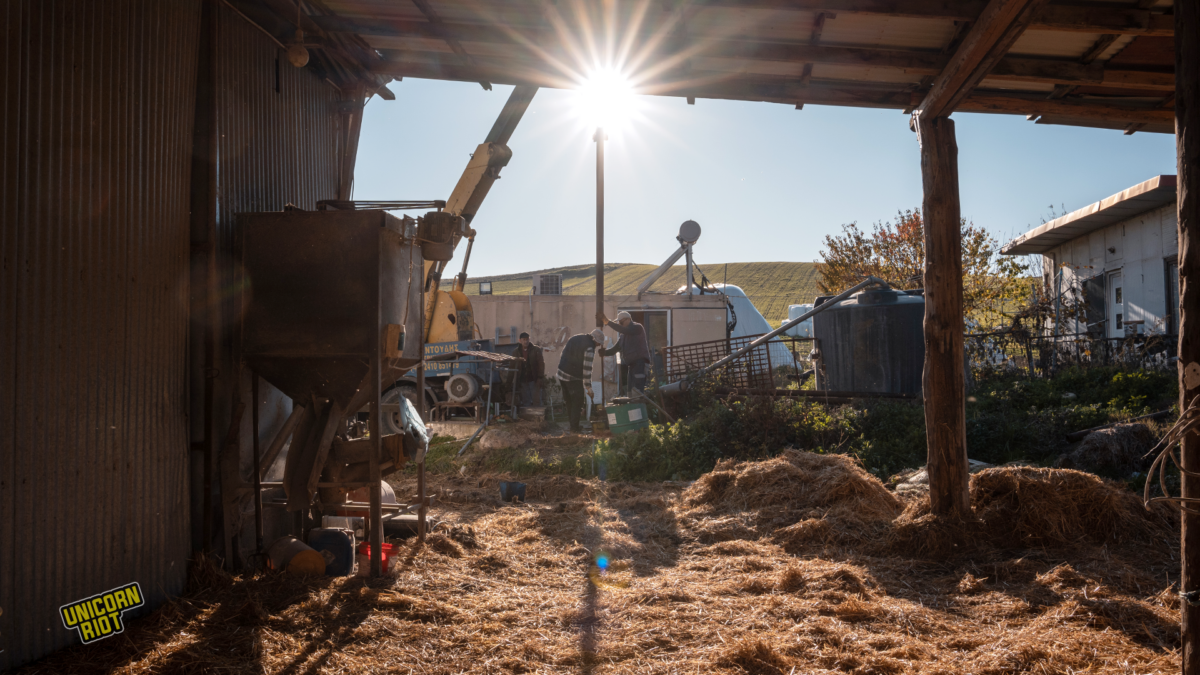 Agricultural workers go about their daily routine on a farm in Greece.
This sense of economic suffocation is not unique to Greece. Across the European continent, agricultural workers are rising up. In Belgium, farmers have taken to the streets to oppose the EU–Mercosur trade agreement. In France, protests have been driven both by outbreaks of lumpy skin disease and by opposition to the same trade pact. Mercosur, a proposed free trade agreement between the European Union and South American countries including Brazil, Argentina, Paraguay, and Uruguay, has sparked widespread resistance.
Farmers across Europe warn that an influx of cheaper agricultural imports, produced under looser environmental and labor standards, will place unbearable pressure on already struggling local producers. They argue that free trade agreements, while beneficial to multinational agribusiness and exporters, undermine small-scale farming and accelerate consolidation.
In Greece, the parallels are striking. The outbreak of sheep pox delivered a devastating blow to livestock farmers, compounding vulnerabilities created by years of rising costs, shrinking margins, and administrative failure. While Greek farmers also oppose the Mercosur agreement, their demands extend far beyond trade policy. At the heart of their mobilization lies a broader critique of the agricultural system itself.
Among their key demands are guaranteed minimum prices that cover production costs and ensure a viable income and lowering production costs.
For many farmers, the current mobilizations are inseparable from the events of September 2023, when Storm Daniel swept through central Greece, compounding the damage left by Storm Ianos and devastating Thessaly, the country’s most productive agricultural region.
What Daniel left behind was not simply flood damage, farmers argue, but proof of long-term state abandonment.
Entire villages were submerged. Fields disappeared under meters of water and mud. Livestock drowned. The disaster hit at the very heart of Greek agricultural production. Thessaly alone accounts for a significant share of the country’s grain, cotton, and livestock output. In the aftermath, the government made promises of swift compensation. But while emergency aid was announced, many farmers say payments were delayed, partial, or insufficient to cover even basic losses. Two years on, compensation is still stalled.
For livestock breeders, the devastation unfolded in waves rather than a single moment. As farmers describe it, some lost their herds to Storm Daniel, managed to rebuild by purchasing new animals, only to see those herds wiped out months later by livestock disease — first by plague, then by sheep and goat pox. Each attempt to recover pushed them further into debt and closer to collapse.
“When someone from the outside sees this devastation,” says Panagiotis Zisis, a farmer and livestock breeder by lineage, “how could they possibly choose to go into livestock farming?”
One could argue that the floods exposed what they describe as a broader political logic: one that treats agriculture as expendable, rural regions as peripheral, and disaster as an administrative inconvenience rather than a systemic failure.
In this sense, the roadblocks are not only about prices, subsidies, or trade agreements. They are also about memory. Daniel is remembered not just as a storm, but as a moment when the countryside was left alone — again.
“In 2019 we had Ianos,” says Giorgos Beis.
“That’s when we saw things we had never seen before — rivers entering our homes. In 2023, politicians said that infrastructure projects would be carried out. Then, in 2023, history repeated itself: we had Daniel, and once again water flooded our houses and our fields. The damage to homes was far greater. Just three or four days ago, with 120 millimeters of rainfall in Farsala, we almost experienced the same phenomena again. Not a single thing has been done. No projects have been carried out.”
Without meaningful intervention, they warn, the consequences will extend far beyond the fields. Rural depopulation will accelerate, domestic food production will decline, and agricultural land will increasingly fall into the hands of large corporations.
“These pressures are compounded by OPEKEPE and by the theft of European funds that never reached real, honest farmers,” says Socrates Aleiftiras, vice president of the Larissa Federation of Agricultural Associations.
OPEKEPE, the Greek agency responsible for distributing Common Agricultural Policy (CAP) funds, has been at the center of a growing scandal involving delays, mismanagement, and the misallocation of subsidies. European audits and interventions by the European Public Prosecutor’s Office have exposed systemic failures in oversight, leading to frozen payments and further financial strain for farmers who rely on subsidies to cover basic production costs.
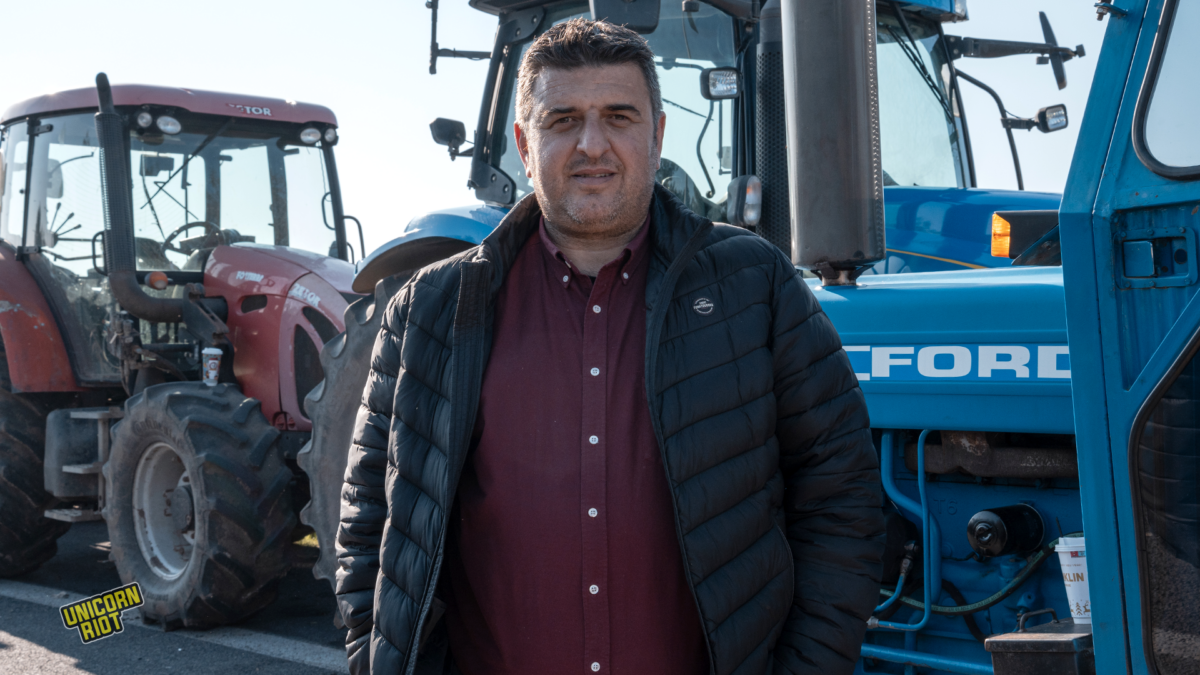 Socrates Aleiftiras at the tractor blockade.
“Add to this the outbreak of sheep and goat pox,” Aleiftiras continues, “which wiped out 500,000 animals and pushed more than 2,500 families to the brink of destitution. That’s why farmers across Greece — from one end of the country to the other — have taken to the roads, setting up more than 70 blockades and bringing out nearly 20,000 tractors.”
“For us, this is a struggle for dignity,” he adds. “For our lives, our love of the countryside, and our right to remain on our land.”
Behind the statistics and the scale of the mobilization lie individual lives shaped entirely around the land and its animals. For many farmers and livestock breeders, the crisis is not an abstract policy failure but a direct threat to a way of life passed down through generations — one built on continuity, attachment to place, and daily labor that leaves little separation between work and home.
Panagiotis Zisis is a livestock breeder, continuing the profession of his grandfather. It is what he knows. He grew up inside the rhythm of agricultural life and remains deeply connected to the land. As he puts it, he considers his profession a calling — the act of creating life and coexisting with animals.
His daily life follows a basic routine, with the animals at its center. As he notes, many livestock breeders have their homes built around their stables. The animals are the core of their lives.
That sense of attachment makes the outbreak of sheep and goat pox all the more devastating.
“There are vaccines,” Zisis says. “From the very first moment, we asked for official vaccination.”
He argues that the outbreak wasn’t unavoidable, pointing to systemic failures and contradictions in the state’s response.
“Whether it was a mistake or something deliberate, the outbreak seems to serve the purposes of OPEKEPE,” he says. “That’s where questions should have been asked — how many animals were declared as slaughtered, and how many were actually slaughtered.”
He describes scenes that he says defy basic disease-control logic.
“Colleagues are being fined for killing their own sheep, while at the same time the regional authorities had a truck full of slaughtered animals driving around Larissa looking for a place to bury them,” he says. “Doesn’t the disease spread there?”
“Mistakes were made,” he adds. “Many, many mistakes.”
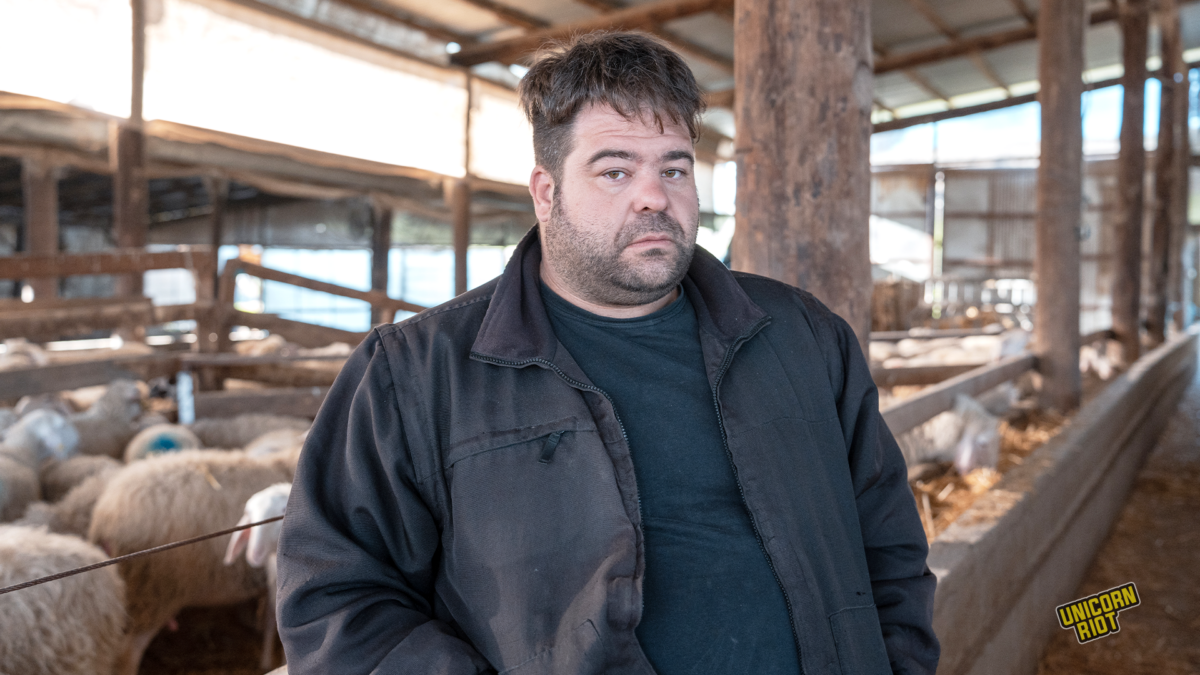 Panagiotis Zisis with his sheep.
For Zisis, the scale of the losses amounts to a crime.
“The fact that half a million animals were killed — and that more will be killed — is a crime,” he says. “These animals are our children.”
Although his own animals are still alive, he says he has cried for the animals of his colleagues. “They are souls,” he says simply.
Beyond the mass culling itself, Zisis describes the handling of dead animals as an added layer of trauma.
“They dig a pit inside your stable and bury them there,” he explains. “You have to step over your dead animals just to enter your now-empty pen. And you ask yourself — go in and do what?”
Under current protocols, once pox is detected, entire herds are slaughtered.
“One day you might have 500 animals,” Zisis says. “The next day, nothing. It sounds catastrophic — and it is.”
For livestock breeders who lose their entire herd, the destruction does not end with the slaughter. Rebuilding is a long, costly process that pushes many beyond their limits.
A breeder who has lost 100 percent of their livestock, Zisis explains, must start from zero. One option is to buy six-month-old lambs, feed them for another two months until they enter reproduction, and then wait an additional four to five months for them to give birth. The alternative is to purchase pregnant sheep and return immediately to production.
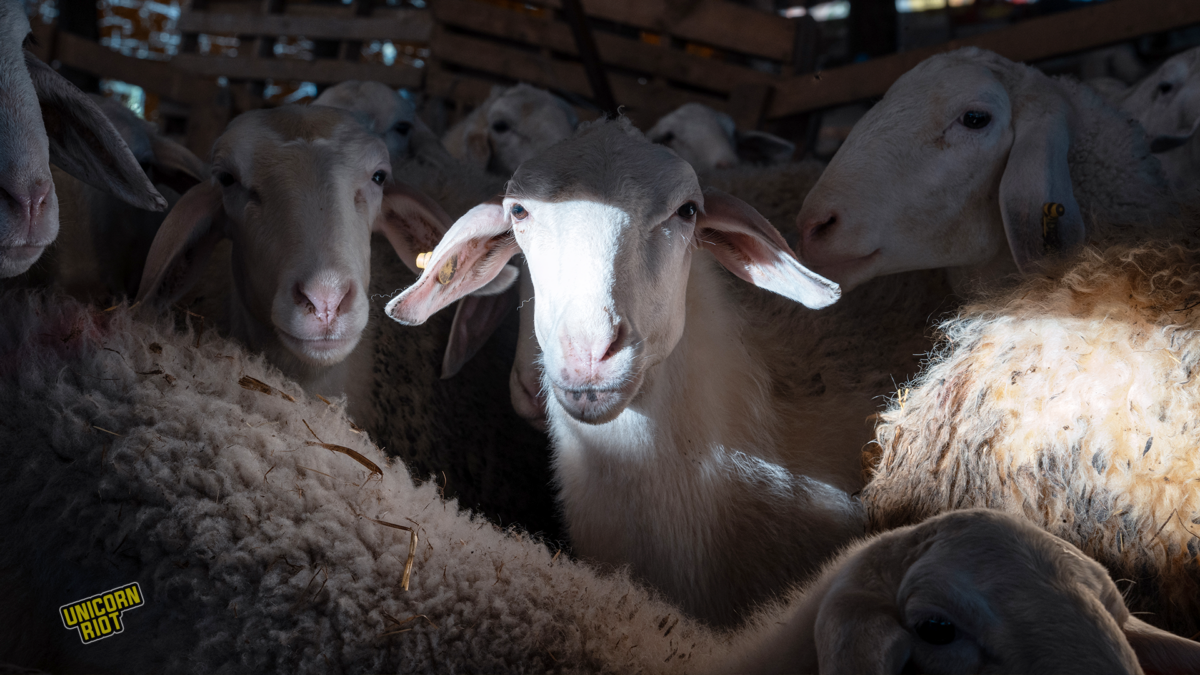 Sheep huddle in a stable on a Greek farm.
Both options have become increasingly unaffordable. In the aftermath of the outbreak, prices have surged. A six-month-old lamb now costs around €400, while an older animal sells for roughly €500. State compensation, breeders say, does not come close to covering the gap.
Even under the most favorable conditions, recovery is measured in years.
“To get back to where you were before — if you had, say, 500 animals — it takes years,” Zisis says. “Years.”
“And where will this lead? Those of us who remain in the end will be pushed to such a level of destitution that an offer we cannot refuse will fall from the sky, and we will effectively give away our herds, our livelihood, and everything we have built to large corporations. And we will end up working like dogs, as employees, on what we ourselves built.”
This argument — that current policies are paving the way for the privatization and consolidation of agricultural land — has surfaced repeatedly in conversations with farmers. Many describe the situation as a form of forced abandonment. Subsidies, they argue, increasingly favor industrial production rather than small-scale food systems, while the prices paid for their products remain humiliatingly low.
Warnings from Minister of Citizen Protection Michalis Chrysochoidis in the beginning of the protest have done little to deter the demonstrators.
“Occupying a customs office is very serious and comes at a high cost,” he said. “There are specific offenses involved. No intervention can obstruct the passage of goods and people. Everything else is open for discussion.”
Yet his words fell on deaf ears. From Greece’s northern borders to the island of Crete, farmers remain resolute. They have poured milk into the streets to protest rock-bottom prices, gathered outside town halls, and blocked ports and transport routes. Government officials, including the prime minister, have issued repeated invitations for dialogue, insisting the door remains open.
Farmers have responded clearly: protest is no longer a tactic—it is a necessity.
Due to the fact that the mobilizations continue, authorities are now considering the imposition of administrative fines of 350 euros per day via mobile notifications to tractor owners— it is reported the police have the registration numbers of the tractors on the blocks. All these are following warnings of the Supreme Court prosecutor, which are based on the Road Traffic Code, which prohibits placing, abandoning, or leaving any object or material on roads if it even minimally obstructs pedestrian or vehicle traffic or vehicle parking.
Greek farmers, meanwhile, continue to hold tractors and block major roads nationwide, saying “yes” to substantive dialogue with the government, including a planned meeting on Tuesday, Jan. 13 with Prime Minister Kyriakos Mitsotakis, but “no” to lifting their roadblocks until their core demands are meaningfully addressed.
But despite government attempts to frame the protests as disruptive to the public interest, popular sentiment has largely sided with the farmers. Faced with rising food prices and declining living standards, much of the population views the mobilization not as an inconvenience, but as a warning.
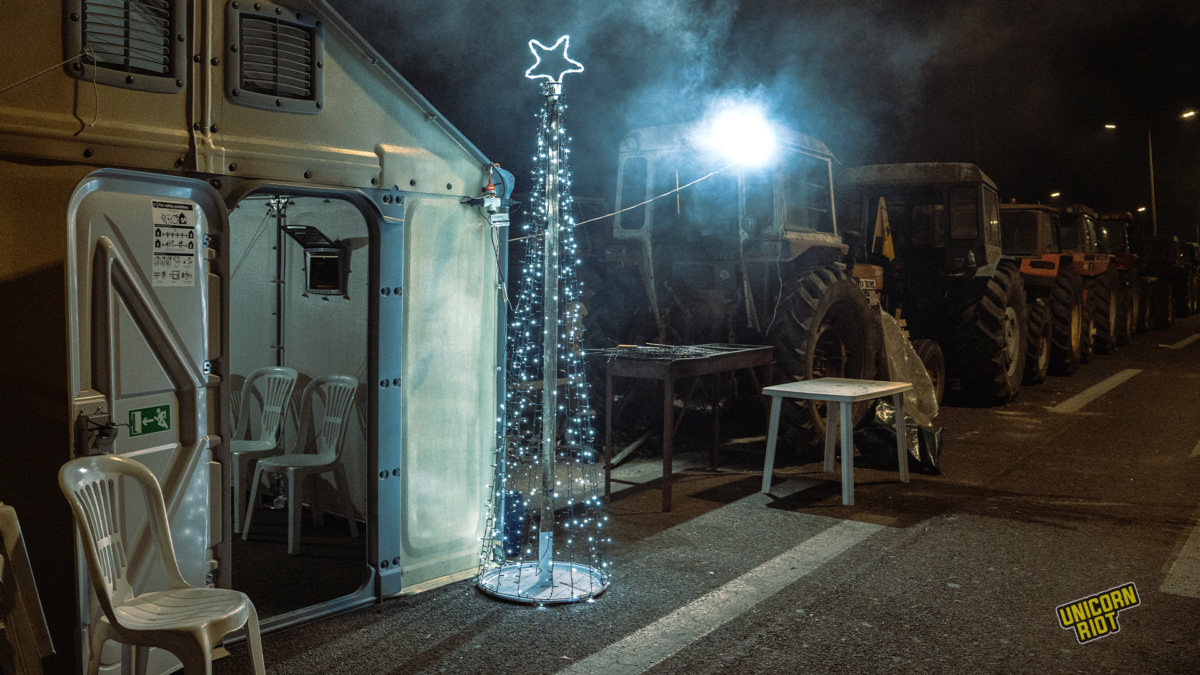 A Christmas tree lights up the tractor blockade over the 2025 holiday season.
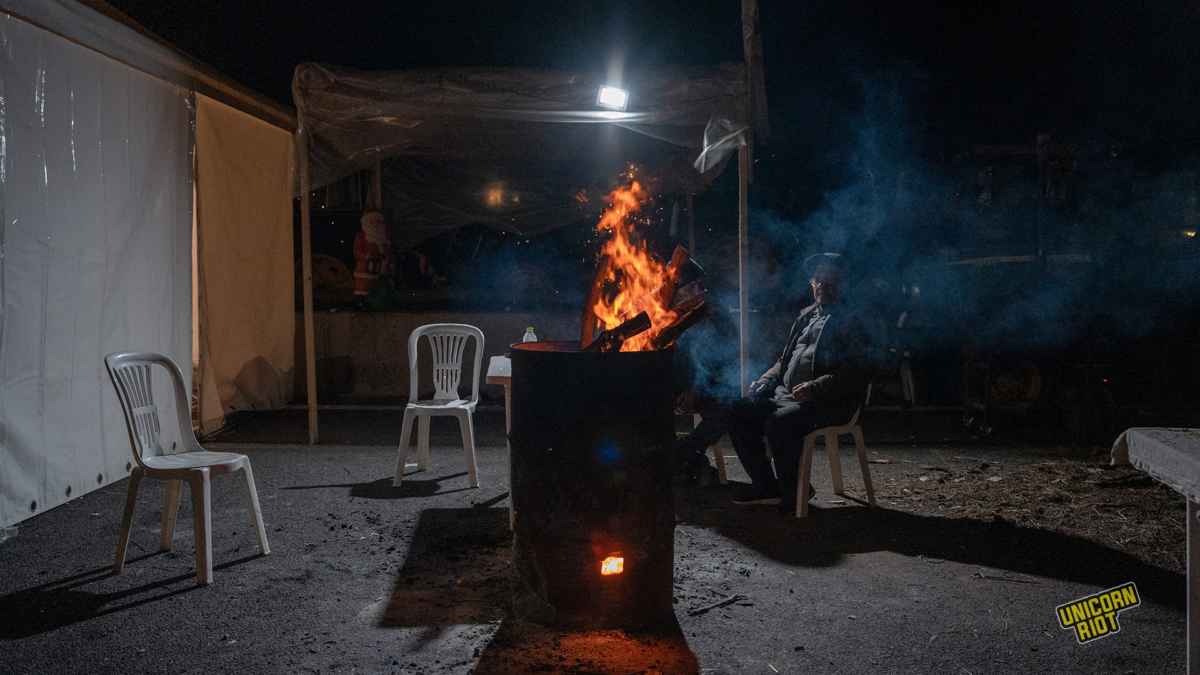 People gather around a fire at night in the Nikaia tractor blockade.
All photos, including cover photo, were taken in Dec. 2025 by contributor Sophia Potsi.
For more media from Greece, see our Greece archive page.
Follow us on X (aka Twitter), Facebook, YouTube, Vimeo, Instagram, Mastodon, Threads, BlueSky and Patreon.
Please consider a tax-deductible donation to help sustain our horizontally-organized, non-profit media organization: