
While globally the focus is on the emerging situation in Venezuela and in India the focus has been understandably been on Trump’s go ahead to a bill aims to impose 500 per cent tariffs on countries for buying Russian oil as well as the remarks of US Commerce Secretary Howard Lutnick that the Indo-US trade deal fell through because PM Modi did not make a call to Donald Trump.
While globally the focus is on the emerging situation in Venezuela and in India the focus has been understandably been on Trump’s go ahead to a bill aims to impose 500 per cent tariffs on countries for buying Russian oil as well as the remarks of US Commerce Secretary Howard Lutnick that the Indo-US trade deal fell through because PM Modi did not make a call to Donald Trump.
Developments in Iran: Possible US action
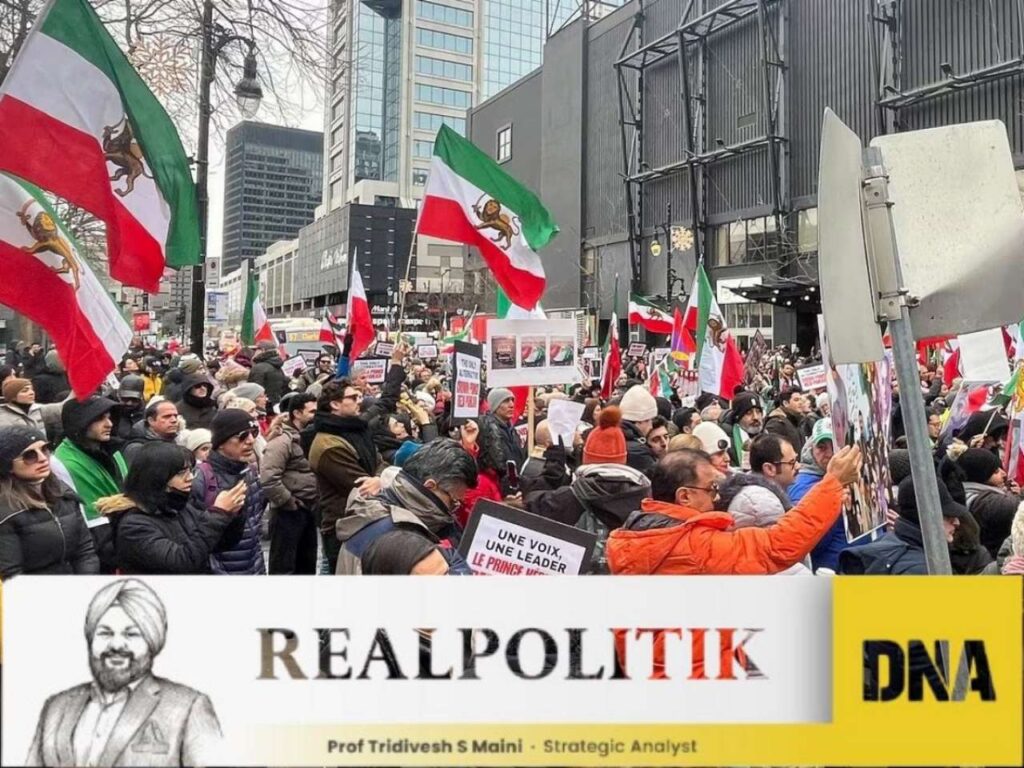
Like several other countries, India has been closely watching the developments in Iran. The protests against growing inflation – which had surpassed 50% — as well as the decline of the Iranian Rial, which began over two weeks ago, in Grand Bazaar Tehran have led to several arrests and deaths and protests are being seen in other parts of the world including the US and UK. Iran has also been witness to an internet shut down as well as suspension of telecommunications services, since January 8, due to the intensification of protests.
As of January 11, 2026 the number of protesters killed according to several sources was 538 and those arrested was over 10,000. On Friday, January 9, 2026 one of Iran’s largest mosques was burnt.
In the aftermath of the US invasion of Venezuela, several analysts and commentators are pointing to the possibility of US President Donald Trump pushing for a regime change. In an interview, with Fox News, Donald Trump said
“I have let them know that if they start killing people, which they tend to do during their riots… we’re going to hit them very hard,
On January 10, 2026 Trump said
“Iran is looking at FREEDOM, perhaps like never before,” he said. “The USA stands ready to help!!!
On January 11, 2026 gave mixed signals. The US President said that while Iran wanted to negotiate with the US, the latter may have to react before any “meeting” is set up.
On January 9, 2026 Iran’s Supreme leader Seyyed Ali Hosseini Khamenei categorically stated that the protesters were propped up by the US.
The 12-day conflict between Iran and Israel in June, 2025 had an adverse impact on the Iranian economy as well as the overall control of the Iranian Administration. The weakening of Iran’s nuclear program, by US and Israeli strikes in June 2025 has also reduced its space for negotiation/bargaining.
While there is no doubt, that these protests are unprecedented and the possibility of regime change is strong, other possibilities can not be ruled out. One possibility is the removal of
Iran’s Supreme leader and some-one else taking over. US precision strikes at Khamenei can not be ruled out.
It would be important to point out that the approach of Khamenei vis-à-vis the protests has been very different from that of the Iranian President Masoud Pezeshkian which has been more reconciliatory and open to engagement. Even earlier, the Iranian President was more open to engagement with the west regarding the Iran Nuclear deal. While responding to the current set of protests on January 11, 2025 the Iranian President said that while the government was open to responding to economic demands, it would be compelled to take a tough stance against protesters indulging in violence. Some of the important steps taken by the Iranian government to address the economic situation are:
Firstly, ending subsidies on essential imports with the objective of stabilising the foreign exchange rate. Second, it started direct cash and voucher transfers (the equivalent of 7$) to a large percentage of the population.
He also pointed to a US and Israel hand in the current riots.
Another point to bear in mind that Trump has refused to meet Iran’s self-proclaimed Crown Prince Reza Pahlavi, the successor of the Shah of Iran who was toppled by the Iranian Revolution of 1979.
In an article for Project Syndicate (January 9, 2026) Political Scientist Vali Nasr makes a pertinent point:
“ the current protests pose a dilemma: cracking down too hard could undo the fragile understanding that the regime forged with the population after the war, while letting them grow could invite foreign intervention.
He also underscores the fact, that even if Iran is successful in muddling through the current crisis, long term challenges will persist.
Amidst this situation, Iran’s Foreign Minister, Abbas Araghchi’s was to visit Delhi ( January 15-16, 2026) but his visit was called off due to the protests. The Iranian Foreign Minister had also visited India in May 2025.
Iran-India ties : Strategic and Economic importance
Iran is important for India for several reasons. Both countries share historical and cultural linkages and in recent years Iran has emerged as an important component of India’s regional connectivity ambitions. New Delhi has been closely involved in the development of Phase 1 of the Chabahar Port project since 2018 – which enables connectivity with Afghanistan (in May 2024, India had signed a 10-year agreement for managing and developing Chabahar). The port has become more important, because transit trade with Afghanistan via Pakistan has become impossible, given the tensions between India and Pakistan, in the aftermath of the May 2025 conflict between both countries as well as tensions between both countries resulting in the closure of the Pakistan-Afghanistan border. During his visit to India in November 2025, the Afghanistan Commerce Minister, Nooruddin Azizi called for expansion of the Chabahar Port project.
India has also been pushing for the inclusion of Chabahar into the International North-South Transport Corridor (INSTC) which will connect India to Russia and Europe.
India also exports Basmati to Iran (Iran is the second largest exporter of Indian Basmati after Saudi Arabia). Iran’s Basmati imports from India are estimated at over 1 million tonnes actually. The recent drop of the Rial has resulted in Iran removing a subsidy on food imports, which has impacted Basmati exporters from Punjab and Haryana.
Iran has also entered BRICS in January 2024 and has been seeking to diversify its economic relations. Like other countries, Iran has also begun to move towards trade in local currencies.A significant percentage of Russia-Iran trade (80%) is carried out in local currencies. Iran has also been seeking to push non-dollar trade with other BRICS countries via crypto-currency.
India has taken over the Presidency of BRICS and has also been pushing for trade in local currencies. As BRICS chair, it would be interesting to see how India reacts to geopolitical developments like the events in Venezuela and situation in Iran. More importantly, it would be important to see how India reconciles the contradictions, if any, within BRICS on these issues.
Conclusion
In conclusion, the current protests in Iran are unprecedented and could lead to some decisive changes in Iran and the reverberations of these would extend beyond the region. The next few days are important and there is a strong possibility of US intervention/action – it is tough to predict the form and degree given the complex situation.
(Disclaimer: The views expressed above are the author’s own and do not reflect those of DNA)
(The author is a policy analyst and faculty member at the Jindal School of International Affairs, OP Jindal Global University, Sonipat)